Northern Fur Seal
Callorhinus ursinus
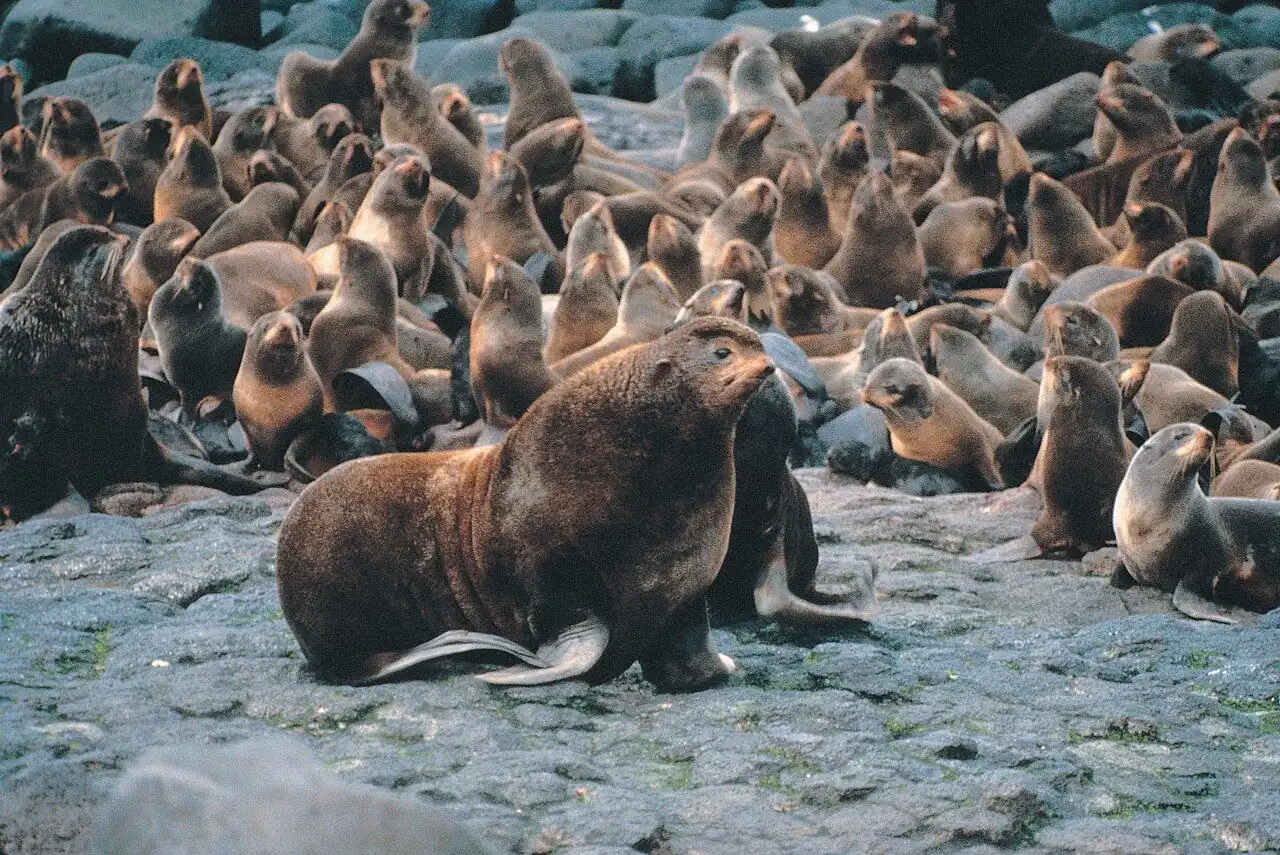
A North Pacific fur seal with about 46,500 hairs per square centimeter, which breeds mainly on Alaska's Pribilof Islands and is declining there.
Photo: M. Boylan / Public domain
3 things to know
- Its fur holds about 46,500 hairs per square centimeter (about 300,000 per square inch).
- Adults spend more than 300 days a year at sea.
- In seawater it can go days or weeks with almost no REM sleep.
- Scientific name
- Callorhinus ursinus
- Depth
- 0 m – 180 m
0 – 591 ft - Size
- Males up to about 2.1 m (7 ft); females about 1.5 m (5 ft)
- Weight
- Males up to about 270 kg (600 lb); females up to about 55–64 kg (120–140 lb)
- Lifespan
- Females up to 27 years; males up to 18
- Diet
- Walleye pollock, herring, sand lance, capelin, salmon, squid and other schooling fish
- Where
- North Pacific, Bering Sea and Sea of Okhotsk; breeds mainly on Alaska's Pribilof Islands, also in Russia and California
- IUCN status
- Vulnerable
- Depth zones
- Sunlight
The northern fur seal's coat holds about 46,500 hairs in every square centimeter, according to NOAA Fisheries, and that fur nearly finished the species. It was hunted on land and at sea for its pelt until the 1911 Fur Seal Treaty banned hunting at sea, and the United States ended its commercial harvest on Alaska's Pribilof Islands in 1984.
It is an eared seal, with a stocky body, small head and very short snout. Its flippers are the longest in the sea lion and fur seal family; the hind ones can reach a quarter of its body length, and the strong front flippers let it run on all fours, outpace a person on slippery rocks and climb nearly vertical cliffs. Males reach about 2.1 meters (7 feet) and 270 kilograms (600 pounds), several times the size of females, which grow to about 1.5 meters (5 feet).
Adults spend more than 300 days a year at sea, across the North Pacific and the Bering and Okhotsk seas, in winter as far south as southern California. They feed mainly at night on schooling fish and squid, walleye pollock above all over the Bering Sea shelf, and can dive to about 180 meters (600 feet). In May, bulls return to the breeding beaches and hold territories for about 46 days without eating, losing about a third of their weight. Females arrive from late June, give birth about a day after arriving, mate again about five days later, and then alternate trips to sea with nursing until the pup is weaned at about four months.
It can also sleep with half its brain at a time, as dolphins do. A 2018 study in Current Biology by Oleg Lyamin and colleagues found that fur seals kept in seawater went without REM sleep, or nearly so, for days or weeks, and made up little or none of it afterward.
NOAA says the Pribilof Islands hold about half of all northern fur seals; Alaska's Department of Fish and Game says more than two-thirds. That population was designated depleted under the Marine Mammal Protection Act in 1988 after falling by more than half from about 2.2 million in the 1950s, and declines on St. Paul Island continue; the Eastern Pacific stock was estimated at 626,618 in 2019. A smaller California stock breeds on San Miguel Island and the Farallones. The IUCN Red List rates the species Vulnerable.



