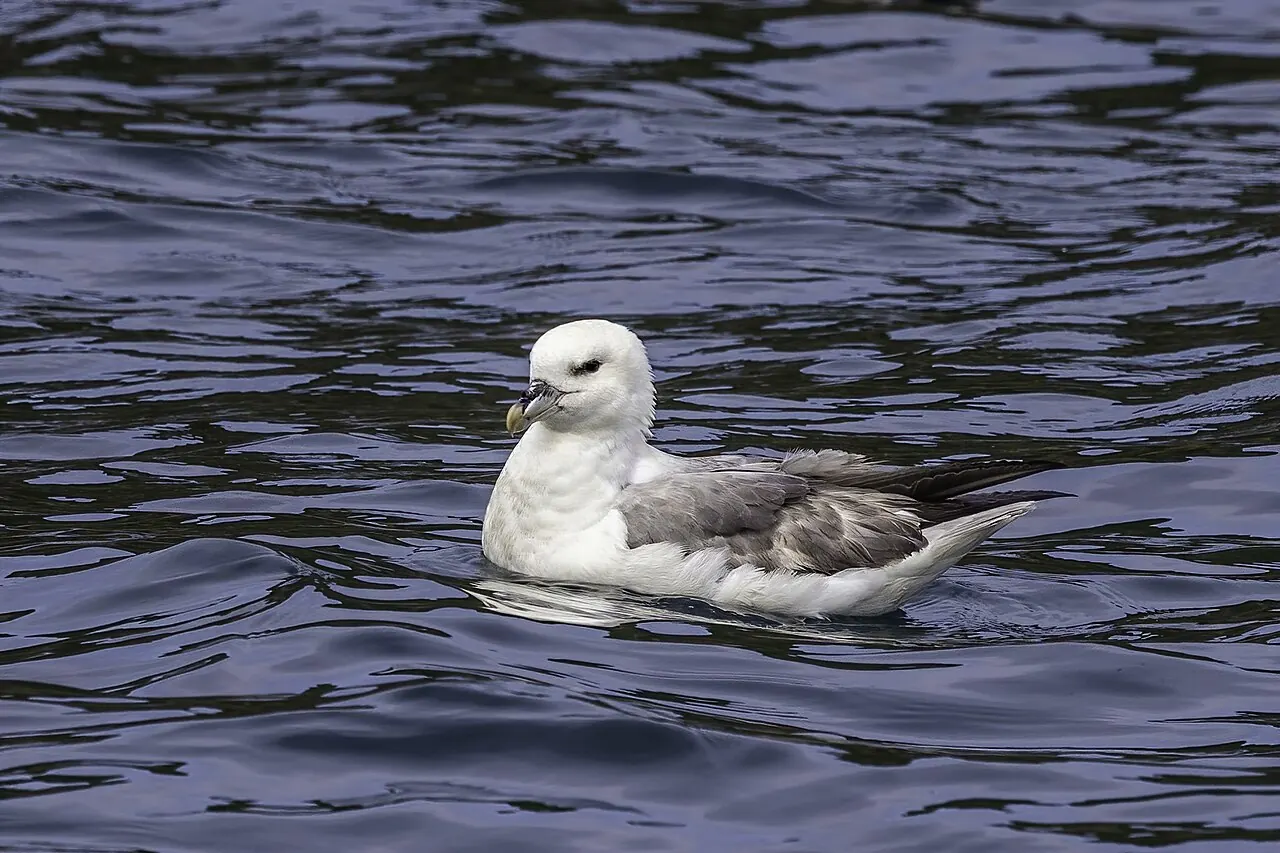
Northern Fulmar
Fulmarus glacialis
A gull-like petrel of northern seas that spits foul oil at intruders and has become the North Sea's standard gauge of floating plastic.
Photo: Charles J. Sharp / CC BY-SA 4.0
3 things to know
- Fulmars on Eynhallow, an island in Orkney, have been studied since 1950.
- Both adults and chicks spit foul-smelling oil at intruders.
- From 2014 to 2018, about half the North Sea fulmars checked had more than 0.1 g of plastic in their stomachs.
- Scientific name
- Fulmarus glacialis
- Depth
- 0 m – 4 m
0 – 13 ft - Size
- 43–53 cm (17–21 in) long, with a wingspan of 1–1.1 m (3.3–3.75 ft)
- Weight
- About 600–970 g (1.3–2.1 lb)
- Lifespan
- Long-lived; the British ringing record is almost 42 years
- Diet
- Crustaceans, small squid, marine worms, fish, jellyfish and carrion, plus offal and scraps from fishing boats
- Where
- North Atlantic and North Pacific; in North America breeds in Arctic Canada and on Bering Sea islands, and winters south to New England and southern California
- IUCN status
- Least Concern
- Depth zones
- Sunlight
At a glance a northern fulmar looks like a gull, gray above and white below with a short, very thick yellow bill, but it is a petrel, related to shearwaters and albatrosses. Its color varies a lot: there are dark and light forms and many birds in between. Adults are 43 to 53 centimeters (17 to 21 inches) long, with wings spanning 1 to 1.1 meters (3.3 to 3.75 feet).
Like other petrels, fulmars make a rich, high-energy stomach oil from the prey they eat. It feeds the chicks, helps adults exploit food far from the colony, and serves as a weapon: both adults and young spit foul-smelling oil at intruders.
Fulmars take crustaceans, small squid, marine worms, fish and jellyfish at or just below the surface and follow fishing boats for offal. Audubon gives dives of 3.7 meters (12 feet) or more, and a data logger fitted to one breeding fulmar in Shetland by Garthe and Furness in July 1998 recorded 972 dives, generally shallow. In North America they breed mainly in the high Arctic of Canada and on islands in the Bering Sea, and they winter as far south as New England and southern California. A pair raises one white egg, incubated for about 50 days. Birds first breed at 6 to 12 years old.
In the northeast Atlantic, fulmars have spread dramatically since the late 1700s, colonizing coasts of Iceland, Britain, Ireland, northwest France and Norway, possibly helped by offal from fishing fleets. The University of Aberdeen has followed the fulmars on Eynhallow, an uninhabited island in Orkney, since 1950, and the British Trust for Ornithology's ringing record is a fulmar of 41 years and 11 months.
Because fulmars are common, widespread and feed at the surface, the plastic in their stomachs is used to measure pollution in the North Sea, against a target that fewer than 10 percent of birds carry 0.1 gram or more. Jan van Franeker and colleagues examined 2,661 North Sea fulmars from 2002 to 2018. Between 2014 and 2018, 51 percent of 393 birds were over the line. The share was falling, but at that pace the target would not be met until about 2054. The IUCN lists the species as Least Concern.
Sources
- audubon.org/field-guide/bird/northern-fulmar
- bto.org/understanding-birds/birdfacts/fulmar
- Study: doi:10.2307/1522045
- eprints.gla.ac.uk/4227
- Study: doi:10.1016/j.marpolbul.2021.112246
- abdn.ac.uk/lighthouse/research/northern-fulmars
- Study: doi:10.2305/IUCN.UK.2018-2.RLTS.T22697866A132609419.en
- rspb.org.uk/birds-and-wildlife/fulmar
- Study: doi:10.1021/es1009983



