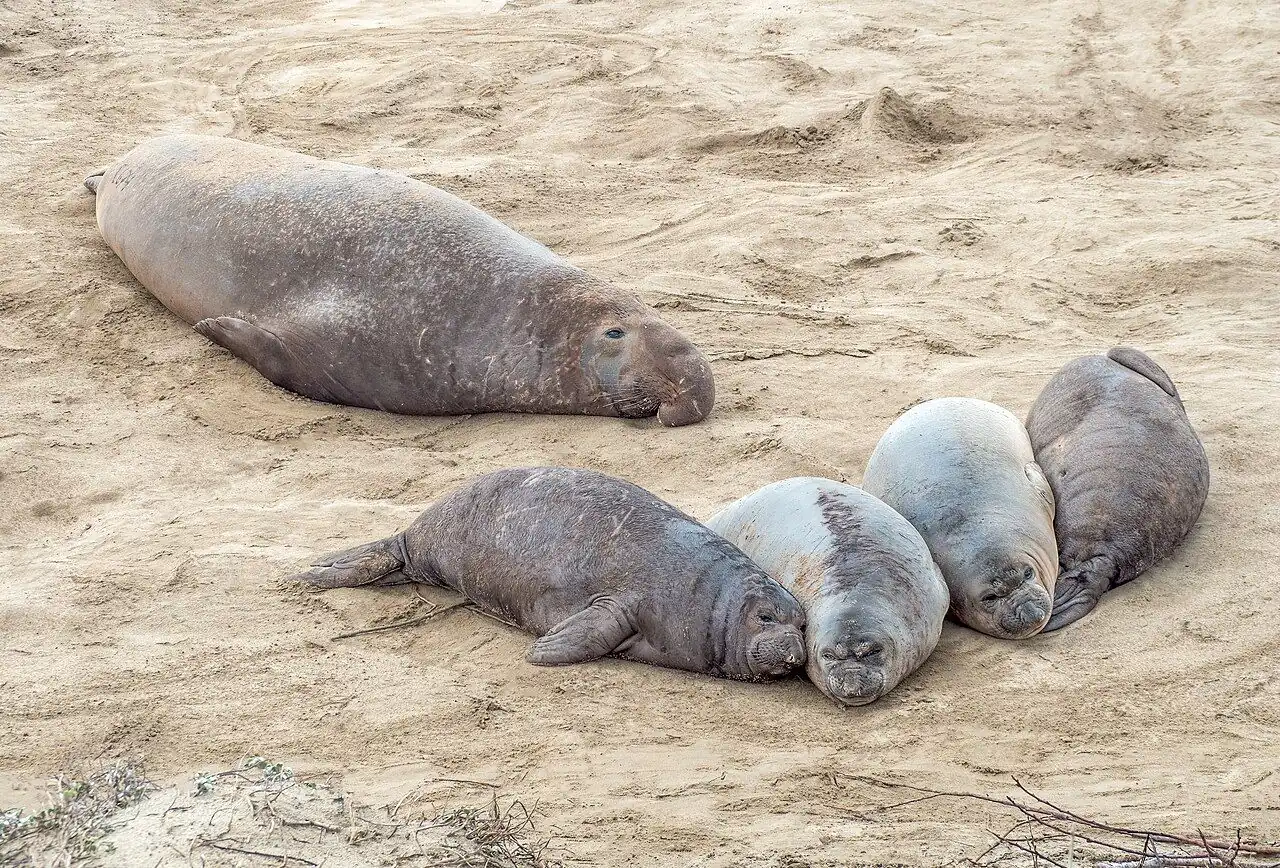
Northern Elephant Seal
Mirounga angustirostris
A giant North Pacific seal that spends months at sea diving hundreds of meters deep, and naps in short spiraling dives.
Photo: Rhododendrites / CC BY-SA 4.0
3 things to know
- Males grow a large inflatable nose, the proboscis, at about 7 years old.
- Its dives usually reach about 300–760 m (1,000–2,500 ft) and last 20 to 30 minutes.
- Seals at sea averaged only about 2 hours of sleep a day over seven months.
- Scientific name
- Mirounga angustirostris
- Depth
- 0 m – 760 m
0 – 2,494 ft - Size
- Males over 4 m (13 ft); females about 3 m (10 ft)
- Weight
- Males up to nearly 2,000 kg (4,400 lb); females much lighter
- Lifespan
- About 19 years for females, about 13 for males
- Diet
- Squid and fish, also rays and sharks
- Where
- Eastern and central North Pacific
- IUCN status
- Least Concern
- Depth zones
- Sunlight · Twilight
Male northern elephant seals grow a large, inflatable nose, the proboscis, when they reach puberty at about 7 years old. Males are enormous, more than 4 meters (13 feet) long and up to nearly 2,000 kilograms (4,400 pounds). Females are much smaller, growing to about 3 meters (10 feet).
They live in the eastern and central North Pacific and spend long stretches at sea, where they eat mainly squid and fish, along with rays and sharks. Their dives usually reach about 300 to 760 meters (1,000 to 2,500 feet) and last 20 to 30 minutes, according to NOAA Fisheries.
They come ashore to breed and to molt, which takes four to five weeks. Breeding runs from December to March, and pups are born in December and January after a pregnancy of about 11 months. Females generally live about 19 years, males about 13. Commercial sealing in the 1800s left the species thought to be extinct, but a small population survived in Mexico, and numbers began to climb steadily in the early 1900s. The IUCN now lists it as Least Concern, and it is protected under the US Marine Mammal Protection Act. Entanglement in fishing gear and vessel strikes are current threats.
Jessica Kendall-Bar and colleagues recorded the brain waves of seals diving in Monterey Bay, California, and found they took naps of less than 20 minutes in the middle of dives, as deep as 377 meters (1,237 feet). The team then used those recordings to read the dive records of 334 seals, which held 514,406 sleeping dives. Over seven months at sea, the seals averaged only about 2 hours of sleep a day, close to the African elephant, which holds the record for the least sleep known in any mammal.



