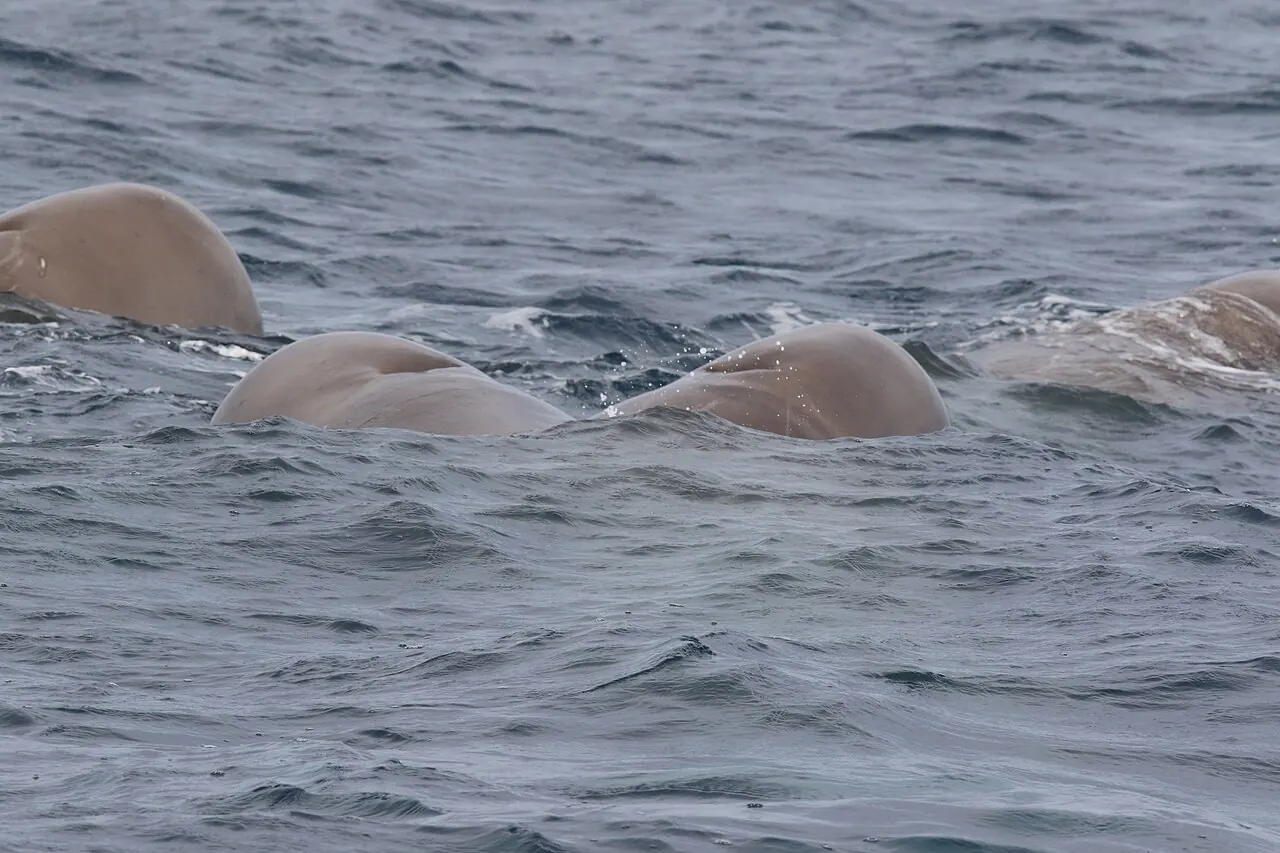
Northern Bottlenose Whale
Hyperoodon ampullatus
A bulbous-headed North Atlantic beaked whale that dives past 1,400 m (4,600 ft) and was once hunted by the tens of thousands.
Photo: Deepdivewhales (Whitehead Lab) / CC BY-SA 4.0
3 things to know
- Whales tagged in the Gully off Nova Scotia in 1997 dove as deep as 1,453 m (4,767 ft).
- Whalers killed more than 80,000 of them after the hunt began in the 1850s.
- Males butt each other with their big heads instead of raking with their teeth.
- Scientific name
- Hyperoodon ampullatus
- Depth
- 0 m – 1,500 m
0 – 4,922 ft - Size
- Females up to about 8.6 m (28.2 ft); males up to about 11.2 m (36.7 ft)
- Weight
- Up to about 7,500 kg (16,534 lb)
- Lifespan
- At least 37 years; Canada's COSEWIC estimates about 48
- Diet
- Mostly deep-sea squid; also fish such as herring
- Where
- North Atlantic, from about 30° N to the edge of the Arctic ice
- IUCN status
- Near Threatened
- Depth zones
- Sunlight · Twilight · Midnight
A big, rounded forehead marks the northern bottlenose whale, the largest beaked whale in the North Atlantic, and the forehead grows steeper and flatter as the animal ages. Males reach about 11.2 meters (36.7 feet), females about 8.6 meters (28.2 feet), and NOAA Fisheries puts weights at up to 7,500 kilograms (16,534 pounds). Mature females often have a white band around the neck. Males are combative and hit each other with their heads, and unlike other beaked whales they do not rake each other with their teeth.
The species ranges from about 30° north to near the Arctic ice edge, usually alone or in groups of four to ten. It feeds near the bottom, mostly on deep-sea squid and also on fish such as herring. NOAA calls it the most studied of all beaked whales, because heavy hunting once supplied carcasses, and scientists have followed a resident group for years in the Gully, a large submarine canyon off Nova Scotia. In 1997 Sascha Hooker and Robin Baird made two deployments of suction-cup depth recorders there. In their 1999 paper the tagged whales dove about every 80 minutes to more than 800 meters (2,600 feet), as deep as 1,453 meters (4,767 feet), for up to 70 minutes, and many dives reached or neared the seafloor. NOAA says the species is probably capable of holding its breath for up to two hours.
Commercial whaling began in the 1850s, whalers exploited the whales' curiosity and close social bonds, and more than 80,000 were killed before the hunt closed in the 1970s. Off Nova Scotia, whalers took 87 between 1962 and 1967, and farther north, off Labrador and Baffin Island, 818 between 1969 and 1971.
In its 2024 report, Canada's wildlife assessment committee, COSEWIC, put the Scotian Shelf population at about 210 whales, roughly 95 of them mature, and again designated it Endangered. It appears to be slowly increasing. The Gully became a marine protected area in 2004, and COSEWIC lists noise from naval sonar and seismic surveys as a threat to that population. The whales mature at 7 to 11 years, and females give birth to a single calf every two or more years after a pregnancy of about 12 months. The IUCN lists the species as Near Threatened, and in US waters it is protected under the Marine Mammal Protection Act.



