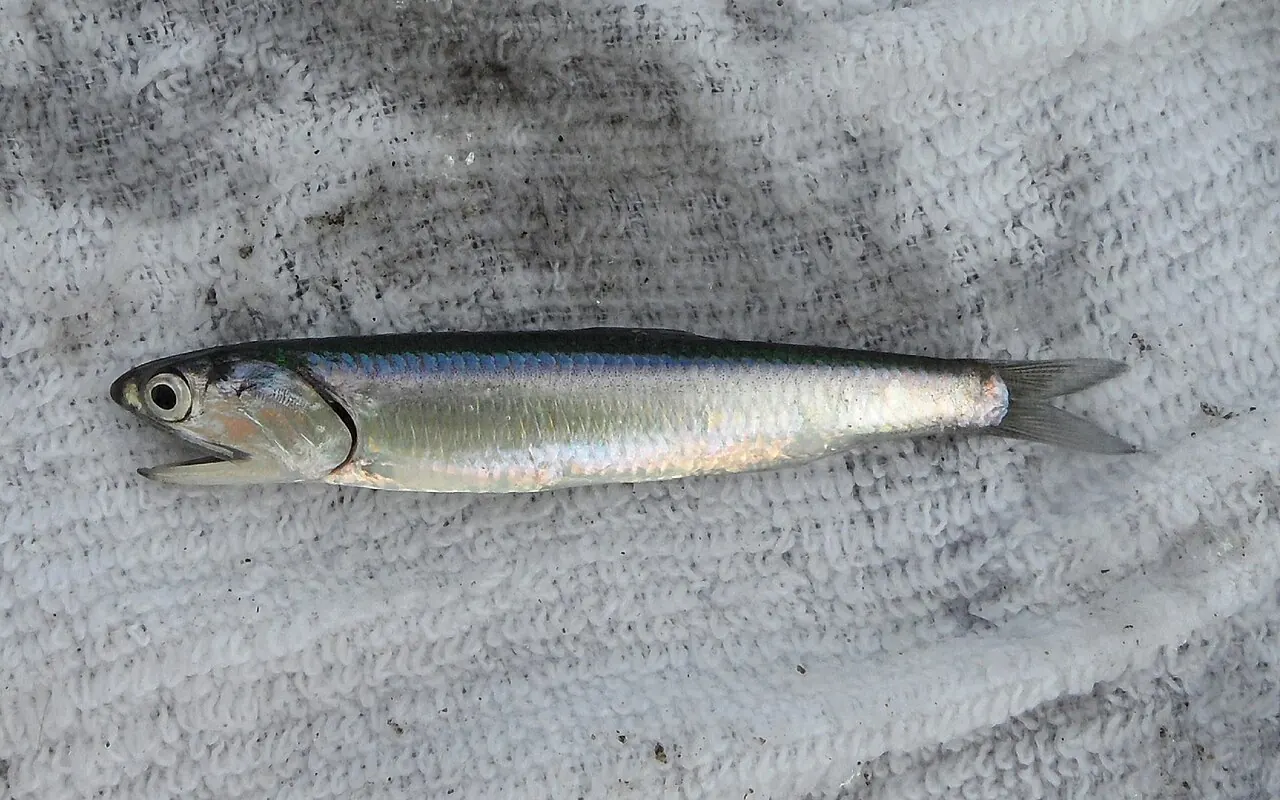
Northern Anchovy
Engraulis mordax
A short-lived West Coast fish whose population booms and crashes, and whose recent boom has been linked to dying salmon fry in California.
Photo: Theo Modder / CC BY 4.0
3 things to know
- A northern anchovy's long, pointed snout hangs over a large mouth.
- Even without fishing, about half of all northern anchovies would die of natural causes each year.
- Anchovies contain thiaminase, an enzyme that breaks down vitamin B1, which can harm salmon that eat a lot of them.
- Scientific name
- Engraulis mordax
- Depth
- 0 m – 220 m
0 – 722 ft - Size
- Up to about 18 cm (7 in) in US waters; FishBase lists a maximum of 24.8 cm (9.8 in)
- Weight
- Up to about 68 g (2.4 oz)
- Lifespan
- Rarely more than 4 years; up to 7 years reported
- Diet
- Plankton, including krill, copepods and the larvae of crabs and shrimp
- Where
- British Columbia to Baja California, Mexico, and the Gulf of California
- IUCN status
- Data Deficient
- Depth zones
- Sunlight · Twilight
A northern anchovy has a long, pointed snout that hangs over a large mouth, and its upper jaw reaches back nearly to the bony edge in front of the gill opening. The body is slim, bluish-green above and silvery below, and adults have a faint silver stripe along each side. NOAA Fisheries puts their size at up to about 18 centimeters (7 inches).
They live along the Pacific coast from British Columbia to Baja California and in the Gulf of California, usually within about 30 kilometers (19 miles) of shore, in large, tightly packed schools near the surface. They eat krill, copepods and the larvae of crabs and shrimp, sometimes straining the water as they swim and sometimes picking off prey one at a time. Life is short. Anchovies can spawn after 2 years and rarely live past 4, and NOAA estimates that 45 to 55 percent of the population would die of natural causes each year even with no fishing. Females spawn all year, most heavily from February to April, releasing batches of eggs every 7 to 10 days, usually at night. The eggs hatch in 2 to 4 days.
Anchovy numbers rise and fall sharply. In 2023, Rasmus Swalethorp of Scripps Institution of Oceanography and colleagues studied 45 years of anchovy larvae collected by the CalCOFI ocean surveys off California. Booms tended to follow years when the larvae fed on shorter food chains, and busts followed longer ones. Off California, the latest boom began around 2017 and reached a near-record high in 2021.
That boom has had a cost for salmon. In 2020, newly hatched Chinook salmon in California's Central Valley hatcheries swam in corkscrews and died at unusually high rates. Nathan Mantua of NOAA's Southwest Fisheries Science Center and colleagues traced the deaths to a lack of thiamine, vitamin B1, and linked it to adult salmon eating mostly anchovies at sea. Anchovies are low in thiamine and carry an enzyme, thiaminase, that breaks it down. The team estimated that thiamine deficiency killed 26 to 48 percent of endangered winter-run Chinook fry in 2020 and 2021.
The IUCN lists the northern anchovy as Data Deficient. NOAA says the size of both US populations is uncertain, but both are thought to be abundant and neither is subject to overfishing. Today the US catch is used mainly as bait.
Sources
- fisheries.noaa.gov/species/northern-anchovy
- fishbase.se/summary/Engraulis-mordax.html
- fisheries.noaa.gov/feature-story/anchovy-dominated-diets-west-coast-pose-new-dangers-sa…
- Study: doi:10.1073/pnas.2426011122
- Study: doi:10.1038/s41467-023-42966-0
- eurekalert.org/news-releases/1009605
- api.gbif.org/v1/species/2414024/iucnRedListCategory
- iucnredlist.org/species/183856/102904070



