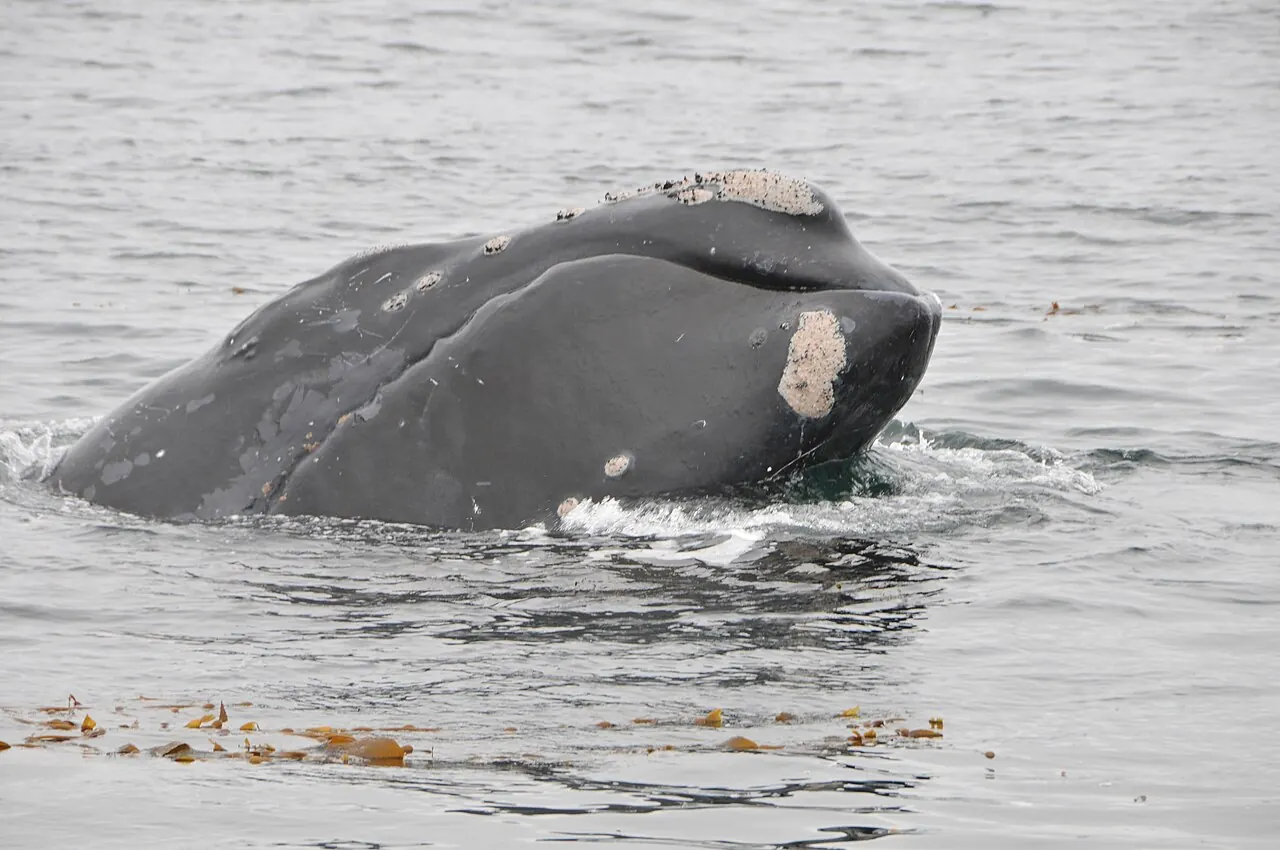
North Pacific Right Whale
Eubalaena japonica
A stocky black baleen whale with fewer than 50 left in the eastern North Pacific, and the first right whale found to sing.
Photo: Mark Hoffman and Bruce Long / CC BY-SA 4.0
3 things to know
- NOAA estimates the eastern population at fewer than 50 whales.
- Illegal Soviet whaling killed an estimated 681 of these whales, and only 11 of those kills were reported.
- Males in the Bering Sea sing songs built mostly from loud gunshot-like calls.
- Scientific name
- Eubalaena japonica
- Depth
- 0 m – 70 m
0 – 230 ft - Size
- About 13.7–19.5 m (45–64 ft) long
- Weight
- Up to about 91 metric tons (100 tons)
- Lifespan
- At least 70 years, NOAA's figure for northern right whales
- Diet
- Copepods, krill and other zooplankton
- Where
- North Pacific; most recent sightings in the Bering Sea and Sea of Okhotsk, rarely as far south as Baja California
- IUCN status
- Endangered
- Depth zones
- Sunlight
This is the Pacific's own right whale, a separate species from the right whales of the North Atlantic and the Southern Hemisphere. It has a stocky black body, sometimes with white patches underneath, and NOAA Fisheries puts adults at 13.7 to 19.5 meters (45 to 64 feet) long and up to 100 tons, with females slightly larger than males. Like other right whales, it strains copepods, krill and other tiny zooplankton through its baleen.
Most recent sightings come from the Sea of Okhotsk and the Bering Sea, though whales have turned up as far south as central Baja California. NOAA treats them as two populations. The western one, which feeds in the Sea of Okhotsk, likely numbers in the low hundreds. The eastern one, seen since 1996 mostly in a small area of the southeastern Bering Sea, has fewer than 50 whales. In recordings analyzed by John Hildebrand and Lisa Munger of Scripps, nearly all of 3,685 right whale calls came from moorings on the middle of the shelf there, in water about 70 meters (230 feet) deep. NOAA designated critical habitat for the species in 2008.
The species once numbered in the tens of thousands, and commercial whaling in the 1800s cut it down hard. Working from Soviet records, Yulia Ivashchenko and Phillip Clapham estimated that Soviet whalers killed 681 North Pacific right whales, while reporting only 11. NOAA says the illegal whaling in US waters during the 1960s decimated the eastern population, and the IUCN lists that subpopulation as Critically Endangered and the species as a whole as Endangered. The US first listed right whales in the North Pacific as endangered in 1970, and in 2008 NOAA split them from the North Atlantic whales as a separate endangered species. NOAA lists ship strikes, entanglement in fishing gear, ocean noise and a changing Arctic as possible threats today.
The eastern whales sing. In a 2019 paper, Jessica Crance of NOAA's Alaska Fisheries Science Center and colleagues described four song types recorded at five locations in the Bering Sea between 2009 and 2017, each built from repeating phrases made mostly of gunshot sounds. The songs came every year from July to January and stayed the same over eight years. Every singer whose sex could be determined was male. No other right whale species had been documented singing, and the team suggests the songs are reproductive displays.
Sources
- fisheries.noaa.gov/species/north-pacific-right-whale
- iucnredlist.org/species/41711/50380694
- iucnredlist.org/species/133706/50385246
- Study: doi:10.1121/1.5111338
- fisheries.noaa.gov/feature-story/first-recording-north-pacific-right-whale-song
- spo.nmfs.noaa.gov/sites/default/files/pdf-content/mfr761-21.pdf
- cetus.ucsd.edu/docs/reports/MPLTM493-2007.pdf



