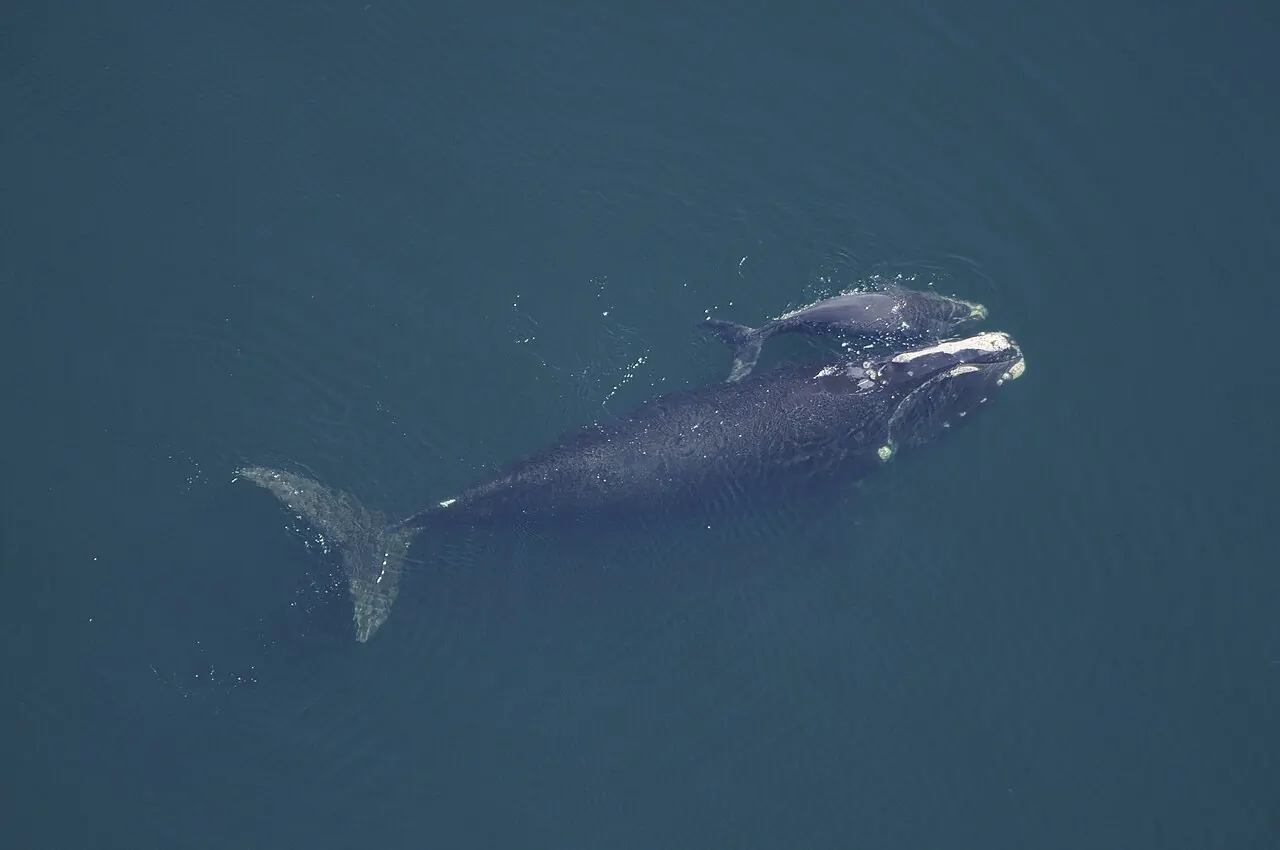
North Atlantic Right Whale
Eubalaena glacialis
One of the most endangered large whales, a slow copepod feeder of the US East Coast with only about 380 left.
Photo: NOAA Photo Library / Public domain
3 things to know
- About 380 remain, including only about 70 breeding females.
- More than 85 percent have been tangled in fishing gear at least once.
- The white patches on its head are rough skin covered in whale lice.
- Scientific name
- Eubalaena glacialis
- Depth
- 0 m – 175 m
0 – 574 ft - Size
- Up to about 16 m (52 ft) long
- Weight
- Up to about 64 metric tons (140,000 lb)
- Lifespan
- At least 70 years, but females now live only to about 45
- Diet
- Copepods and other zooplankton
- Where
- Coastal and shelf waters of the western North Atlantic, from Florida to Canada
- IUCN status
- Critically Endangered
- Depth zones
- Sunlight
A right whale's head is covered in knobby white patches. They are callosities, rough skin that looks white because it is crowded with whale lice, and every whale's pattern is different. Researchers at the New England Aquarium keep a photo catalog of those patterns, used to track individual whales over the years. The rest of the whale is stocky and black, with no dorsal fin, paddle-shaped flippers and a V-shaped blow. Adults reach 16 meters (52 feet) and 64 metric tons (140,000 pounds).
Right whales feed on copepods, tiny crustaceans, by swimming slowly with the mouth open through dense patches and straining them out on fine, hair-like baleen. When Mark Baumgartner and Bruce Mate fixed depth recorders to feeding whales in the summers of 2000 and 2001, the whales dropped quickly to one depth between 80 and 175 meters (260 and 575 feet), held it for 5 to 14 minutes and came straight back up. The depth they chose tracked the layer where their copepod prey was most abundant. In spring and summer many feed off New England and in Canadian waters. Each fall some travel more than 1,600 kilometers (1,000 miles) to give birth off the Carolinas, Georgia and Florida.
Whalers named them the right whales to hunt because they floated when killed, and by the early 1890s they had almost wiped them out. The species has never recovered to its pre-whaling numbers. About 380 remain, with only about 70 breeding females by NOAA's count, and the IUCN lists it as Critically Endangered. Collisions with ships and entanglement in fishing gear are the leading causes of death, and more than 85 percent of right whales have been tangled in gear at least once. Only about a third of deaths are ever found.
Right whales can reach at least 70 years, but females now survive only to about 45 and males to about 65, cut short by human causes rather than old age. A healthy female should calve every three years. On average they now take 7 to 10 years between calves, a slowdown biologists link in part to the strain of dragging fishing gear. The North Atlantic Right Whale Consortium's estimate, released in November 2026, put the population at 382 in 2025, down slightly from a revised 389 a year earlier and within the margin of error. The 2025-2026 calving season brought 24 calves, the most since 2009.
Sources
- fisheries.noaa.gov/species/north-atlantic-right-whale
- sealifebase.se/summary/Eubalaena-glacialis.html
- Study: doi:10.3354/meps264123
- en.wikipedia.org/wiki/North_Atlantic_right_whale
- wbur.org/news/2026/11/16/engandered-north-atlantic-right-whale-population-drops
- ifaw.org/international/press-releases/north-atlantic-right-whale-population-2026
- iucnredlist.org/species/41712/178589687



