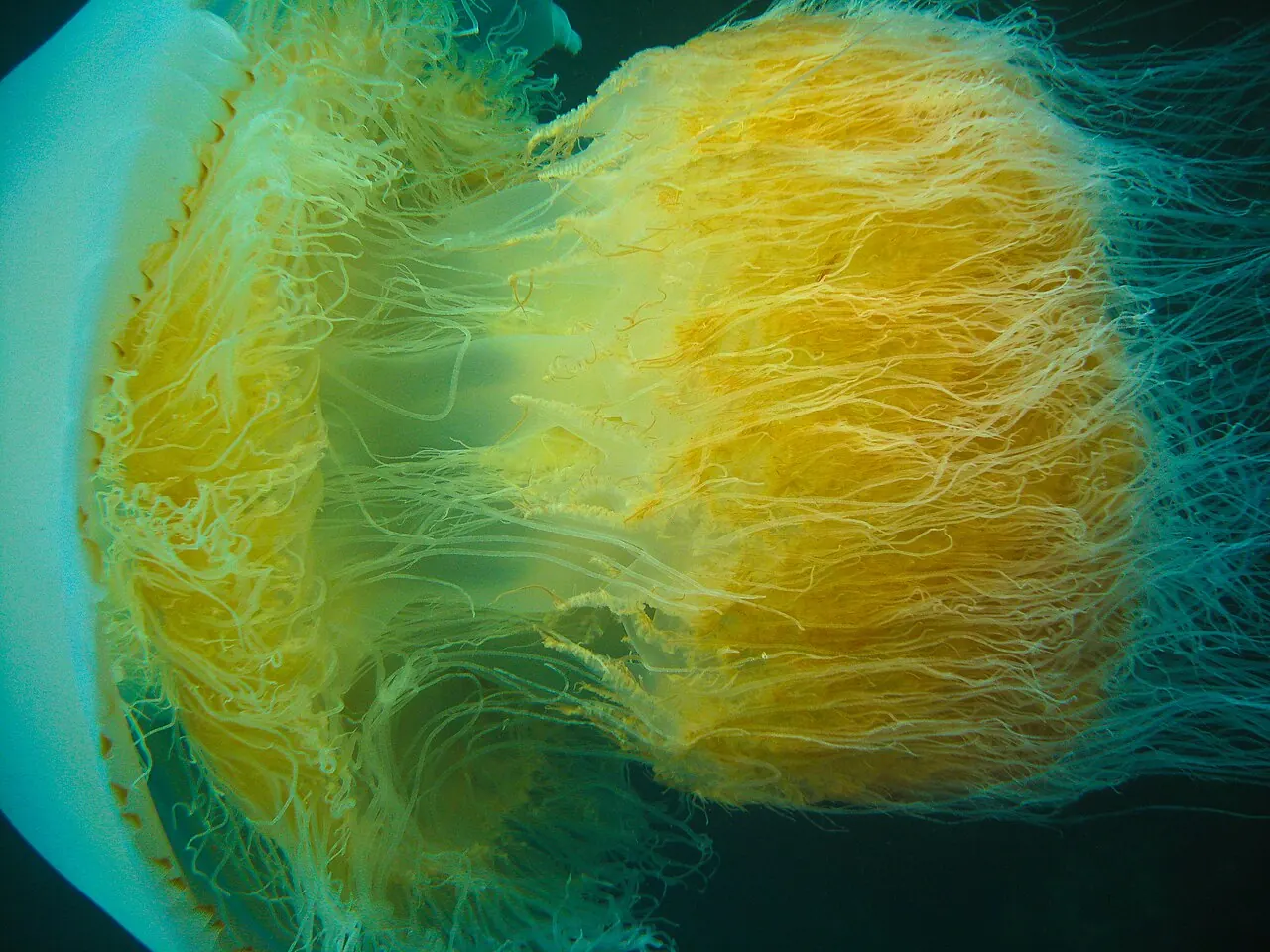
Nomura's Jellyfish
Nemopilema nomurai
One of the world's largest jellyfish, up to 2 m across and 200 kg, whose blooms in East Asian seas clog and burst fishing nets.
Photo: Janne Hellsten / CC BY 2.0
3 things to know
- A big one can have a bell about 2 m (6.6 ft) across and weigh about 200 kg (440 lb).
- In the 2005 bloom, 300 to 500 million may have drifted through the Tsushima Strait each day.
- Huge blooms once came about every 40 years but struck four times between 2002 and 2006.
- Scientific name
- Nemopilema nomurai
- Depth
- 0 m – 176 m
0 – 577 ft - Size
- Bell up to about 2 m (6.6 ft) across
- Weight
- Up to about 200 kg (440 lb)
- Lifespan
- Less than a year as a jellyfish
- Diet
- Mostly small plankton, plus organic detritus
- Where
- East Asian marginal seas: the Bohai, Yellow and East China Seas, carried by currents into the Sea of Japan
- IUCN status
- Not Evaluated
- Depth zones
- Sunlight
Shin-ichi Uye of Hiroshima University puts the largest Nomura's jellyfish at a bell about 2 meters (6.6 feet) across and a wet weight of about 200 kilograms (440 pounds), which places it among the biggest jellyfish anywhere. It belongs to the marginal seas of East Asia. Polyps on the seafloor release young jellies in the Yellow Sea and East China Sea from April to June, and the Tsushima Current carries many of them north into the Sea of Japan. SeaLifeBase records it from the surface to 176 meters (577 feet).
The jellyfish stage lasts less than a year: young jellies appear in early summer, and the medusae die off by midwinter. As a young medusa grows, its single central mouth closes and is replaced by many small mouth openings on its oral arms. A 2022 study of Yellow Sea jellies by Junjian Wang and colleagues, using chemical tracers in their tissues, found that organisms smaller than a millimeter made up about 70% of the diet, and that organic detritus was also a large part.
Big blooms used to be rare. Uye counted earlier mass occurrences in 1920, 1958 and 1995, about one every 40 years, and then four in five years: 2002, 2003, 2005 and 2006. The 2005 bloom may have been the largest ever, with 300 to 500 million medusae passing through the Tsushima Strait each day in summer and more than 100,000 complaints from commercial fishermen. During the 2003 bloom, Masato Kawahara and colleagues reported, the jellies clogged and burst nets, killed fish with their venom, lowered catches and raised the risk of trawlers capsizing. In Aomori Prefecture alone the loss came to 2.3 billion yen, about $20 million.
On October 30, 2009, the 9.85-ton trawler Daisan Shinsho Maru capsized off Choshi, Chiba Prefecture, as its captain and two crew hauled in a net heavy with the jellyfish. Japan's Transport Safety Board found that a wave threw the net onto the stern deck, where spilled jellyfish blocked the drains and trapped seawater. A nearby fishing boat rescued all three. Uye suggested the more frequent blooms may come from warmer water, nutrient pollution, coastal modification and overfishing in Chinese coastal waters. The species has not been assessed for the IUCN Red List.
Sources
- Study: doi:10.3800/pbr.3.125
- Study: doi:10.3354/meps307161
- int-res.com/articles/meps2006/307/m307p161.pdf
- sealifebase.se/summary/Nemopilema-nomurai.html
- Study: doi:10.1007/s00343-021-1024-y
- jtsb.mlit.go.jp/ship/rep-acci/2010/MA2010-12-6_2009yh0266.pdf
- en.wikipedia.org/wiki/Nomura%27s_jellyfish
- api.gbif.org/v1/species/2264583/iucnRedListCategory



