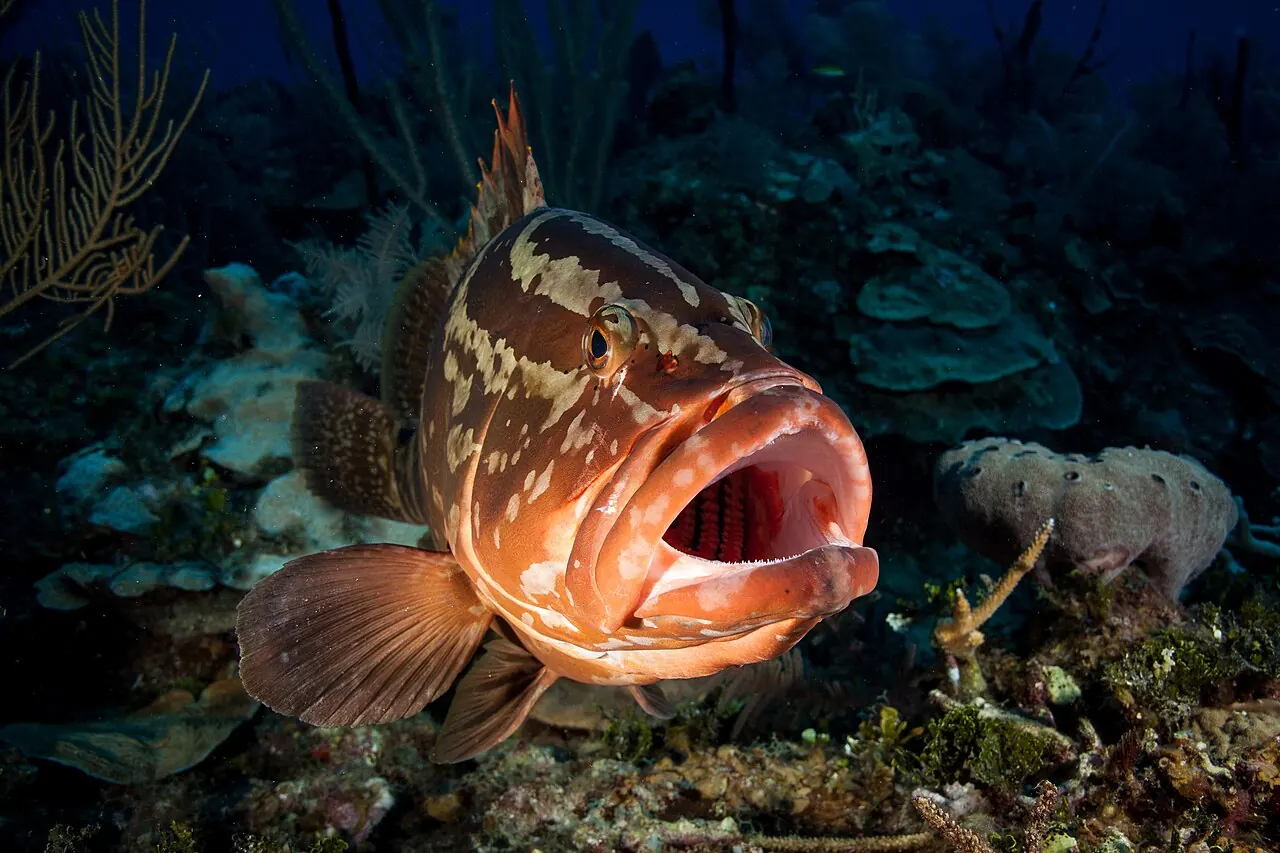
Nassau Grouper
Epinephelus striatus
A Caribbean reef grouper that spawns in huge gatherings timed by the moon, now protected in US waters and bouncing back in the Cayman Islands.
Photo: q phia / CC BY 2.0
3 things to know
- A Nassau grouper can change from almost white to dark brown within minutes.
- All of its known spawning happens in aggregations that can reach tens of thousands of fish.
- On Little Cayman, the Nassau grouper population more than tripled in 15 years of protection.
- Scientific name
- Epinephelus striatus
- Depth
- 0 m – 90 m
0 – 295 ft - Size
- Up to about 1.2 m (4 ft) long
- Weight
- Up to about 25 kg (55 lb)
- Lifespan
- Up to 29 years
- Diet
- Adults eat fish; juveniles eat fish, shrimp and crabs
- Where
- Tropical western Atlantic: Bermuda, south Florida, the Bahamas and the Caribbean to southern Brazil; rare in the Gulf of Mexico
- IUCN status
- Critically Endangered
- Depth zones
- Sunlight
Within minutes, a Nassau grouper can shift from almost white to bicolored to plain dark brown, depending on what it is doing. Its everyday look is light beige with five dark brown bars, a black saddle on top of the tail base, black spots below and behind each eye, and a dark tuning-fork mark on top of the head. NOAA Fisheries gives a maximum of about 1.2 meters (4 feet), 25 kilograms (55 pounds) and 29 years.
It lives on reefs, rocks and ledges in the Caribbean and western Atlantic, including south Florida, Puerto Rico, the US Virgin Islands, Bermuda and the Bahamas, with one verified record in the Gulf of Mexico at Flower Garden Banks. FishBase says it occurs from the shoreline to at least 90 meters (295 feet), and NOAA reports it down to 130 meters (426 feet). Adults are ambush hunters that suck in fish whole, probably most often in the low light of dawn and dusk.
All known spawning happens in aggregations of hundreds to tens of thousands of fish. NOAA says they form from November through February around the full moon. A 1999 NOAA synopsis by Yvonne Sadovy and Anne-Marie Eklund puts spawning within about a week of the full moon, or between full and new moon. Some adults travel several hundred kilometers to reach a site. Courtship runs through a set of color phases and ends near sunset, when a group races upward, a female in the lead releasing eggs and males behind her releasing sperm. Older accounts assumed it changes sex, but NOAA notes that natural sex change has not been confirmed.
Those predictable gatherings made it easy to catch. Once among the most common groupers in the United States, it is now illegal to catch or keep anywhere in US waters, including Puerto Rico and the US Virgin Islands. NOAA listed it as threatened under the Endangered Species Act in 2016, and in 2024 designated about 2,385 square kilometers (921 square miles) of critical habitat off southeastern Florida, Puerto Rico, Navassa and the Virgin Islands. The IUCN lists it as Critically Endangered.
In the Cayman Islands, the government brought in spatial and seasonal fishing closures and partnered with academic and nonprofit groups on a monitoring program called Grouper Moon. In 2020 Lynn Waterhouse and colleagues reported that the Nassau grouper population on Little Cayman had more than tripled over 15 years.
Sources
- fisheries.noaa.gov/species/nassau-grouper
- fishbase.se/summary/Epinephelus-striatus.html
- iucnredlist.org/species/7862/46909843
- st.nmfs.noaa.gov/spo/SPO/tr146.pdf
- federalregister.gov/documents/2024/01/02/2023-28483/endangered-and-threatened-species-d…
- Study: doi:10.1073/pnas.1917132117
- commons.wikimedia.org/wiki/File:2017,_cuba,_jardines_aggressor,_los_indios,_nassau_grou…



