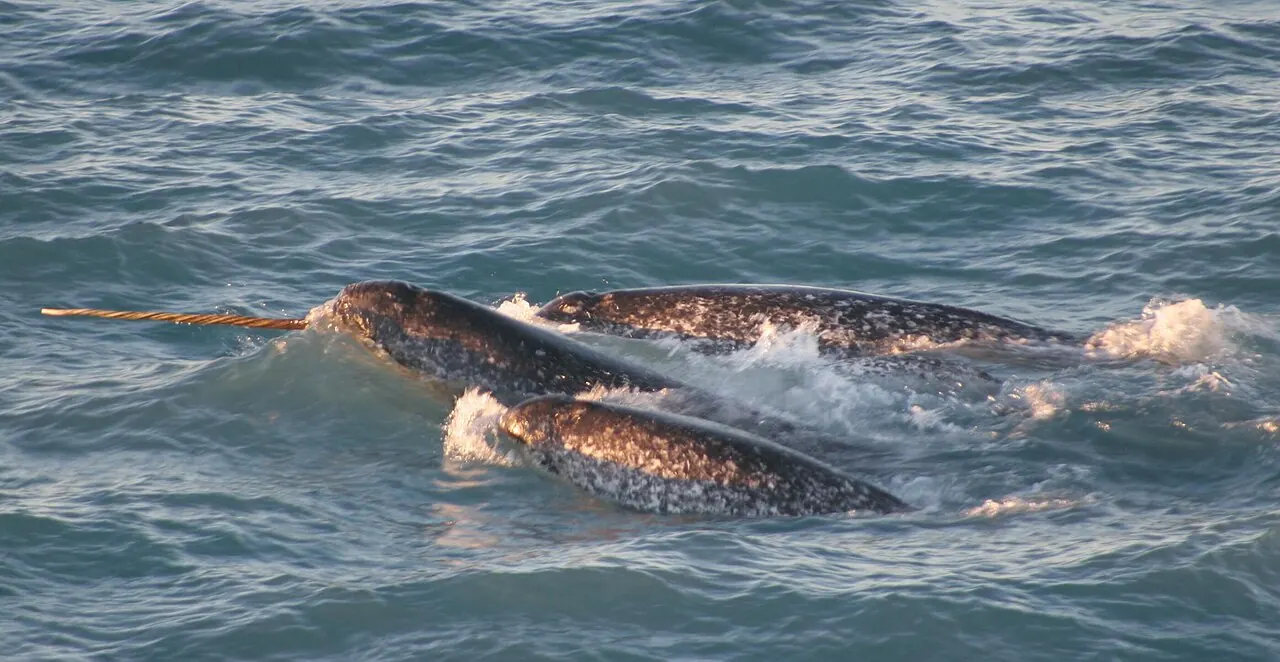
Narwhal
Monodon monoceros
An Arctic whale whose males grow a single spiral tusk, a tooth that can reach about 3 m (10 ft) and keeps a yearly record.
Photo: Dr. Kristin Laidre, Polar Science Center, UW / NOAA / Public domain
3 things to know
- The tusk is a tooth that can grow to about 3 m (9.8 ft) and weigh more than 9 kg (20 lb).
- Narwhals can dive to about 1,200 m (3,937 ft) and stay down for up to 25 minutes.
- The tusk adds a growth layer every year that records the whale's diet and mercury exposure.
- Scientific name
- Monodon monoceros
- Depth
- 0 m – 800 m
0 – 2,625 ft - Size
- Females up to about 4.2 m (13.8 ft); males up to about 4.8 m (15.7 ft), not counting the tusk
- Weight
- Females up to about 1,000 kg (2,204 lb); males up to about 1,600 kg (3,527 lb)
- Lifespan
- At least 25 years, possibly up to 50
- Diet
- Arctic fish such as Arctic cod, polar cod and turbot, plus squid and shrimp
- Where
- Arctic Ocean, mainly the Atlantic side
- IUCN status
- Least Concern
- Depth zones
- Sunlight · Twilight
In male narwhals, a canine tooth on the left side of the upper jaw erupts through the lip and grows in a long spiral that can reach about 3 meters (9.8 feet) and weigh more than 20 pounds, according to NOAA Fisheries. Females rarely grow one. Leaving the tusk aside, males reach about 4.8 meters (15.7 feet) and 1,600 kilograms (3,527 pounds), and females about 4.2 meters (13.8 feet) and 1,000 kilograms (2,204 pounds).
Narwhals live in the Arctic, mostly on its Atlantic side. They eat medium to large Arctic fish such as Arctic cod, polar cod and turbot, along with squid and shrimp, and they dive deep for them. At one wintering ground in Baffin Bay, Kristin Laidre's team found tagged narwhals spending most of their time on dives to at least 800 meters (about 2,600 feet), 13 to 26 a day, and NOAA reports dives to 1,200 meters (3,937 feet) lasting up to 25 minutes.
A single calf is born in July or August after a pregnancy of about 13 to 16 months. Narwhals live at least 25 years and may reach 50. The IUCN lists the species as Least Concern. Threats include hunting by Arctic peoples for meat, blubber and tusks, getting trapped in ice, and contaminants that build up in their tissue.
What the tusk is for is still argued over. Martin Nweeia and colleagues reported in 2014 that seawater can reach nerves inside the tusk through tiny channels, and that heart rates changed when very salty and then fresh water were run over a tusk. Zackary Graham's team looked at measurements of 245 adult males gathered over 35 years and found tusk length so variable, and so out of proportion in the biggest males, that they suggested it is a sexually selected signal used in contests between males. Nweeia's paper allows that the tusk may do more than one job.
The tusk also keeps a record. It lays down a new layer of dentine each year, and a team led by Rune Dietz read those layers in 10 tusks from northwest Greenland, covering 1962 to 2010. The layers showed diets shifting as sea ice changed, and mercury rising, with an unexpected jump in the later years.



