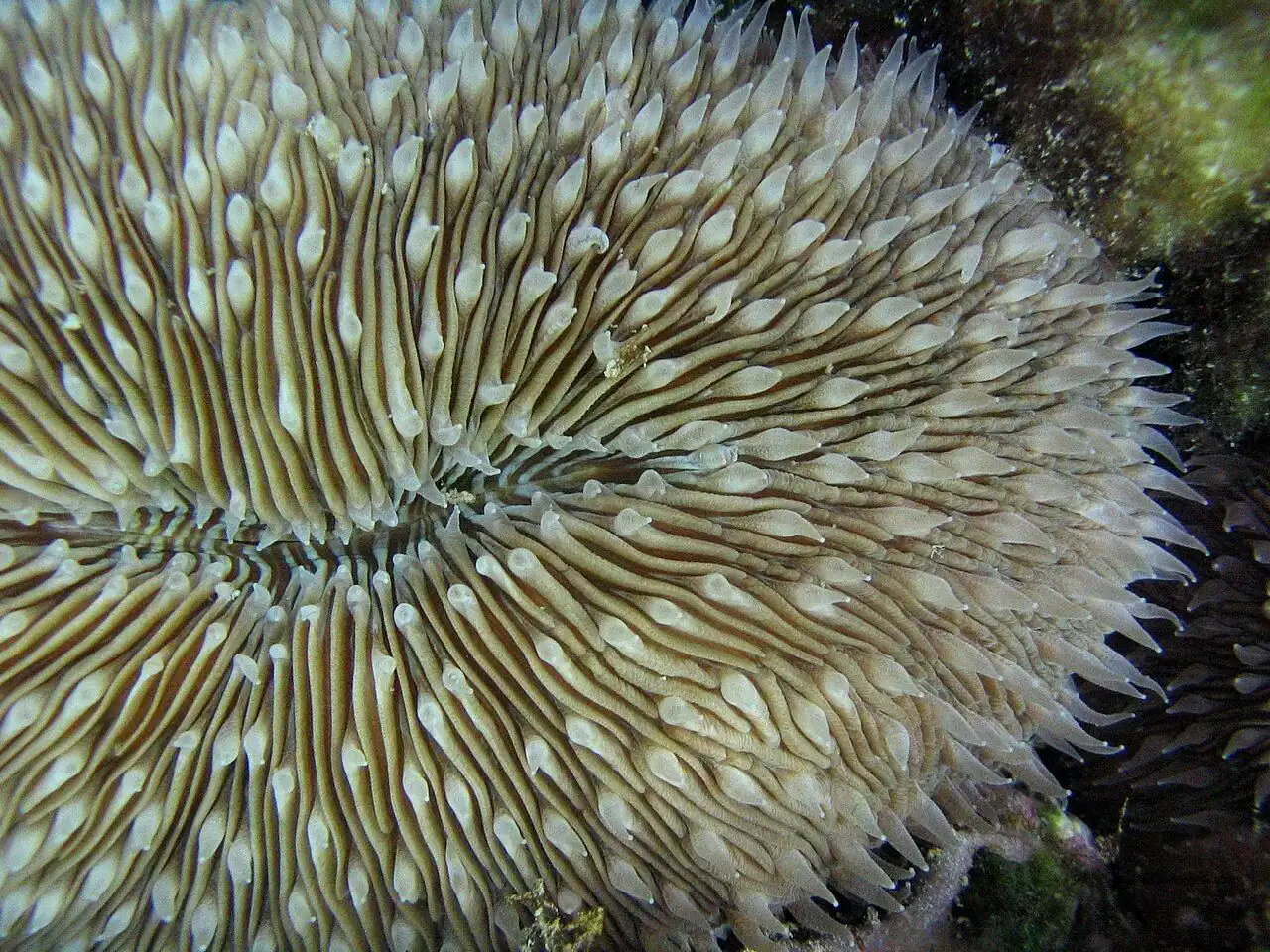
Mushroom Coral
Family Fungiidae (several genera, including Fungia, Lobactis and Heliofungia)
Corals that live loose on the seafloor as single large polyps, able to crawl toward light, dig out of sand and flip themselves upright.
Photo: Dr. Dwayne Meadows, NOAA/NMFS/OPR / Public domain
3 things to know
- Young mushroom corals grow on a stalk, then dissolve their skeleton below the disk and break free.
- In lab tests, one small species crawled toward light at up to 3 cm (1.2 in) an hour.
- An overturned Herpolitha limax righted itself in under six hours in a time-lapse film.
- Scientific name
- Family Fungiidae (several genera, including Fungia, Lobactis and Heliofungia)
- Depth
- 3 m – 20 m
10 – 66 ft - Size
- Common mushroom coral up to about 28 cm (11 in) across; some species exceed 50 cm (20 in)
- Weight
- Unknown
- Lifespan
- Unknown
- Diet
- Food from algae living in their tissues, plus prey caught by their tentacles
- Where
- Indo-Pacific reefs, from the Red Sea and East Africa to Hawaii
- IUCN status
- Varies by species (common mushroom coral and Lobactis scutaria Least Concern)
- Depth zones
- Sunlight
Unlike most stony corals, many mushroom corals do not stay put. The common mushroom coral, Fungia fungites, is a single large polyp: a round disk of skeleton covered in radiating ridges and tentacles, lying loose on the reef and reaching about 28 centimeters (11 inches) across. Some relatives grow wider than 50 centimeters (20 inches). They start life attached: a young coral grows on a short stalk, then dissolves its own skeleton just below the disk and breaks free, leaving a scar underneath. Hoeksema and Bongaerts note that more than 70 percent of mushroom coral species have this free-living adult stage.
They live on Indo-Pacific reefs from the Red Sea to Hawaii. The common mushroom coral is usually found 3 to 20 meters (10 to 66 feet) down, though the IUCN records it to 72 meters, and mushroom corals can gather in dense groups on sandy bottoms below 20 meters. Their food comes partly from algae living in their tissues and partly from what their tentacles catch.
Being loose lets them move. In lab tests published in 1995, Yamashiro and Nishihira found that mushroom corals crawl toward light; the small Diaseris distorta managed up to 3 centimeters (1.2 inches) an hour and climbed slopes as steep as 30 degrees. Another species backed away from a toxic sponge. Buried in sand, they inflate their tissue in rhythmic pulses until they dig themselves out, which Bongaerts, Hoeksema and colleagues filmed in time-lapse with corals from Heron Island on the Great Barrier Reef. In time-lapse footage published in 2015, a roughly 7-centimeter Herpolitha limax flipped itself upright in under six hours. In the wild the trips are short: tracking 51 mushroom corals in a Chagos Archipelago lagoon for a year with 3D photogrammetry, Bayley and Mogg found that common mushroom corals moved about half a meter (1.6 feet) on average.
Hawaii's reefs are home to Lobactis scutaria, long called Fungia scutaria. David Krupp of the Hawaii Institute of Marine Biology reported in 1983 that it spawned in summer, one to four days after the full moon, between 5 and 7 p.m., with each coral either male or female and females ejecting their eggs through their mouths. The IUCN lists both it and the common mushroom coral as Least Concern, in assessments made in 2022, while recording both populations as decreasing.
Sources
- Study: doi:10.1007/s12526-015-0384-y
- Study: doi:10.1007/s00338-011-0862-z
- Study: doi:10.1007/s00338-011-0856-x
- Study: doi:10.1007/bf00363920
- Study: doi:10.1007/s00338-022-02331-x
- Study: doi:10.1007/bf00336722
- Study: doi:10.1038/262212a0
- coralsoftheworld.org/species_factsheets/species_factsheet_summary/fungia-fungites
- sealifebase.se/summary/Fungia-fungites.html
- iucnredlist.org/species/133503/165923380
- iucnredlist.org/species/133201/165768683



