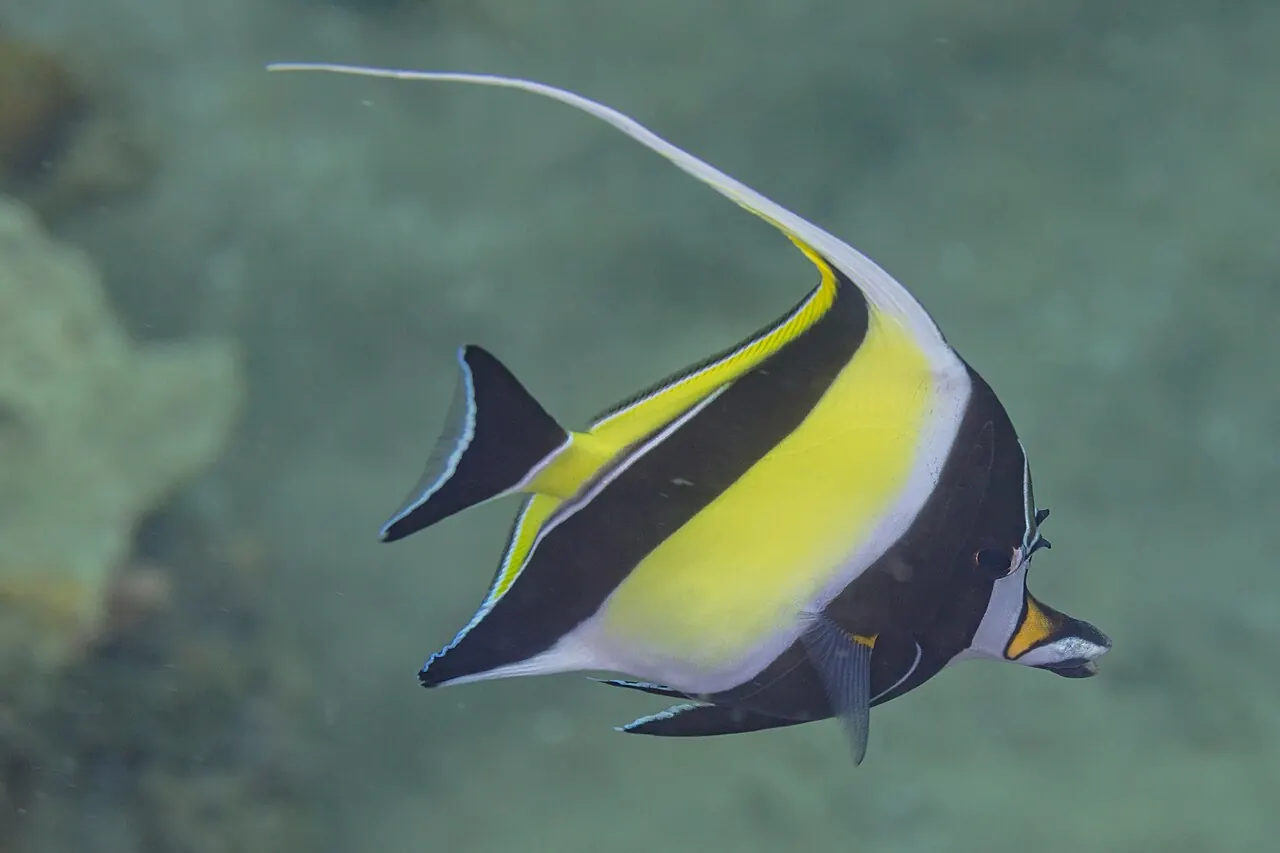
Moorish Idol
Zanclus cornutus
The only species in its family: a disc-shaped reef fish with a sickle-like streamer, found from East Africa to Hawaii and Peru.
Photo: Diego Delso / CC BY-SA 4.0
3 things to know
- It is the only species in the family Zanclidae.
- Its young are about 7.5 cm (3 in) long when they change from larva to juvenile.
- Adults grow a small bony bump in front of each eye, larger in males.
- Scientific name
- Zanclus cornutus
- Depth
- 1 m – 182 m
3 – 597 ft - Size
- Up to about 23 cm (9 in) long
- Weight
- Not well known
- Lifespan
- Unknown
- Diet
- Mostly encrusting sponges, plus coral polyps, tunicates, coralline algae and other small bottom-living animals
- Where
- Indo-Pacific from East Africa to Hawaii and the Rapa and Ducie islands, and the eastern Pacific from the Gulf of California to Peru
- IUCN status
- Least Concern
- Depth zones
- Sunlight
A long white streamer trails from the back of the Moorish idol, a flat, disc-shaped reef fish with two broad black bars and a yellow saddle near its snout. The streamer is an extended dorsal fin, and it gives the fish its scientific name: Zanclus comes from the Greek word for sickle. The species name, cornutus, is Latin for horned, a reference to the small bony bumps that adults grow in front of the eyes, larger in males than in females. Adults reach about 23 centimeters (9 inches), and the Moorish idol is the only species in its family, the Zanclidae.
The Moorish idol lives from East Africa across the Indian and Pacific oceans to the Rapa and Ducie islands, north to southern Japan and the Hawaiian Islands, and in the eastern Pacific from the southern Gulf of California to Peru. It turns up in murky inner lagoons, on reef flats and on clear seaward reefs, from the shallows to 182 meters (about 600 feet). Divers usually see one, two or three together, though adults occasionally form large schools.
FishBase links that huge range to a long larval stage drifting in the open ocean. The young are about 7.5 centimeters (3 inches) long when they change from larvae into juveniles, and the long drift helps explain why the fish's colors show no geographic variation from one end of its range to the other.
The tube-shaped snout ends in a small mouth lined with long, bristle-like teeth. The fish uses it to reach into cracks and crevices, and it feeds mostly on encrusting sponges, along with coral polyps, tunicates, coralline algae and other small animals living on the reef. The species is popular with aquarium keepers, but FishBase notes that it rarely survives in tanks, and the Fishes of Australia project puts the difficulty down to its diet of encrusting sponges.
The IUCN lists the Moorish idol as Least Concern, from a 2015 assessment.



