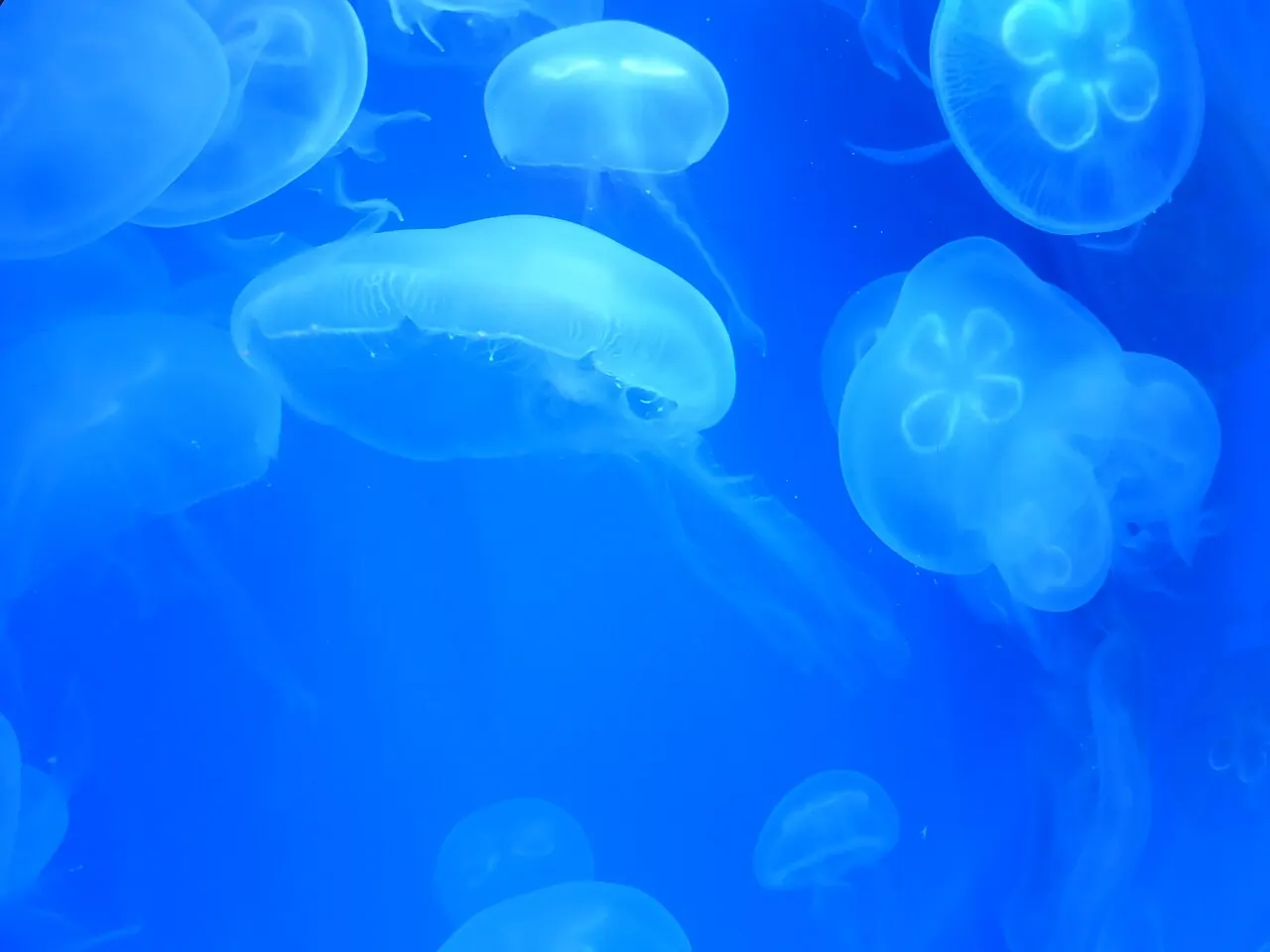
Moon Jellyfish
Aurelia aurita
The classic see-through jellyfish with four rings in its bell, and a name that once covered what DNA now splits into 28 species.
Photo: MartinThoma / CC0
3 things to know
- Its four horseshoe-shaped gonads show through the top of the bell.
- A 2021 study recognized 28 species of moon jellyfish, many of them once filed under this one name.
- Moon jelly polyps flew on the space shuttle Columbia in 1991 and produced young jellyfish in orbit.
- Scientific name
- Aurelia aurita
- Depth
- 0 m – 20 m
0 – 66 ft - Size
- Bell usually about 25 cm (10 in) across, up to about 40 cm (16 in)
- Weight
- Unknown
- Lifespan
- Not well known; young jellyfish usually mature in about 3 months, some take up to 2 years
- Diet
- Plankton, including small crustaceans and their larvae, rotifers and fish larvae
- Where
- Northeast Atlantic, North and Baltic Seas; also recorded in the Black and Caspian Seas, Greenland, northeastern US and Canada, and South America
- IUCN status
- Not Evaluated
- Depth zones
- Sunlight
Look down through the clear bell of a moon jellyfish and you see four rings, horseshoe-shaped gonads that are usually mauve, violet, pink or yellowish. The bell itself is a flattened, colorless saucer, usually about 25 centimeters (10 inches) across and sometimes 40 centimeters (16 inches), edged with a fringe of short tentacles. It is Britain's most common jellyfish, and it is erratic: some years it forms huge local swarms, while in other years it is missing from the same waters. In the Baltic Sea's Bornholm Basin, K. Barz and H.-J. Hirche found about 80 percent of moon jellies in the top 20 meters (66 feet) from July to October. SeaLifeBase's range of 0 to 1,250 meters predates the genus split.
For decades, moon jellies worldwide were filed under Aurelia aurita. In 2021 Jonathan Lawley and colleagues, writing in PeerJ, recognized 28 species in the genus Aurelia, mostly on genetic evidence, because their body shapes overlap from place to place. Under that scheme the true A. aurita belongs to the northeast Atlantic, including the North and Baltic Seas, with populations in the Black and Caspian Seas, Greenland, northeastern North America and South America that may stem from introductions. Moon jellies on the US West Coast include other species, such as A. coerulea, and much older research on "A. aurita" may describe its relatives.
It is a suspension feeder, collecting plankton such as small crustaceans and their larvae, rotifers and fish larvae. Its stinging cells cannot get through human skin. The sexes are separate. Eggs are fertilized inside the female and brooded in pits on her oral arms until they hatch as larvae, which settle on hard surfaces and become tiny polyps. The polyps bud off baby jellyfish called ephyrae. Most reach adulthood in about three months; some take up to two years.
The polyp stage has been to space. On the Spacelab Life Sciences-1 mission, launched aboard the shuttle Columbia on June 5, 1991, D. B. Spangenberg and colleagues flew moon jelly polyps and ephyrae for nine days. Polyps budded ephyrae in orbit that looked very similar to those raised on Earth, but 18.3 percent of the space-grown ephyrae pulsed abnormally, against 2.9 percent of the Earth controls. The team suggested the gravity sensors, the nerves and muscles, or the link between them had developed abnormally. The species has not been assessed for the IUCN Red List.



