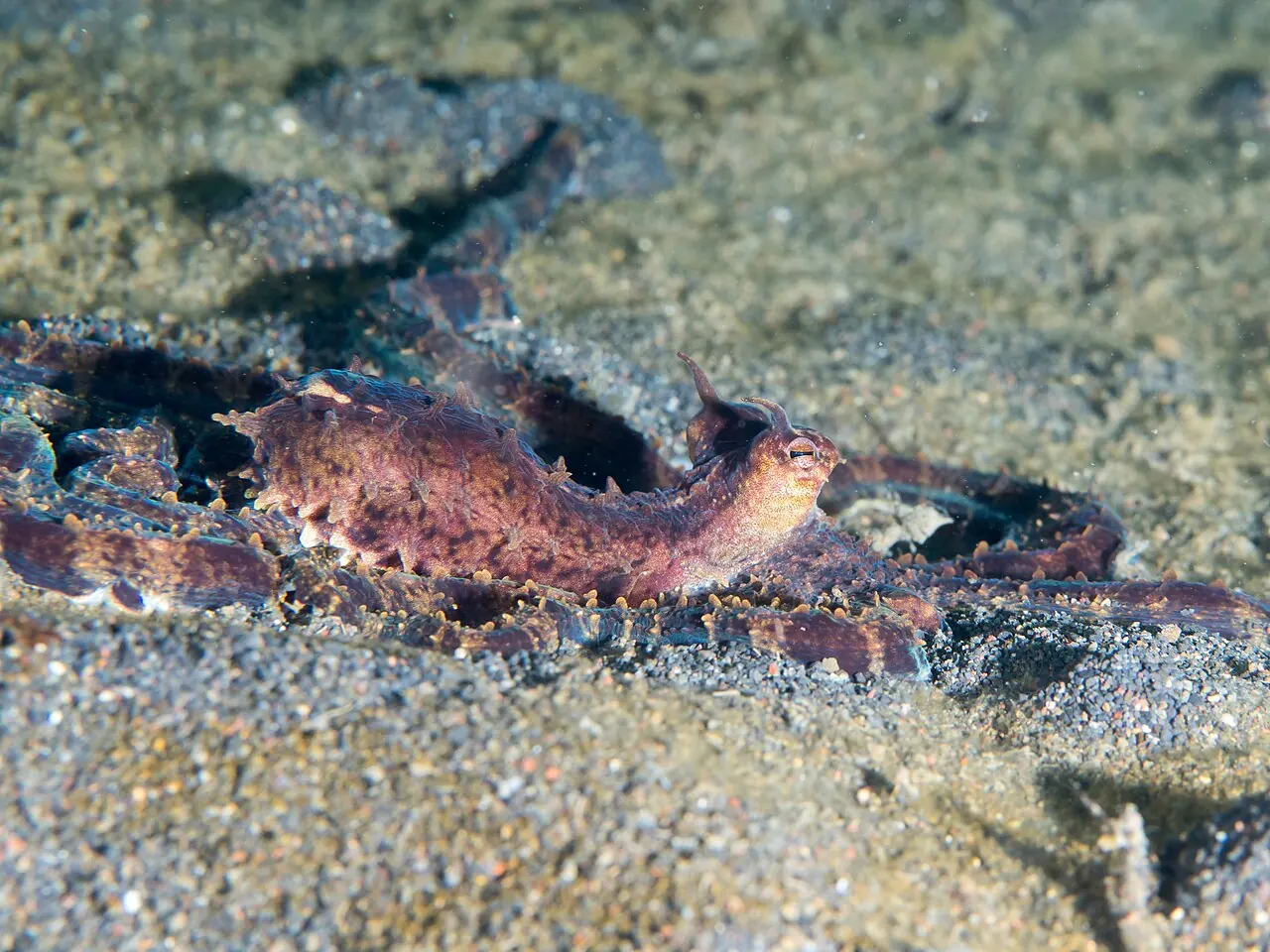
Mimic Octopus
Thaumoctopus mimicus
A long-armed octopus of Indo-Pacific sand flats that can swim like a flatfish and pose like a lionfish or a sea snake.
Photo: Rickard Zerpe / CC BY 2.0
3 things to know
- It forages in the open on bare sand and mud, in daylight.
- It often swims flat and low like a flatfish, but only when moving would give its camouflage away.
- It can drop an arm at a set breaking point near the base.
- Scientific name
- Thaumoctopus mimicus
- Depth
- 0 m – 37 m
0 – 121 ft - Size
- Mantle about 6 cm (2.3 in); up to about 48 cm (19 in) long including the arms
- Weight
- Unknown
- Lifespan
- Unknown
- Diet
- Small fish and crustaceans
- Where
- Tropical Indo-West Pacific, mainly from New Caledonia to Indonesia, Malaysia and the Philippines; also the Red Sea and Australia's Great Barrier Reef
- IUCN status
- Least Concern
- Depth zones
- Sunlight
Long, narrow arms and a small body mark the mimic octopus, Thaumoctopus mimicus. Its mantle is only about 6 centimeters (2.3 inches) long, but SeaLifeBase gives a total length of up to about 48 centimeters (19 inches), most of it arm. A white teardrop-shaped ring on the middle of its back and a white U-shaped patch near the rear of the mantle help set it apart from other long-armed octopuses. It can also shed an arm at a set point near the base.
Mark Norman and F. G. Hochberg gave the species its name in 2005. It lives on soft sand and mud in shallow water, 0.5 to 37 meters (2 to 121 feet) deep, mainly in the Indo-Malayan Archipelago from New Caledonia to Indonesia, Malaysia and the Philippines. Photographs extend its range to the Red Sea, and it has been documented on Australia's Great Barrier Reef. It hunts small fish and crustaceans by day, out in the open, probing holes and burrows. Some individuals leave a hole at first light, forage all day and spend the night in the last burrow they entered.
Out on that open sand, Norman and colleagues reported in 2001, the octopus impersonates venomous or toxic animals that share its habitat: banded soles, lionfish and sea snakes. They called it dynamic mimicry, because one animal switches between several models, and their observations suggested it picks a disguise to suit the threat. Other postures have been read as copies of other animals, but those remain open to interpretation.
A team led by Roger Hanlon of the Marine Biological Laboratory in Woods Hole, Massachusetts, later filmed mimic octopuses and a related species on volcanic sand off North Sulawesi, Indonesia, and analyzed nearly 500 flatfish acts over five days. The octopuses copied a local flounder's shape, swimming style and speed, and switched the act on only while moving, when their camouflage would give them away. Sitting still, they looked like small sponges or worm tubes.
How long it lives is unknown. The IUCN lists it as Least Concern.



