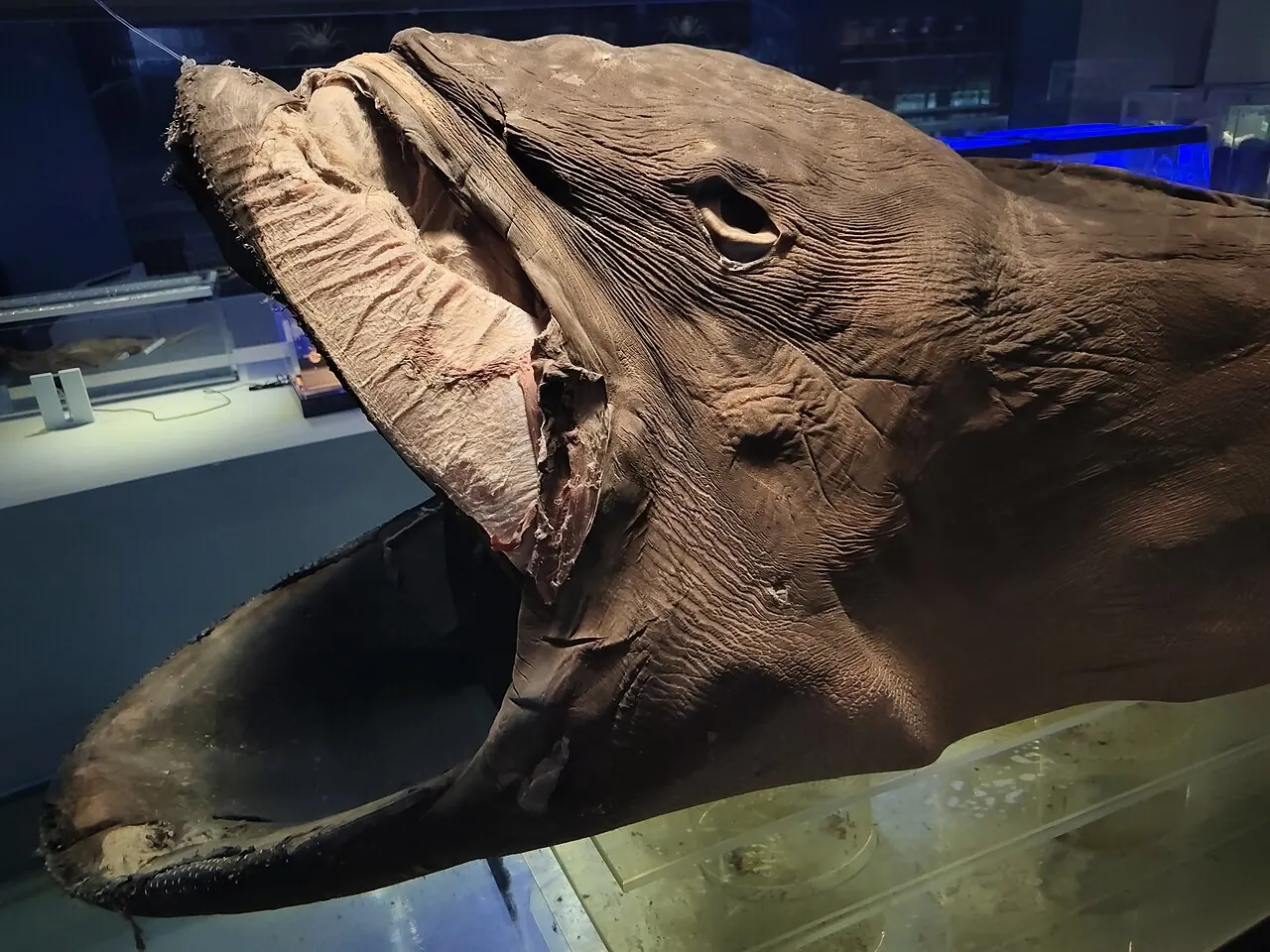
Megamouth Shark
Megachasma pelagios
A rare, flabby filter-feeding shark unknown to science until 1976, when one tangled in a US Navy ship's sea anchor off Oahu, Hawaii.
Photo: 丘崈 (Wikimedia Commons) / CC0
3 things to know
- Its scientific name is Greek for giant yawner of the open sea.
- One tracked off California spent nights at 12–25 m (39–82 ft) and days at 120–160 m (390–520 ft).
- Every megamouth stomach examined has held krill.
- Scientific name
- Megachasma pelagios
- Depth
- 5 m – 600 m
16 – 1,969 ft - Size
- Males up to about 5.5 m (18 ft) long; FishBase lists a female of 7.1 m (23 ft)
- Weight
- Not well known
- Lifespan
- Unknown
- Diet
- Krill (euphausiid shrimp), copepods and jellyfish
- Where
- Warm open oceans worldwide, roughly 40°N to 40°S, with records from the Pacific, Indian and Atlantic oceans
- IUCN status
- Least Concern
- Depth zones
- Sunlight · Twilight
Nobody had seen a megamouth shark until November 15, 1976, when a US Navy research ship hauled up its sea anchors about 25 miles (40 kilometers) off Kahuku Point on Oahu, Hawaii. One of the parachute-like anchors, set at 500 feet (150 meters), had snared a 14.5-foot (4.4-meter) shark unlike any known. Leighton Taylor, director of the Waikiki Aquarium, and two colleagues later described it as a new species, and in a new family, naming it Megachasma pelagios, Greek for "giant yawner of the open sea." That first specimen is still kept at the Bishop Museum in Honolulu.
Megamouth is stout and flabby, with a big rounded head, soft fins, a lopsided tail and a mouth that reaches behind the eyes. It is blackish brown above and white below, with a white band on the snout above the upper jaw that may play a role in feeding or let megamouths recognize one another. FishBase lists males up to 5.5 meters (18 feet) and a female of 7.1 meters (23 feet).
It is one of three filter-feeding sharks, with the whale shark and the basking shark. Every specimen examined has had krill (euphausiid shrimp) in its stomach, and copepods and a jellyfish have also turned up. The Florida Museum describes it swimming slowly through krill swarms with its mouth open, then pushing its jaws forward and widening its mouth to suck prey in. In October 1990 a megamouth caught off Dana Point, California, was tagged and tracked for two days. It stayed 12 to 25 meters (39 to 82 feet) deep at night, dove to 120 to 160 meters (390 to 520 feet) at dawn and came back up at dusk, which suggests the species migrates up and down on a daily cycle.
Megamouths have been found in the Pacific, Indian and Atlantic oceans, and the Florida Museum's list of confirmed records counted 273 when it was last updated, in 2022. Two caught in drift gillnets set for swordfish off Southern California, in 1999 and 2001, were released alive with federal fisheries observers on board. Breeding is poorly known; embryos probably feed on unfertilized eggs inside the mother. The IUCN lists the megamouth as Least Concern, though the Florida Museum notes that there are no real data on its population size.



