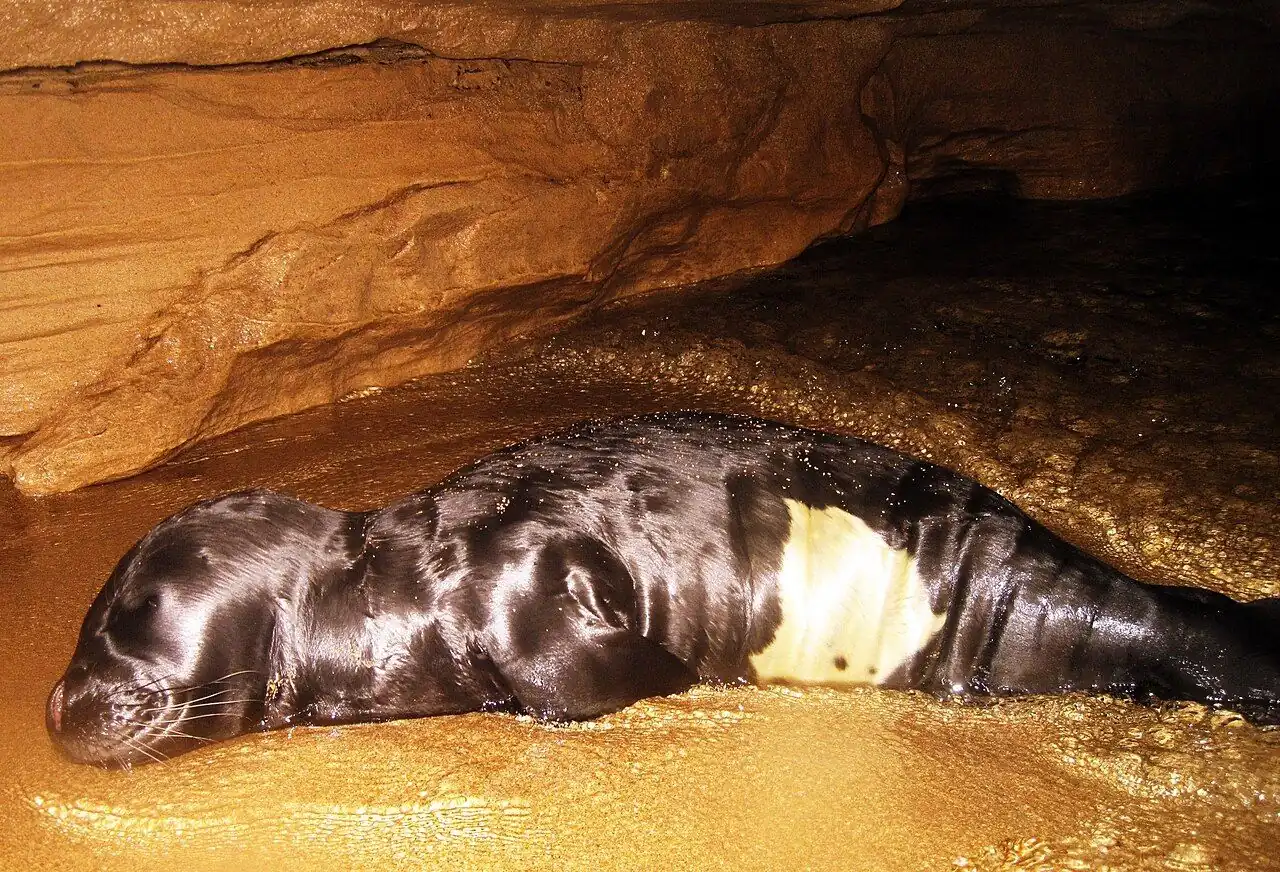
Mediterranean Monk Seal
Monachus monachus
One of the rarest seals on Earth, which now raises its pups in hidden sea caves; numbers are slowly rising, with about 444 to 600 adults.
Photo: Melina Marcou / CC BY-SA 4.0
3 things to know
- Mothers give birth in remote sea caves, a habit NOAA links to centuries of persecution on open beaches.
- Each pup's white belly patch has its own shape, which lets researchers tell individuals apart.
- In 2023 the IUCN moved the species from Endangered to Vulnerable as numbers grew.
- Scientific name
- Monachus monachus
- Depth
- 0 m – 250 m
0 – 820 ft - Size
- About 2.1–2.7 m (7–9 ft) long
- Weight
- About 240–300 kg (530–660 lb)
- Lifespan
- About 20–30 years; the oldest reported 36
- Diet
- Bony fish, octopus and other cephalopods, and crustaceans
- Where
- Eastern Mediterranean (mainly Greece, Türkiye and Cyprus), Madeira, and the Cabo Blanco coast of Mauritania and Western Sahara
- IUCN status
- Vulnerable
- Depth zones
- Sunlight · Twilight
Mediterranean monk seals once hauled out on open beaches. Centuries of hunting, persecution and disturbance drove them from much of their range, and NOAA Fisheries says females now tend to give birth in remote sea caves, choosing ones where mother and pup cannot be seen, with some light, more than one way out, a soft beach inside and little risk of the pup being washed away. Some of these caves have underwater entrances.
Pups are born in a black or dark brown woolly coat with a white patch on the belly. The patch's shape and spots differ from seal to seal, so researchers use it to identify individuals, and even their sex, before the first molt at four to eight weeks. Adult males are black and usually keep the white patch; females are brown or gray with a paler belly. Adults run about 2.1 to 2.7 meters (7 to 9 feet) and 240 to 300 kilograms (530 to 660 pounds), and live 20 to 30 years.
The seals feed mostly in shallow water near shore, on bony fish, crustaceans and cephalopods, mainly the common octopus, though they have been recorded foraging as deep as 250 meters (820 feet). They mate in the water, and after a pregnancy of 9 to 11 months a female has one pup, most often in autumn.
Today the species survives mainly in the eastern Mediterranean, around Greece, Türkiye and Cyprus, at Madeira, and on the Cabo Blanco peninsula on the coast of Mauritania and Western Sahara. Disease devastated the Cabo Blanco colony in 1997; it has since grown back to its size before the die-off, and the Madeira group grew about 3 percent a year from 2012 to 2021. The seals have also spread back through more of Greece and Türkiye. The 2023 IUCN assessment moved the species from Endangered to Vulnerable, estimating 444 to 600 mature animals and an increasing trend; it had been rated Critically Endangered as recently as 2013.
Fishermen have been seen shooting seals and using explosives in occupied caves, young seals drown in static nets, and tourism and development disturb breeding caves. In the United States the species is listed as endangered under the Endangered Species Act and depleted under the Marine Mammal Protection Act.



