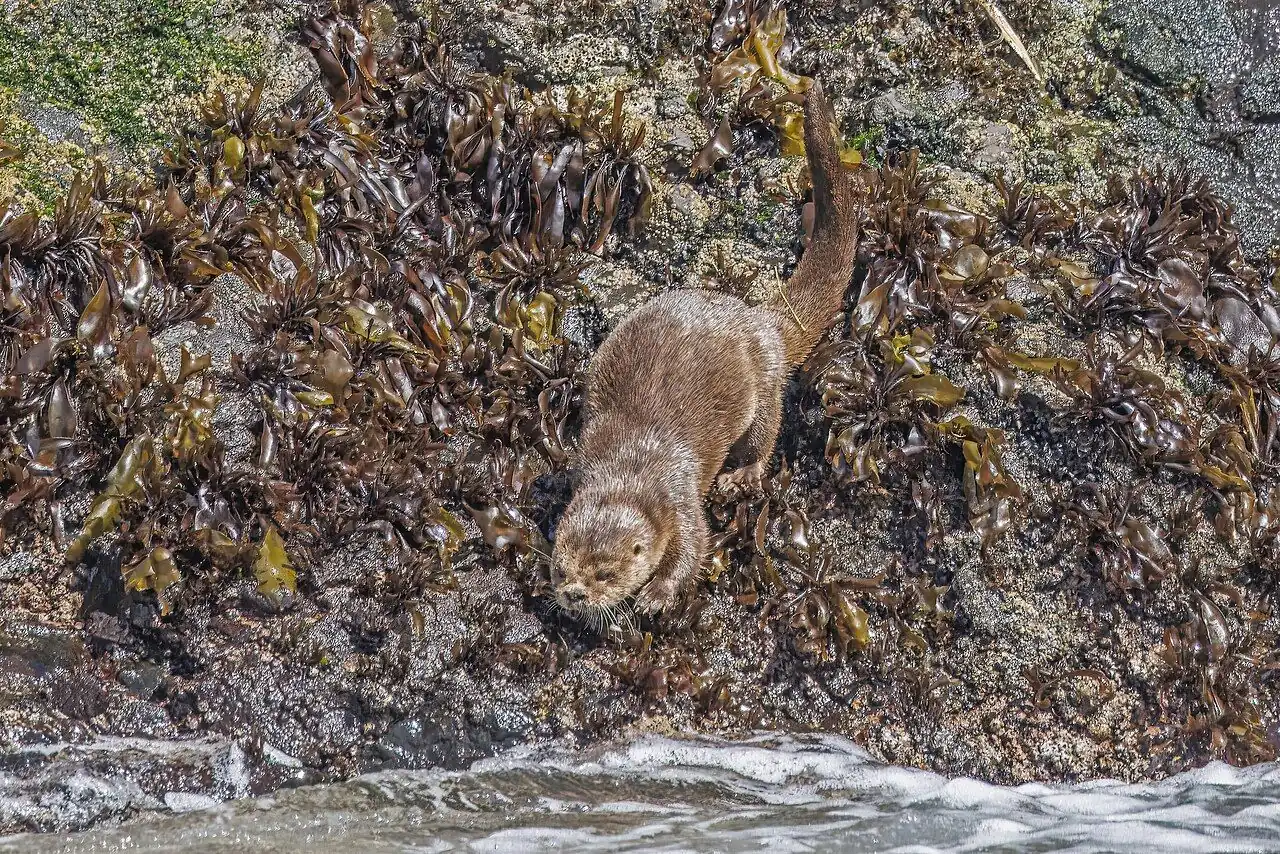
Marine Otter
Lontra felina
A small, shy South American otter that lives mainly on wave-battered rocky coasts, hunting in the surf and resting in seaside caves.
Photo: Charles J. Sharp / CC BY-SA 4.0
3 things to know
- In Chile it is called chungungo or gato de mar, the sea cat.
- When hunting it can dive to 30–40 m (100–130 ft).
- It has been listed as endangered under the US Endangered Species Act since 1976.
- Scientific name
- Lontra felina
- Depth
- 0 m – 40 m
0 – 131 ft - Size
- About 90 cm (35 in) on average from nose to tail tip
- Weight
- 3–5 kg (6.6–11 lb)
- Lifespan
- Not well known
- Diet
- Crustaceans, mollusks and fish; occasionally birds, small mammals and fruit
- Where
- Rocky Pacific coasts of South America from northern Peru to Tierra del Fuego, now patchy; one freshwater population in Peru
- IUCN status
- Endangered
- Depth zones
- Sunlight
Small, dark brown and hard to spot, the marine otter has a thick coat over dense insulating fur, a paler underside, webbed paws and strong claws. From nose to tail tip it averages about 90 centimeters (35 inches), and it weighs 3 to 5 kilograms (6.6 to 11 pounds), making it the smallest otter in its genus. In Chile it is called chungungo or gato de mar, the sea cat.
It lives along the Pacific coast of South America, from northern Peru to Tierra del Fuego, though its range is now patchy. Intensive hunting for fur nearly wiped out the populations at the southern end, around Cape Horn, and fishermen have killed otters as competitors. It is the only member of its genus that lives mainly in the sea, though a resident freshwater population was recently found at Laguna Mamacocha in Peru, more than 150 kilometers (90 miles) inland. It favors rocky shores with strong winds and heavy seas and has not been found on the sandy beaches of Patagonia's Atlantic coast. Gonzalo Medina-Vogel and colleagues, watching otters in southern Chile for a year, found them out of sight about 80 percent of the time and concluded that they need safe shelters ashore as well as water to hunt in.
Marine otters dive for crustaceans, mollusks and fish. They can reach 30 to 40 meters (100 to 130 feet), and the IUCN gives 50 meters (164 feet) as the lower limit. They sometimes catch birds, and they have been seen eating fruit.
Mating happens in December or January. After a gestation of about two months, a female has two to four pups, most often two, and the young stay with her for about 10 months. Like sea otter pups, they sometimes ride on their mother's belly as she swims on her back.
The IUCN lists the marine otter as Endangered, in a 2022 assessment, with numbers falling. It is on CITES Appendix I, and the US Fish and Wildlife Service has listed it as endangered under the Endangered Species Act since June 1976. Laws protect it in Peru and Chile, but a 2020 Chilean government review calls enforcement very weak. Medina-Vogel's team flagged settlements and domestic dogs on the shore as likely limits on where the otters can live.



