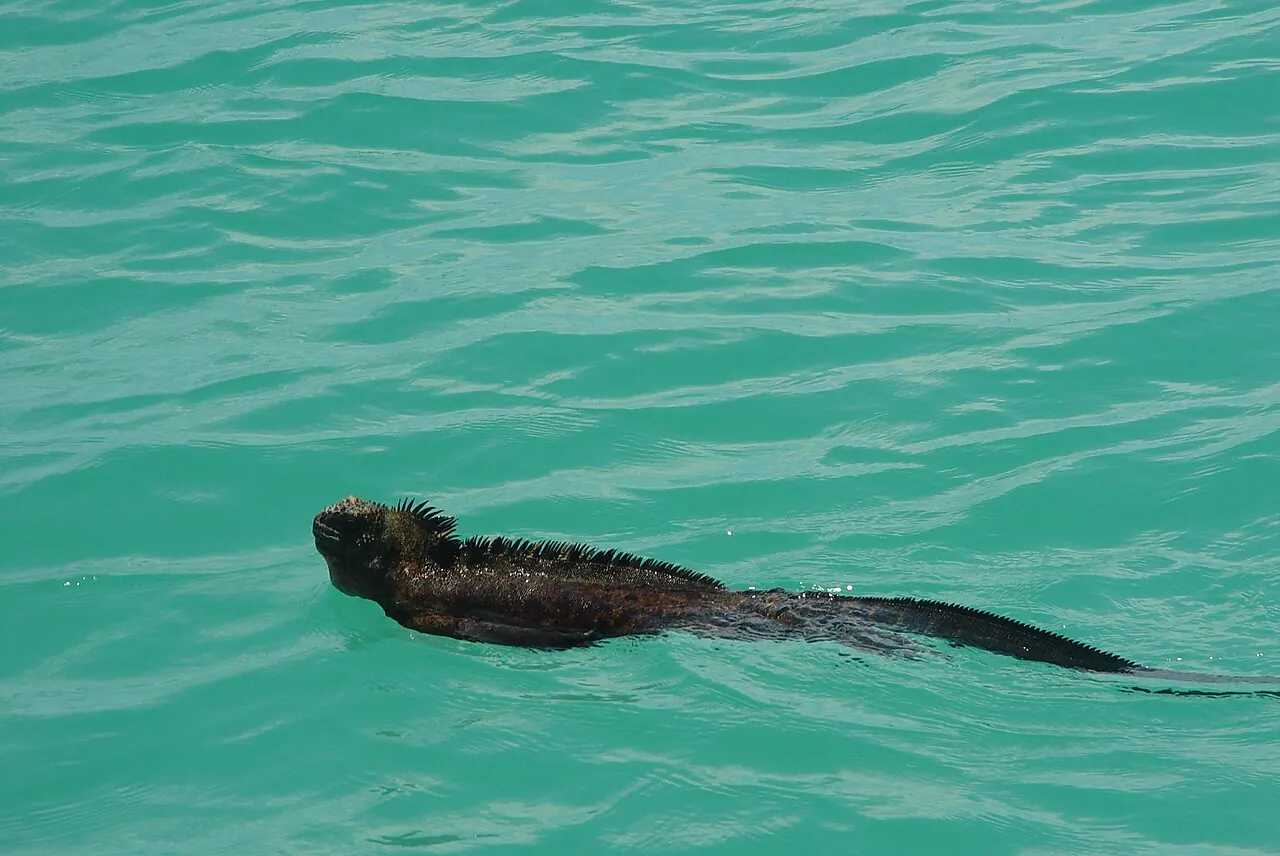
Marine Iguana
Amblyrhynchus cristatus
The only lizard known to feed in the sea, a Galápagos seaweed grazer that dives up to 30 m and can shrink during El Niño famines.
Photo: Adavyd / CC BY-SA 4.0
3 things to know
- Large marine iguanas dive up to 30 m (98 ft) to graze on algae.
- It gets rid of excess salt by sneezing it out through its nostrils.
- During El Niño famines some iguanas got up to 20 percent shorter, then grew again.
- Scientific name
- Amblyrhynchus cristatus
- Depth
- 0 m – 30 m
0 – 98 ft - Size
- Varies greatly between island populations; males are larger than females in almost every population
- Weight
- Varies by island
- Lifespan
- Not well known
- Diet
- Red and green marine algae
- Where
- Galápagos Islands, Ecuador
- IUCN status
- Vulnerable
- Depth zones
- Sunlight
No other living lizard is known to feed in the sea. Marine iguanas live only in the Galápagos Islands, and they eat almost nothing but marine algae, mostly red and green kinds. They are gray to black, with pyramid-shaped scales along the back, a blunt snout and a slightly flattened tail, and they vary a great deal from island to island in size and in the reds, greens and grays of their skin.
How an iguana feeds depends on its size. Small ones graze on algae exposed between the tides at low tide. Large ones swim out at high tide and dive to the algal beds, up to 30 meters (98 feet) down according to Oceana, scraping the rocks with sharp teeth and gripping with their claws. Charles Darwin, who saw them on the voyage of HMS Beagle, wrote that they swim "with much elegance," legs held against the body, moving like an eel. All that grazing brings in a lot of salt, which a special gland removes; the iguana then blows it out of its nostrils in a sneeze.
The water is cool, and a reptile cannot warm itself from the inside, so after feeding a marine iguana has to bask in the sun to raise its body temperature again. Its dark color helps it soak up heat.
El Niño years are the hardest. Warm water drives off the red and green algae, the brown algae that take over are hard for the iguanas to digest, and between 10 and 90 percent of marine iguanas can die. In January 2000, Martin Wikelski, then at the University of Illinois, and Corinna Thom of the University of Würzburg reported in Nature that the animals shrink. Watching about 6,000 iguanas through four El Niños, they found more than 100 that became shorter, some by as much as 6.8 centimeters (2.7 inches) of body length, or up to 20 percent, and then grew again. Wikelski calculated that losing that much length requires the bones themselves to shrink, though some other reptile biologists were not fully convinced. Among large adults during the 1992 to 1993 El Niño, those that shrank more lived longer.
Females lay one to six eggs in burrows dug in sand or volcanic ash. Introduced cats, dogs and rats eat eggs and young, and the IUCN lists the species as Vulnerable.
Sources
- nhm.ac.uk/discover/shrinking-galapagos-marine-iguanas.html
- oceana.org/marine-life/marine-iguana
- animaldiversity.org/accounts/Amblyrhynchus_cristatus
- Study: doi:10.1038/47396
- sciencenews.org/article/famine-reveals-incredible-shrinking-iguanas
- Study: doi:10.2305/IUCN.UK.2004.RLTS.T1086A3222951.en
- en.wikipedia.org/wiki/Marine_iguana
- Study: doi:10.1007/s00442-016-3618-1



