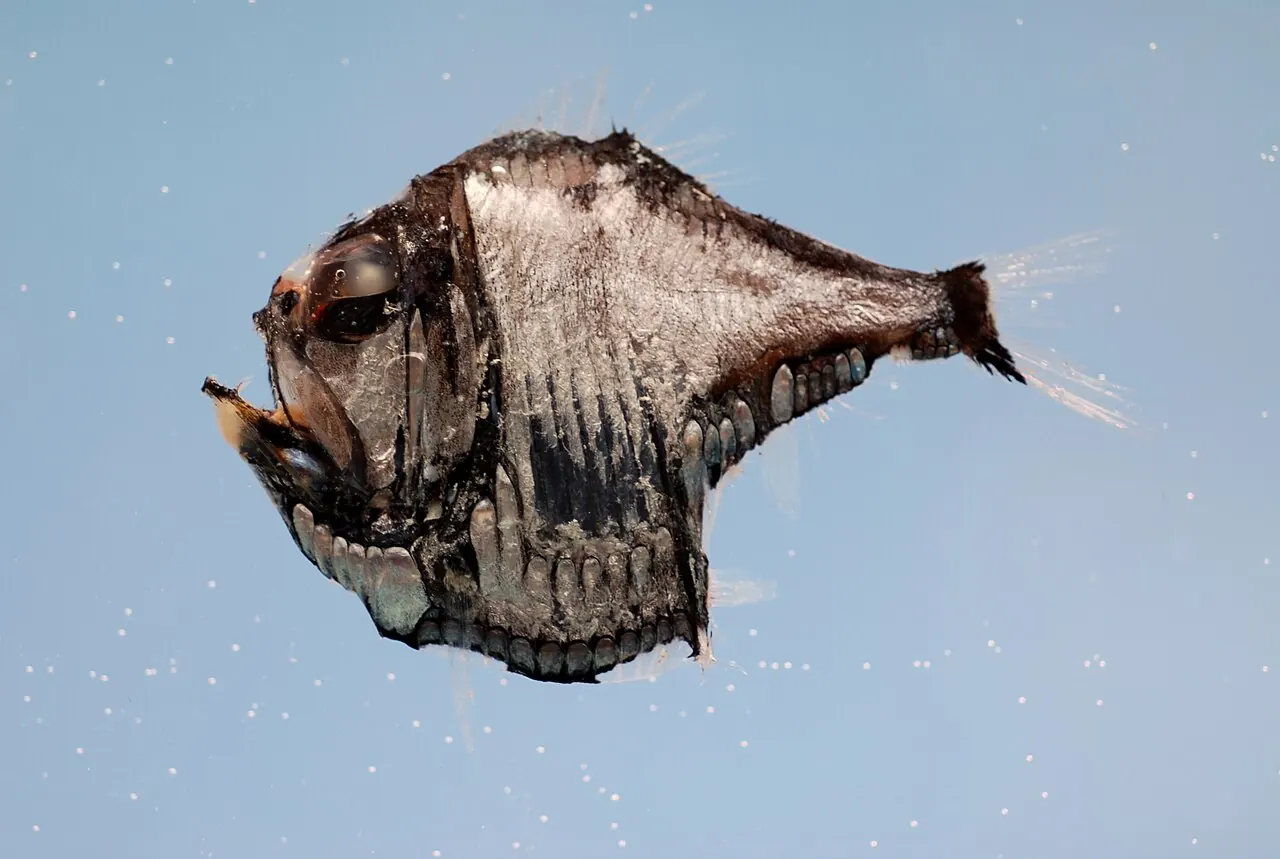
Marine Hatchetfish
Argyropelecus, Polyipnus and Sternoptyx (family Sternoptychidae)
Small, silvery twilight-zone fish shaped like a hatchet blade, with lights on the belly that hide their shadow from hunters below.
Photo: SEFSC Pascagoula Laboratory; Collection of Brandi Noble, NOAA/NMFS/SEFSC / Public domain
3 things to know
- A hatchetfish's belly lights erase its silhouette against the dim light from above.
- Some species rise toward the surface at night to feed; others stay at the same depth day and night.
- Marine hatchetfish are not related to the freshwater hatchetfish sold for home aquariums.
- Scientific name
- Argyropelecus, Polyipnus and Sternoptyx (family Sternoptychidae)
- Depth
- 100 m – 800 m
328 – 2,625 ft - Size
- About 2.8 to 12 cm (1.1 to 4.7 in), depending on species
- Weight
- A few grams; up to about 21 g (0.7 oz) recorded for the silver hatchetfish
- Lifespan
- Not well known; about 1 year reported for one species
- Diet
- Small crustaceans such as ostracods and copepods, plus fish larvae
- Where
- Tropical to temperate oceans worldwide
- IUCN status
- Varies by species
- Depth zones
- Sunlight · Twilight
Seen from the side, a marine hatchetfish is mostly belly. Its body is thin, deep and silvery, narrowing sharply to a small tail, which gives it the outline of a hatchet blade; the genus name Argyropelecus means silver axe. Big eyes point upward, the mouth turns down, and a row of light organs called photophores runs along the underside. Most species are only a few centimeters long. The Woods Hole Oceanographic Institution puts the range at 2.8 to 12 centimeters (1.1 to 4.7 inches) and counts seven species of Argyropelecus, four of Sternoptyx and 33 of Polyipnus. They are not related to the freshwater hatchetfish sold for home aquariums.
Hatchetfish live in the twilight zone of oceans worldwide. Some migrate every day. The silver hatchetfish, Argyropelecus aculeatus, gathers 300 to 600 meters (980 to 1,970 feet) down by day and rises to 100 to 300 meters (330 to 980 feet) at night, feeding at dusk mainly on tiny crustaceans called ostracods, along with copepods and crustacean and fish larvae. Sternoptyx diaphana does not migrate and is usually found 500 to 800 meters (1,640 to 2,620 feet) down both day and night. Lives may be short: FishBase gives a maximum reported age of one year for Argyropelecus hemigymnus, which spawns several batches of eggs in a season.
The belly lights are camouflage. Seen from below, any fish is a dark shape against the faint light from the surface, and photophores that match that light make the shadow disappear, a strategy called counterillumination. It only works if the brightness is right, and a fish cannot see its own belly. In 2020, Alexander Davis, Tracey Sutton, William Kier and Sönke Johnsen reported in Proceedings of the Royal Society B that every species they examined from this order of deep-sea fishes that can counterilluminate also has a small photophore aimed at its own eye, while two species that cannot counterilluminate lack one. In thin sections of a silver hatchetfish's head, they traced light from that photophore through a clear patch of tissue and the lens onto a separate part of the retina. The authors concluded it most likely serves as a built-in reference, letting the fish set its belly lights to match the light coming down.
The IUCN has assessed these three species as Least Concern: Argyropelecus aculeatus and Sternoptyx diaphana in 2014, and Argyropelecus hemigymnus in 2009.



