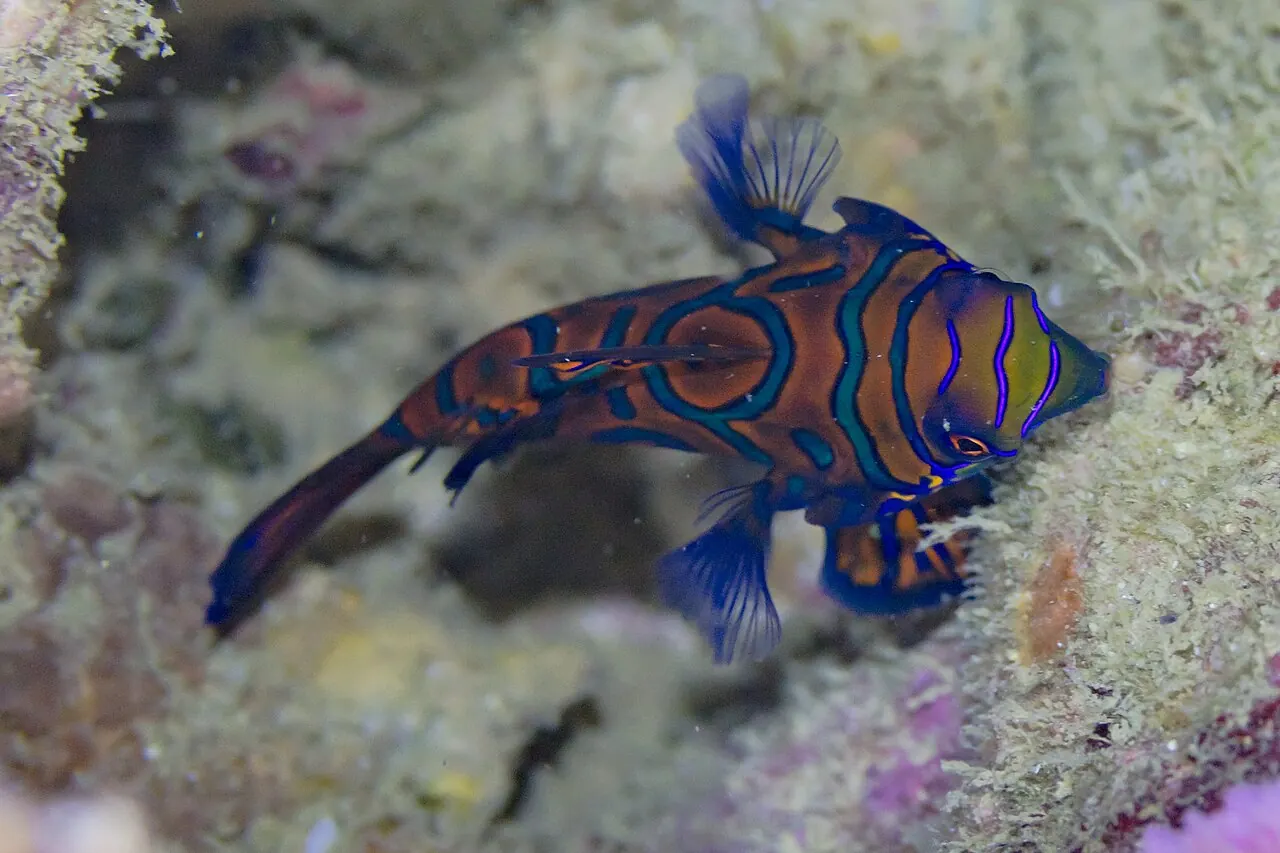
Mandarinfish
Synchiropus splendidus
A tiny, scaleless dragonet of western Pacific lagoons, one of the two fish in which blue pigment cells were first described.
Photo: Diego Delso / CC BY-SA 4.0
3 things to know
- It has no scales; its skin makes a smelly, foul-tasting mucus instead.
- Its blue comes from pigment cells called cyanophores, first described in 1995.
- A male can spawn up to eight times in one night.
- Scientific name
- Synchiropus splendidus
- Depth
- 1 m – 18 m
3 – 59 ft - Size
- Up to about 7 cm (2.8 in) long
- Weight
- Not well known
- Lifespan
- Not well known
- Diet
- Small bottom-dwelling invertebrates such as amphipods, isopods and small worms
- Where
- Western Pacific, from the Ryukyu Islands to Australia
- IUCN status
- Least Concern
- Depth zones
- Sunlight
Wavy bands of electric blue wind over an orange body on the mandarinfish, a dragonet that grows to only about 7 centimeters (under 3 inches). It lives in shallow, sheltered lagoons and inshore reefs of the western Pacific, from Japan's Ryukyu Islands to Australia, at depths of 1 to 18 meters (3 to 59 feet). It keeps to silty bottoms with coral and rubble, usually in small groups spread over a small patch of reef, and picks tiny animals such as amphipods, isopods and small worms off the bottom.
The fish has no scales. According to the Georgia Aquarium, its skin makes up for that with a mucus that smells bad, tastes foul and is toxic. That coating has not kept it out of the aquarium trade, where it is a well-known and commercially collected species. It has also been reared in captivity.
Its blue is made in an unusual way. Most blue in animals had been explained by iridophores, cells that make color by reflecting light, and no blue pigment cells had been reported in cold-blooded vertebrates. In 1995 Makoto Goda and Ryozo Fujii of Toho University in Japan found branching pigment cells packed with blue organelles in the blue skin of the mandarinfish and of its close relative, the psychedelic fish (Synchiropus picturatus). They named the cells cyanophores. In experiments the cells gathered or spread out their blue granules in response to different signals, which the authors suggested might let the fish shift its shade of blue.
Mandarinfish breed at night. In a 2022 study built on more than 400 hours of underwater surveys, Yvonne Sadovy de Mitcheson and colleagues found that pairs spawn together, with each female spawning once a night or not at all, while a male may spawn up to eight times in one night. In aquariums, pairs have been seen rising toward the surface in close contact to release eggs and sperm, and clutches recorded by other observers range from 12 to 205 eggs. Because individual fish can be told apart by their markings, the authors called the species an excellent model for studying small fish that spawn into open water.
The IUCN lists the mandarinfish as Least Concern, from a 2018 assessment.



