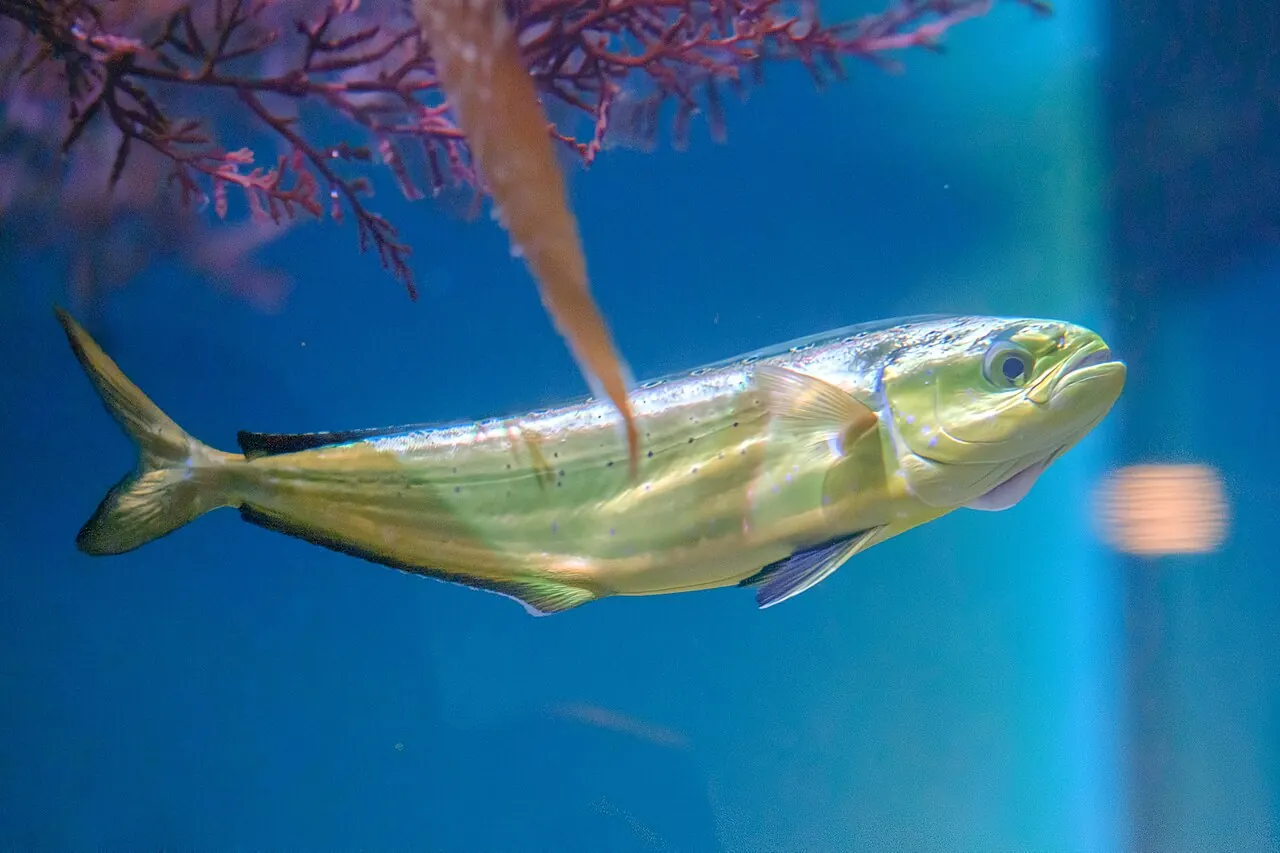
Mahi-Mahi
Coryphaena hippurus
A blunt-headed, green-and-gold surface hunter that matures within months, spawns every few days and rarely lives past five.
Photo: gendereuphorbia / CC0
3 things to know
- It can start reproducing at 4 to 5 months old.
- Mature males grow a tall bony crest on the forehead.
- Its bright colors fade almost immediately after it is caught.
- Scientific name
- Coryphaena hippurus
- Depth
- 0 m – 85 m
0 – 279 ft - Size
- Commonly about 1 m (3.3 ft); up to about 2 m (6.6 ft) long
- Weight
- Commonly about 14 kg (30 lb); the rod-and-reel record is 39.5 kg (87 lb)
- Lifespan
- Up to about 4 to 5 years
- Diet
- Small open-ocean fish such as flyingfish and young tunas, jacks and billfish, plus squid, crabs and other invertebrates
- Where
- Tropical and subtropical waters of the Atlantic, Indian and Pacific oceans, including the Gulf of Mexico, the Caribbean and the Mediterranean
- IUCN status
- Least Concern
- Depth zones
- Sunlight
Mahi-mahi grow up in a hurry. They can reproduce at 4 to 5 months old, at about 20 centimeters (8 inches) long, and are believed to spawn every 2 to 3 days through the season, releasing 33,000 to 66,000 eggs each time. They live only about 4 to 5 years. In that time a fish commonly reaches about 1 meter (3.3 feet) and 14 kilograms (30 pounds); the world rod-and-reel record is 39.5 kilograms (87 pounds).
The shape is unmistakable. A single dorsal fin runs from above the eye almost to the forked tail, and the head is blunt. Mature males grow a tall bony crest that gives them a square forehead, while females keep a rounded head. Alive, the fish is electric greenish blue on the back and gold or silver below, scattered with dark and light spots. NOAA says that pattern fades almost immediately after the fish is caught, and the Florida Museum describes it turning a uniform silver. It also goes by dolphin, dolphinfish and dorado. A close cousin, the pompano dolphinfish, has a deeper body.
Mahi-mahi live near the surface in tropical and subtropical seas worldwide, usually within the top 85 meters (280 feet). Young fish school, while larger ones travel alone or in pairs. Floating objects, natural and artificial, draw them in, and they sometimes follow large ships. In the Atlantic they gather under mats of Sargassum seaweed and spawn beneath them. They hunt by day, by sight. Adults eat mostly fish, and flyingfish make up about a quarter of their food by weight, along with young tunas, jacks and billfish, squid and crabs.
The Florida Museum calls them swift, agile predators. In a 2016 study off Mexico's Yucatán Peninsula, Morten Svendsen and colleagues measured how quickly swimming muscle can contract in freshly caught fish and used it to cap each species' top speed. Dorado came out at about 4 meters per second (9 mph), the lowest of the four species tested, behind sailfish, barracuda and little tunny.
About a third of the US commercial catch comes from the Atlantic, the Gulf of Mexico and the Caribbean, and most of the rest from Hawaii. The South Atlantic stock has not been formally assessed, so whether it is overfished is unknown, and in 2024 scientists began a management strategy evaluation for the US South Atlantic. The IUCN last assessed it in 2010, as Least Concern.



