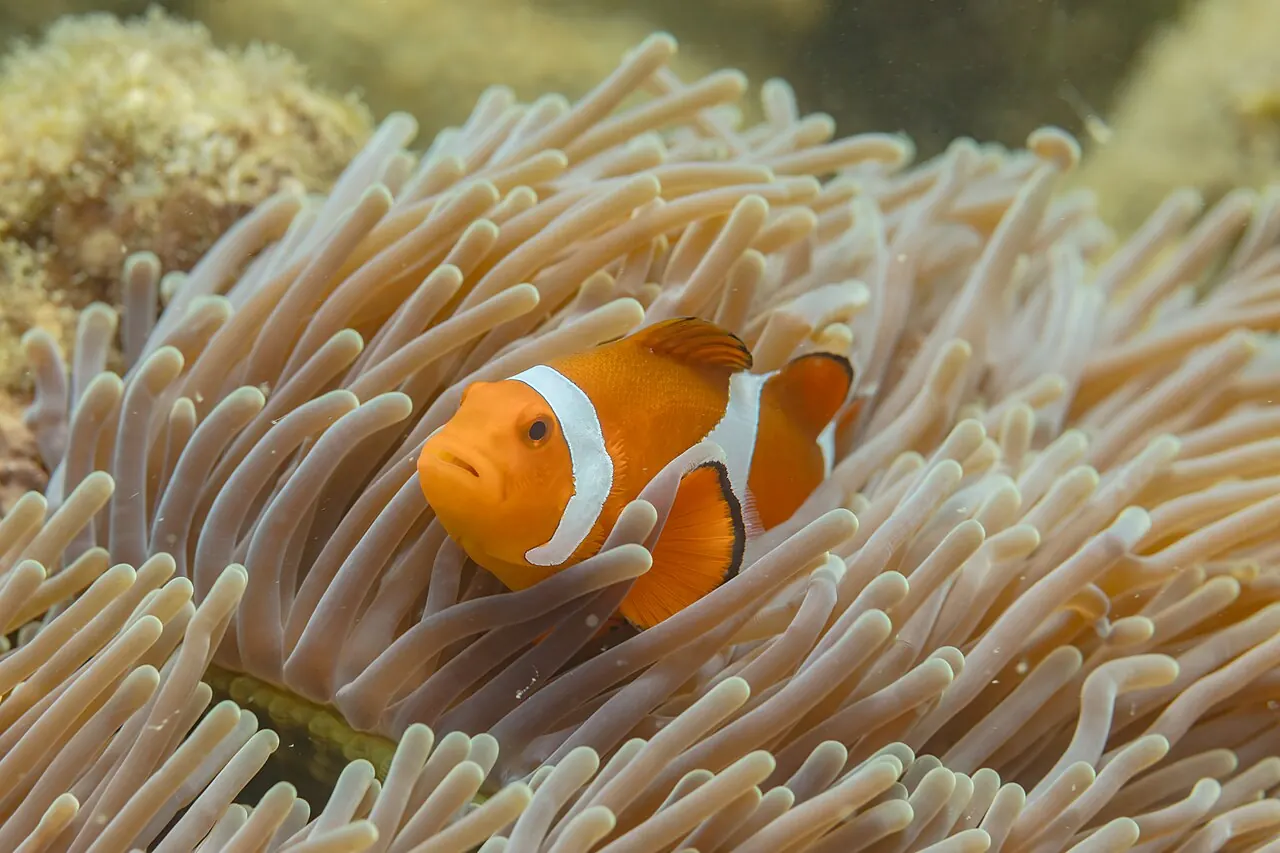
Magnificent Sea Anemone
Radianthus magnifica
A huge reef anemone that hosts clownfish in the open, and whose bleaching in a 2016 heat wave cut its clownfish's egg output by 73%.
Photo: Diego Delso / CC BY-SA 4.0
3 things to know
- It is one of only 10 sea anemone species that host clownfish.
- Its oral disc can reach 1 meter (3.3 feet) across.
- Clownfish living in bleached anemones produced 73% fewer viable eggs during a 2016 heat wave.
- Scientific name
- Radianthus magnifica
- Depth
- 1 m – 50 m
3 – 164 ft - Size
- Oral disc usually 30–50 cm (12–20 in) across, reported up to 1 m (3.3 ft)
- Weight
- Unknown
- Lifespan
- Unknown in the wild
- Diet
- Food made by algae in its tissues, plus small fish, shrimp, other small invertebrates and plankton caught with its tentacles
- Where
- Tropical Indo-Pacific, from the Red Sea to Samoa
- IUCN status
- Not Evaluated
- Depth zones
- Sunlight
Clownfish need a sea anemone to live in, and only 10 anemone species will do. The magnificent sea anemone is one of the biggest of them. Its flat oral disc is usually 30 to 50 centimeters (12 to 20 inches) across and can reach 1 meter (3.3 feet), ringed by tentacles about 7.5 centimeters (3 inches) long with blunt or slightly swollen tips. The column underneath is often brightly colored. It favors clear water with strong currents.
It lives on reefs of the tropical Indo-Pacific, from the Red Sea to Samoa, about 1 to 50 meters (3 to 160 feet) deep. Algae living in its tissues make sugars by photosynthesis that the anemone uses, and its stinging tentacles also catch small fish, shrimp, other small invertebrates and plankton. It can split lengthwise into two anemones. In the Seychelles, where it was the most common host anemone found by a Dutch expedition in 1992 and 1993, J. C. den Hartog wrote that its clones can cover patches a meter or more across.
Many clownfish live in it, including the clown anemonefish and the orange clownfish. For some it is nearly the only option: den Hartog noted that across its range, Amphiprion akallopisos has been recorded only with this anemone and one other, Stichodactyla mertensii.
Like corals, the anemone can bleach, losing its algae in hot water, and its fish pay a price. During the 2016 El Niño, water in the lagoon of Moorea, French Polynesia, warmed to a March average of 29.3°C (84.7°F), and about half of the anemones hosting orange-fin anemonefish there turned white. Ricardo Beldade, Suzanne Mills and colleagues had been checking 13 fish pairs every two days since October 2015. Pairs in bleached anemones spawned 51% less often and produced 73% fewer viable eggs than before, while pairs in unbleached anemones showed no change. The anemones began to recover four to five months after bleaching began.
Long known as Heteractis magnifica, it is now listed by the World Register of Marine Species as Radianthus magnifica, and in 2024 Benjamin Titus and colleagues revised the names of all 10 host anemones to reflect older changes that had never been widely adopted. It has not been assessed for the IUCN Red List.
Sources
- animaldiversity.org/accounts/Heteractis_magnifica
- biodiversity.org.au/afd/taxa/Actinia_magnifica
- sealifebase.se/summary/Heteractis-magnifica.html
- Study: doi:10.1098/rspb.2006.3758
- pmc.ncbi.nlm.nih.gov/articles/PMC1766375
- repository.naturalis.nl/pub/319315/ZM1997071017.pdf
- Study: doi:10.1038/s41467-017-00565-w
- pmc.ncbi.nlm.nih.gov/articles/PMC5634421
- Study: doi:10.11646/zootaxa.5506.1.1
- marinespecies.org/aphia.php
- pmc.ncbi.nlm.nih.gov/articles/PMC4196916
- api.gbif.org/v1/species/5184183/iucnRedListCategory



