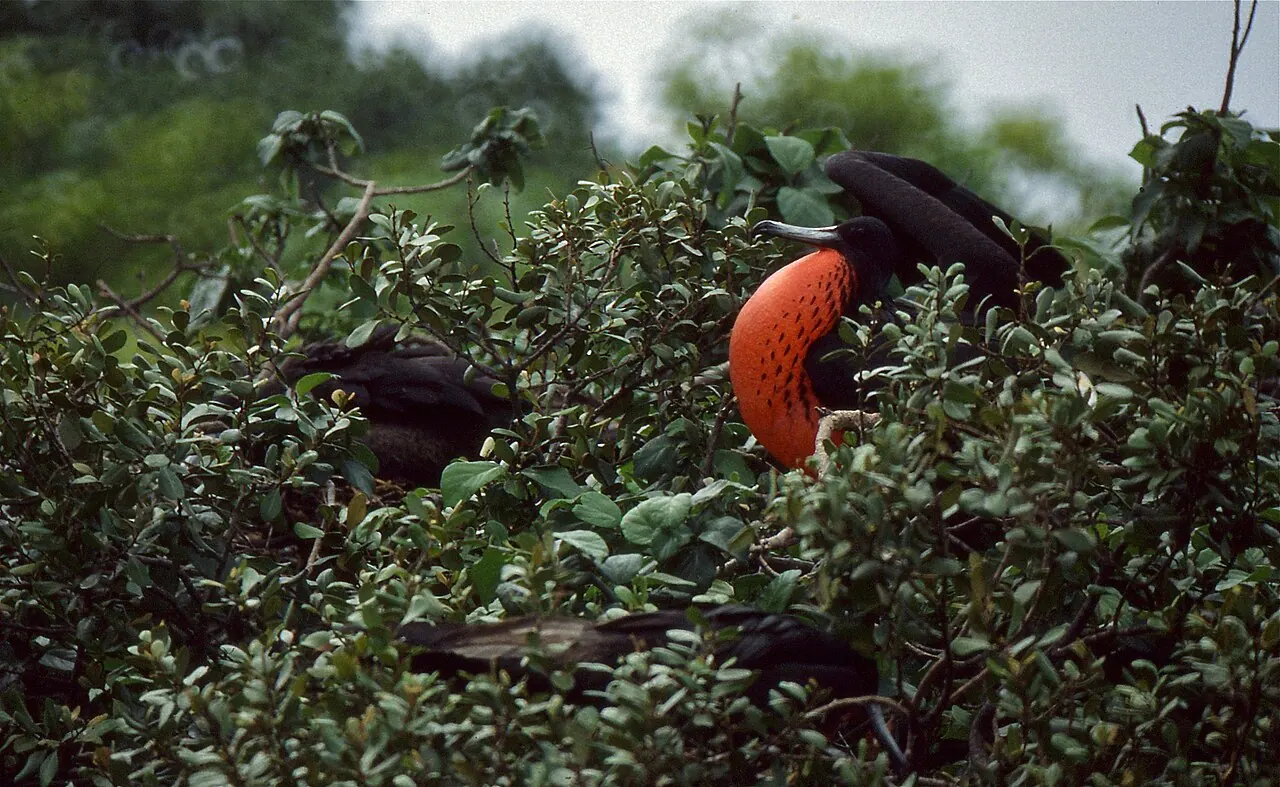
Magnificent Frigatebird
Fregata magnificens
A huge-winged tropical seabird that never swims, plucking food from the surface or stealing it, while males court with a scarlet throat balloon.
Photo: Bernard Dupont / CC BY-SA 2.0
3 things to know
- Males court females by inflating a scarlet throat pouch like a balloon.
- A female may keep feeding her young for 16 weeks or more after it first flies.
- Galápagos birds have probably been cut off from other magnificent frigatebirds for several hundred thousand years.
- Scientific name
- Fregata magnificens
- Depth
- At the surface
- Size
- About 1–1.2 m (3.4–3.8 ft) long, with a wingspan of 2.1–2.4 m (6.8–8 ft); females are larger than males
- Weight
- About 1.2–1.8 kg (2.6–4 lb); females are heavier than males
- Lifespan
- Not well known
- Diet
- Mainly small fish, plus squid, jellyfish and crustaceans; also food stolen from other seabirds
- Where
- Islands and coasts of tropical America, including Florida and the Galápagos; it no longer breeds in the Cape Verde Islands
- IUCN status
- Least Concern
- Depth zones
- Sunlight
This big tropical seabird is mostly black, with long, narrow, angular wings spanning up to 2.4 meters (8 feet), a long forked tail and a long, hooked bill, yet it weighs only about 1.2 to 1.8 kilograms (2.6 to 4 pounds). Females are larger than males and have a white chest. Males have a red throat pouch, and perched in groups they inflate it into a huge balloon to attract females flying overhead. Each female chooses one male as her mate.
Audubon's field guide notes that it never swims. It feeds by swooping low and snatching fish, squid and other prey from on or near the surface, barely touching the water. It also steals, chasing other seabirds until they drop or cough up their catch. On September 29, 1492, sailing west, Columbus wrote in his journal of a man-o'-war bird that makes boobies vomit what they have swallowed, adding that there are many of them at the Cape Verde Islands.
Its nesting colonies are scattered among the islands and coasts of tropical America, including the Galápagos. Its breeding population in the Cape Verde Islands, off West Africa, has died out. In the United States it is seen most often in Florida, though nesting there was not confirmed until the late 1960s, on the Marquesas Keys, and at the Dry Tortugas it began only in 1988.
A pair builds a flimsy stick platform in a tree or bush and raises a single white egg. Both parents incubate, but the male leaves after about 12 weeks. The female carries on alone: the chick first flies at 20 to 24 weeks, and she may keep feeding it for another 16 weeks or more.
Because frigatebirds travel so far, Frank Hailer and colleagues expected genes to flow freely between colonies, and across most of the range they did, even across the Isthmus of Panama, a major barrier for other tropical seabirds. The Galápagos birds were the exception: genetically and physically distinct, and probably isolated for several hundred thousand years. The IUCN lists the species as Least Concern, in a 2020 assessment, but Hailer's team puts the Galápagos population at only about 1,000 pairs.



