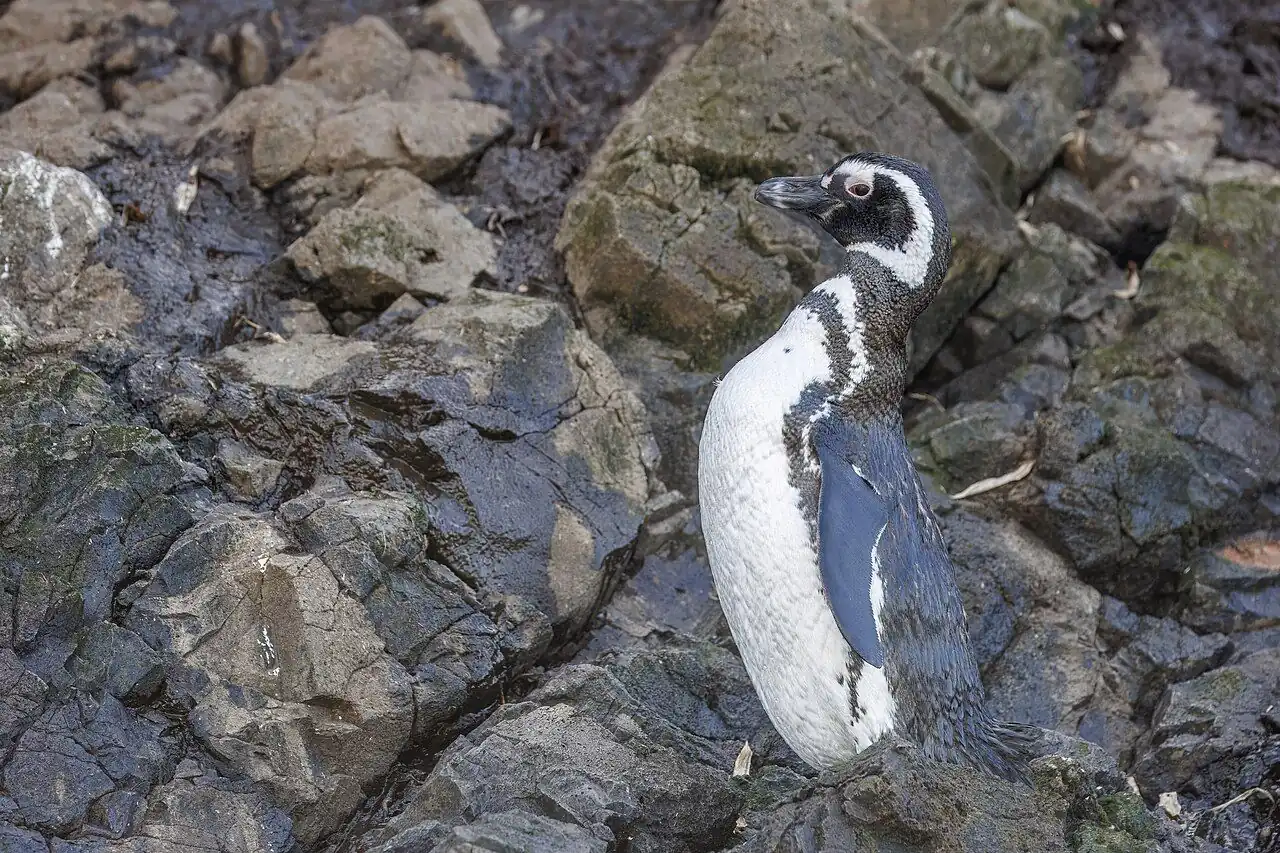
Magellanic Penguin
Spheniscus magellanicus
A burrow-nesting penguin of Argentina, Chile and the Falklands, studied at Punta Tombo since 1982, where a 2019 heat wave killed hundreds.
Photo: Charles J. Sharp / CC BY-SA 4.0
3 things to know
- Adults have two black bands across the chest; juveniles have one.
- In the 1980s and early 1990s, oil pollution was estimated to kill more than 20,000 adults and 22,000 juveniles a year off Argentina.
- On January 19, 2019, a shade temperature of 44°C (111°F) at Punta Tombo killed at least 354 penguins.
- Scientific name
- Spheniscus magellanicus
- Depth
- 0 m – 86 m
0 – 282 ft - Size
- Stands about 61–76 cm (24–30 in) tall
- Weight
- About 3.8–6.5 kg (8.4–14.3 lb), changing with the season
- Lifespan
- About 10 years on average in the wild, some to 20, according to the Aquarium of the Pacific
- Diet
- Small schooling fish such as anchovies, plus squid and crustaceans
- Where
- Atlantic and Pacific coasts of southern South America and the Falkland Islands; in winter, north to Uruguay and southern Brazil
- IUCN status
- Least Concern
- Depth zones
- Sunlight
Look at the chest: an adult Magellanic penguin has two black bands across it, where juveniles have one. A white stripe starts at each eye and arches back along the side of the head, and the two meet above the neck. Adults stand 61 to 76 centimeters (24 to 30 inches) tall, males are a little larger than females, and weight swings with the season, from about 3.8 to 6.5 kilograms (8.4 to 14.3 pounds).
The species breeds on both coasts of southern South America and in the Falkland Islands, nesting in burrows or under bushes in dense colonies. BirdLife International estimates 1.1 to 1.6 million pairs, about 900,000 of them along the coast of Argentina. In winter, most Atlantic birds swim north to northern Argentina, Uruguay or southern Brazil. They hunt fish such as anchovies, along with squid and crustaceans, and dive up to almost 100 meters (330 feet), though usually to a few dozen. In a 2012 study of 31 birds from four Argentine colonies, Juan Sala and colleagues recorded a deepest dive of 85.5 meters (281 feet), with an average of about 20 meters (64 feet).
At Punta Tombo, on Argentina's southern coast, University of Washington researchers under P. Dee Boersma have followed the colony since 1982. In 2009 Boersma reported that parents often had to swim about 25 miles (40 kilometers) farther for food than a decade before, and BirdLife puts the colony's decline at 40 percent since 1987. Oil was an earlier killer: in the 1980s and early 1990s, pollution was estimated to kill more than 20,000 adults and 22,000 juveniles a year along the Argentine coast.
Heat is a newer one. On January 19, 2019, the shade temperature at Punta Tombo hit 44°C (111.2°F), the highest the team had recorded there. Katie Holt and Boersma counted at least 354 dead penguins: 264 adults, many probably dehydrated, and 90 chicks. Just over a quarter of the dead adults lay on the paths between the colony and the sea, a walk that can stretch to a kilometer.
The IUCN lists the Magellanic penguin as Least Concern in its 2020 assessment, judging the overall population stable or declining slowly, by less than 10 percent over three generations.
Sources
- datazone.birdlife.org/species/factsheet/magellanic-penguin-spheniscus-magellanicus
- iucnredlist.org/species/22697822/157428850
- animaldiversity.org/accounts/Spheniscus_magellanicus
- aquariumofpacific.org/onlinelearningcenter/species/magellanic_penguin
- seaworld.org/animals/facts/birds/magellanic-penguin
- Study: doi:10.1371/journal.pone.0051487
- washington.edu/news/2022/01/04/magellanic-penguin-heat-wave
- Study: doi:10.1093/ornithapp/duab052
- washington.edu/news/2009/02/12/changing-ocean-conditions-turning-penguins-into-long-dis…



