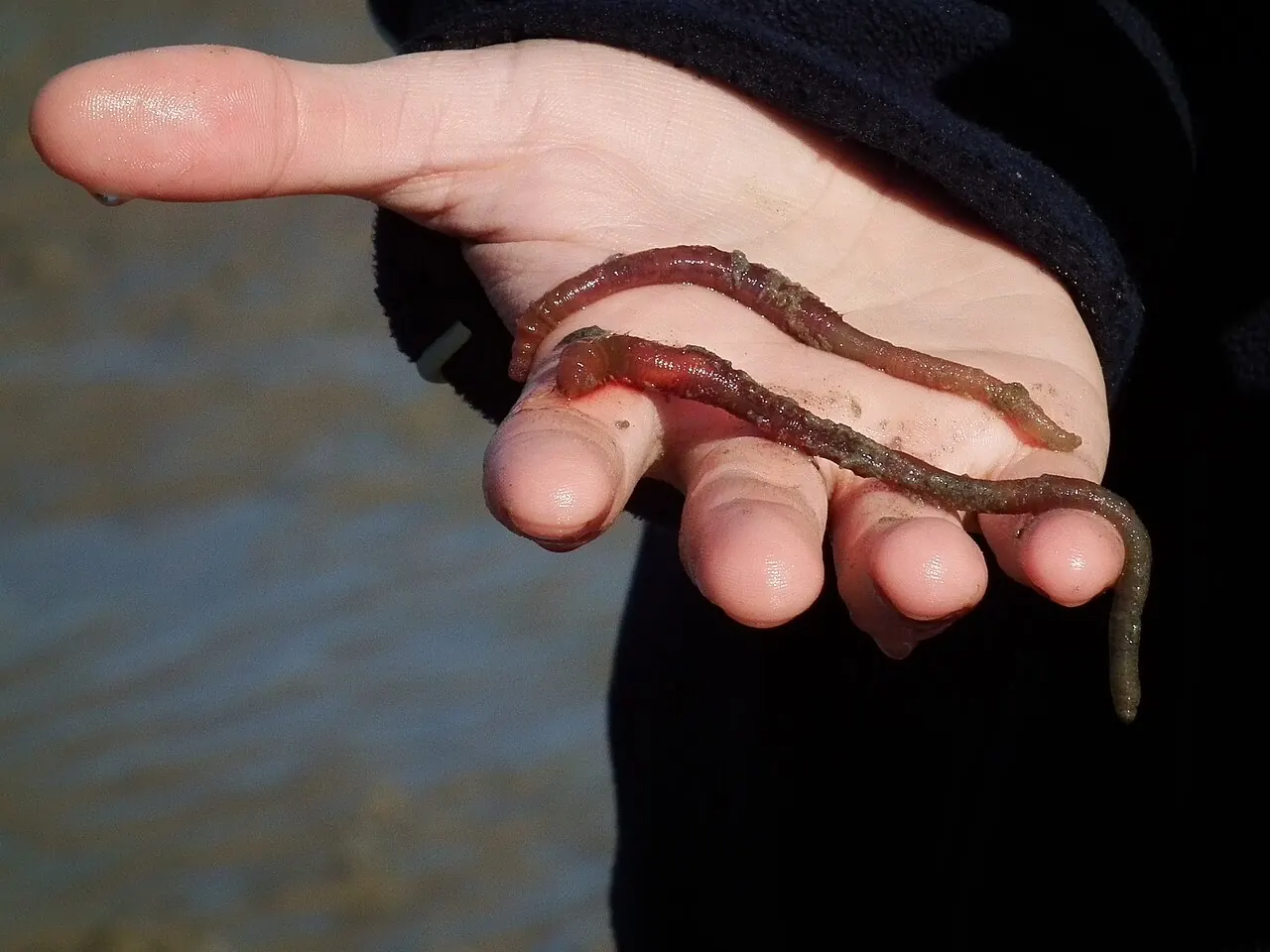
Lugworm
Arenicola spp. (family Arenicolidae)
A sand-swallowing worm that leaves casts of cleaned sand on beaches at low tide. Its blood pigment has been tested in preserving donor kidneys.
Photo: 4028mdk09 / CC BY-SA 3.0
3 things to know
- The northern lugworm lives in a U- or J-shaped burrow 20 to 40 cm (8 to 16 in) deep.
- Thirteen of its front segments carry bushy gills.
- A review co-written by its maker, Hemarina, says its hemoglobin can carry up to 156 oxygen molecules, against 4 for human hemoglobin.
- Scientific name
- Arenicola spp. (family Arenicolidae)
- Depth
- 0 m – 2 m
0 – 7 ft - Size
- Northern lugworm adults 12–20 cm (5–8 in) long
- Weight
- Not well known
- Lifespan
- Not well known; MarLIN gives 5–10 years for the northern lugworm, SeaLifeBase a maximum reported age of 2 years
- Diet
- Detritus and microbes in the sand and mud it swallows
- Where
- Sandy and muddy shores; the northern lugworm in northwest Europe and, in the western Atlantic, from Greenland and the Bay of Fundy to Long Island; the southern lugworm in the western central Atlantic, eastern Pacific and Mediterranean
- IUCN status
- Not Evaluated (northern and southern lugworms)
- Depth zones
- Sunlight
Those little heaps of sand on a beach at low tide are often lugworm casts. Lugworms are segmented worms that live in burrows and swallow sediment, digesting the detritus and microbes in it and leaving the cleaned sand on the surface. The best known, the northern lugworm Arenicola marina of European shores, grows 12 to 20 centimeters (5 to 8 inches) long and can be pink, red, green, dark brown or black. Its front section has 19 segments, and the last 13 of them carry bushy gills.
According to Britain's Marine Life Information Network (MarLIN), the northern lugworm digs a U- or J-shaped burrow 20 to 40 centimeters (8 to 16 inches) deep in sand or muddy sand, from about the high-water mark of neap tides down to the middle or lower shore. It lives on all coasts of Britain and Ireland and widely in northwest Europe; SeaLifeBase adds subtidal flats. A warmer-water relative, the southern lugworm A. cristata, is listed by SeaLifeBase from the western central Atlantic, the eastern Pacific and the Mediterranean, at 0 to 2 meters (7 feet), the only depth figure we found for either species.
Northern lugworms usually spawn in late autumn or early winter, sometimes in early spring, and they mature by their second year. MarLIN gives a lifespan of 5 to 10 years, while SeaLifeBase lists a maximum reported age of only 2. MarLIN notes that mechanical dredging for bait in the Dutch Wadden Sea caused a gradual, substantial local decline over four years. Neither the northern nor the southern lugworm has been assessed by the IUCN.
The worm's blood has also been tried in hospitals. The French company Hemarina makes an oxygen carrier, M101, from its hemoglobin. A 2021 review co-written by Hemarina scientists says this hemoglobin floats free in the blood rather than in cells, and that each molecule can carry up to 156 oxygen molecules, compared with 4 for human hemoglobin. In a trial at six French transplant centers, published in 2020 by Yannick Le Meur and colleagues, M101 was added to the storage fluid for one of the two kidneys from each of 58 donors. No immune, allergic or clotting problems were reported, and in secondary measures those kidneys were less often slow to start working after transplant. The review adds that M101 preserved the graft for a full-face re-transplant in January 2018.
Sources
- marlin.ac.uk/species/detail/1402
- sealifebase.se/summary/Arenicola-marina.html
- sealifebase.se/summary/Arenicola-cristata.html
- Study: doi:10.3390/md19070376
- Study: doi:10.1111/ajt.15798
- Study: doi:10.1142/s2972497x24200013
- api.gbif.org/v1/species/5197443/iucnRedListCategory
- api.gbif.org/v1/species/5197465/iucnRedListCategory



