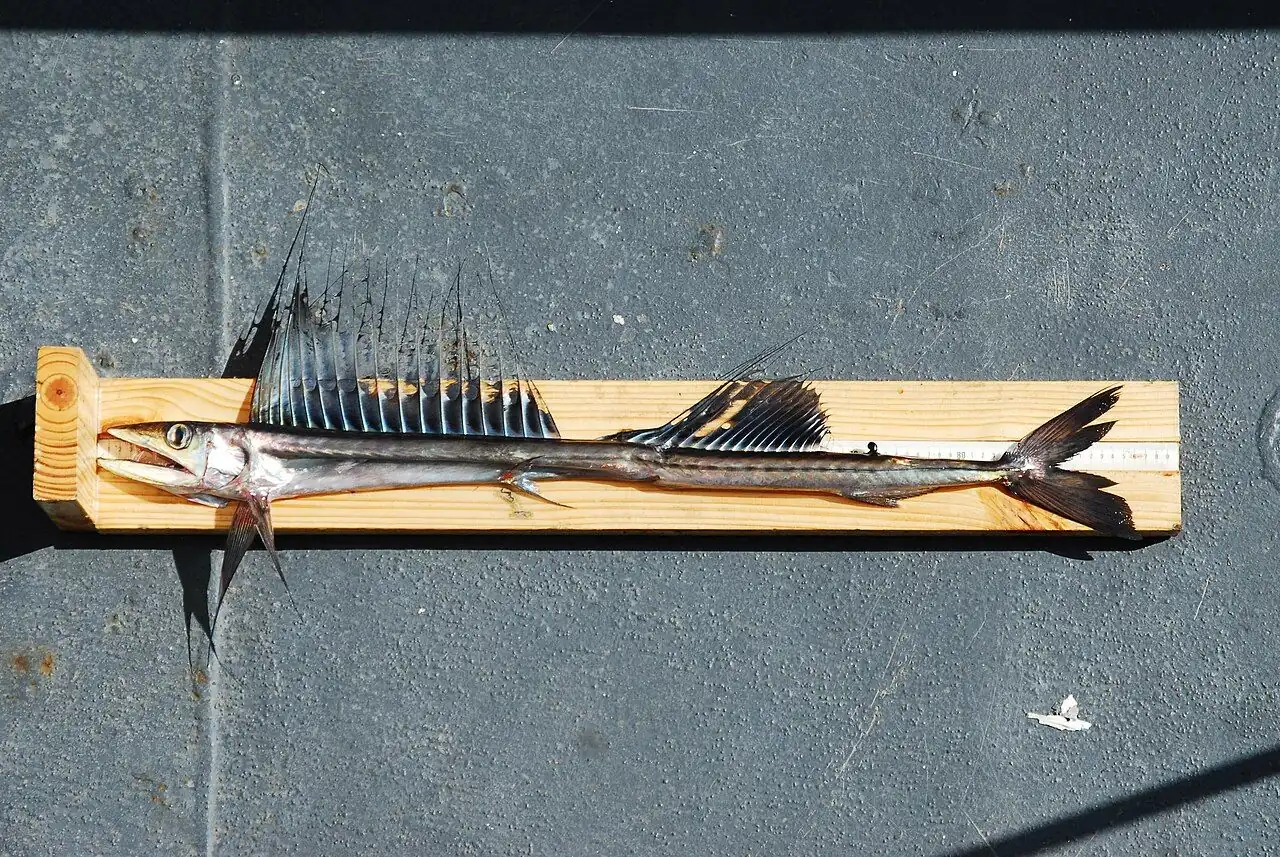
Longnose Lancetfish
Alepisaurus ferox
A fanged, sail-finned predator of the open ocean whose barely digested meals help NOAA scientists study the midwater food web.
Photo: NOAA's Fisheries Collection / Public domain
3 things to know
- Prey in its stomach is often barely digested, so scientists use it to sample midwater animals.
- In one NOAA study, nearly a quarter of the lancetfish sampled had eaten plastic.
- Researchers have found lancetfish inside lancetfish that were themselves inside other lancetfish.
- Scientific name
- Alepisaurus ferox
- Depth
- 0 m – 1,000 m
0 – 3,281 ft - Size
- Up to about 2 m (6.6 ft) long
- Weight
- Up to about 9 kg (20 lb)
- Lifespan
- Unknown
- Diet
- Fishes, squids and other cephalopods, crustaceans, tunicates, and other lancetfish
- Where
- Open ocean worldwide except the polar seas; adults may travel north to Greenland, Iceland and the Bering Sea
- IUCN status
- Least Concern
- Depth zones
- Sunlight · Twilight
Long and slender, the longnose lancetfish carries a towering, spiny sail of a dorsal fin along most of its back, a big mouth armed with fangs, and soft, watery flesh. NOAA Fisheries gives its length as up to 2 meters (6.6 feet), and FishBase lists a maximum weight of 9 kilograms (20 pounds). It is pale and iridescent, darker on the back, with dark brown or black fins. The genus name, Alepisaurus, comes from Greek words for "without scales" and "lizard."
Lancetfish live in the open ocean worldwide except the polar seas, from near the surface to below 1,000 meters (3,300 feet), and FishBase records them as deep as 1,830 meters (6,000 feet). They are mainly tropical and subtropical, but adults may move north to feed as far as Greenland, Iceland and the Bering Sea. In the western Atlantic they range from the Gulf of Maine to the Gulf of Mexico and the Caribbean. Each fish is a synchronous hermaphrodite, with separate ovary and testis regions in the same gonad.
Longline crews catch them by accident, and in the North Pacific sometimes land more lancetfish than the bigeye tuna or swordfish they are after. Few keep them: NOAA says they are not very tasty and their gelatinous flesh is unsuited to local cuisine.
Prey inside a lancetfish is often barely digested, so researchers at NOAA's Pacific Islands Fisheries Science Center, building on diet studies by oceanographer Anela Choy, collect stomachs through observers on longline boats in Hawaii. The contents give a sample of the small fish, squid and crustaceans in the middle of the food web, animals that research trawls often miss, and preliminary results counted prey from 97 families. The stomachs hold plastic, too, from bags and twine to straws and bottles. Lesley Hawn of NOAA's Pacific Islands Regional Office found that nearly a quarter of lancetfish sampled had eaten some, mostly fragments. One piece of black plastic bag was about the size of a kitchen towel.
Lancetfish also eat one another. The NOAA team has found lancetfish in lancetfish stomachs, and lancetfish inside those swallowed lancetfish as well. The IUCN lists the species as Least Concern, in an assessment from 2009.



