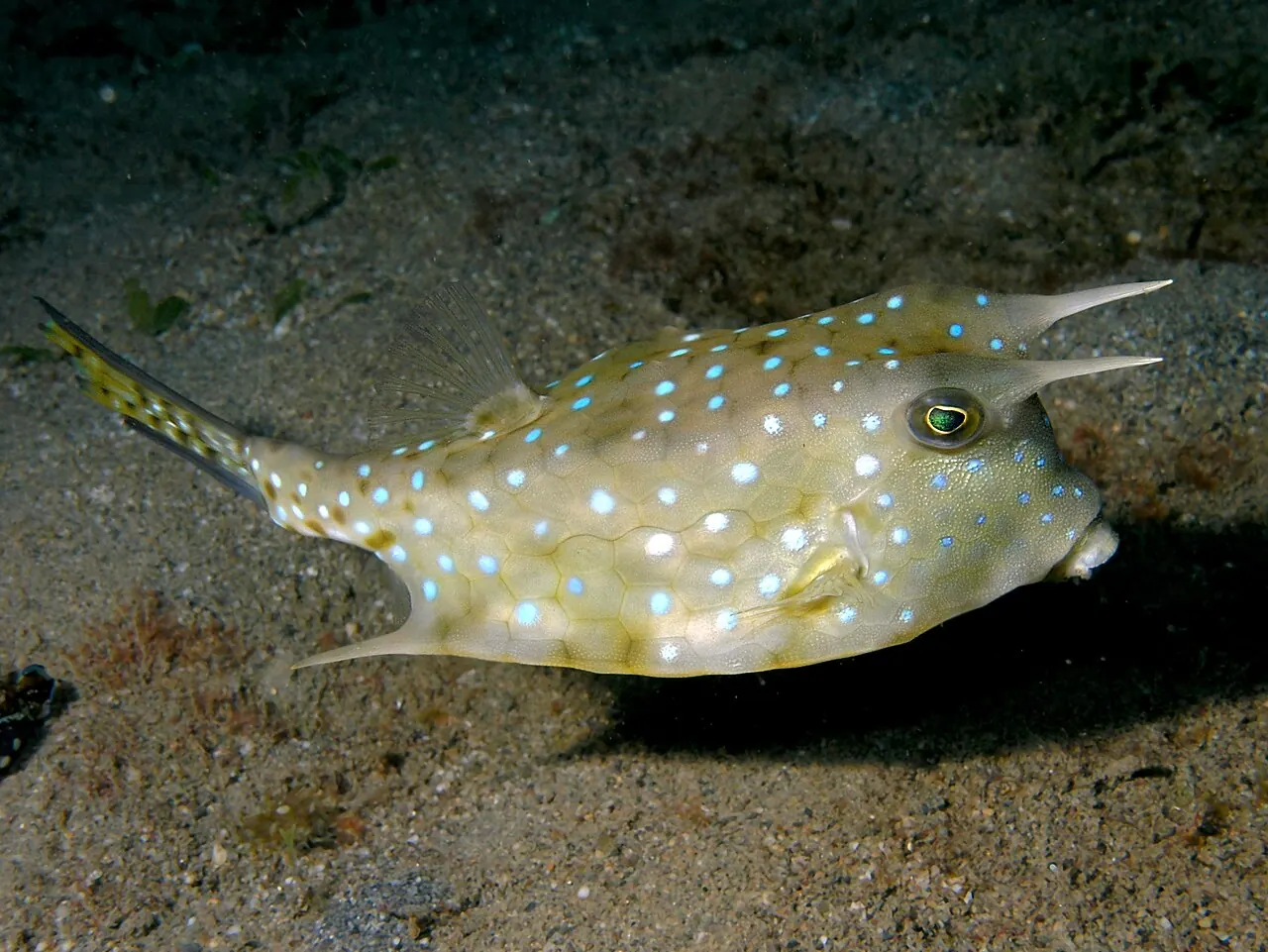
Longhorn Cowfish
Lactoria cornuta
A horned, armor-plated boxfish of sandy bays and harbors that blows water jets to dig up prey and hums and clicks with its swim bladder.
Photo: Nick Hobgood / CC BY-SA 3.0
3 things to know
- Two long horns point forward from its head and two more point back from the rear of its armor.
- It hunts by blowing jets of water into the sand to expose small animals.
- It makes two kinds of sound, long hums and short clicks.
- Scientific name
- Lactoria cornuta
- Depth
- 1 m – 50 m
3 – 164 ft - Size
- Up to about 46 cm (18 in) long
- Weight
- Unknown
- Lifespan
- Unknown
- Diet
- Small bottom-living invertebrates, which it uncovers by blowing jets of water into the sand
- Where
- Indo-Pacific from the Red Sea and East Africa to the Marquesas and Tuamotu islands, north to southern Japan and south to Lord Howe Island
- IUCN status
- Least Concern
- Depth zones
- Sunlight
Long spines stick straight out from the front of the longhorn cowfish's head like a pair of horns, and a second pair points backward from the lower rear of its body. In between is a rigid box of bony armor. Its color varies from green or olive to pale yellow or orange, with blue spots, and it can grow to about 46 centimeters (18 inches).
It lives across the Indo-Pacific, from the Red Sea and East Africa to the Marquesas and Tuamotu islands. It favors muddy and sandy bottoms in calm bays, and it is common in harbors and estuaries, usually in less than 50 meters (164 feet) of water, though FishBase lists records to 100 meters (328 feet). Juveniles often gather in small groups near river mouths and in brackish water. Adults live alone and grow shy as they get large. To feed, a cowfish blows jets of water at the sand, washing away the cover from small invertebrates hidden underneath.
Its armor grows in an unusual way. In a 2022 study, Lennart Eigen and colleagues scanned longhorn cowfish of many sizes with high-resolution micro-CT and counted the hundreds of bony plates, called scutes, that cover each fish. The number of scutes stayed about the same from small fish to large ones. Instead of adding plates, each scute grew larger, thicker and especially wider. The team argued that because a box is made mostly of flat surfaces, the fish can grow its armor simply by adding material at the edges of each plate.
The cowfish is not silent, either. A 2020 study led by Eric Parmentier found that it makes two kinds of sound, long, quiet hums and short, louder clicks, using two separate pairs of muscles attached to its swim bladder. It hears best at frequencies between at least 100 and 400 hertz, which covers the sounds other cowfish make.
Dried cowfish are sold as ornaments, live ones are collected for aquariums, and there are reports of ciguatera poisoning from eating it. The IUCN lists the longhorn cowfish as Least Concern, from a 2023 assessment.



