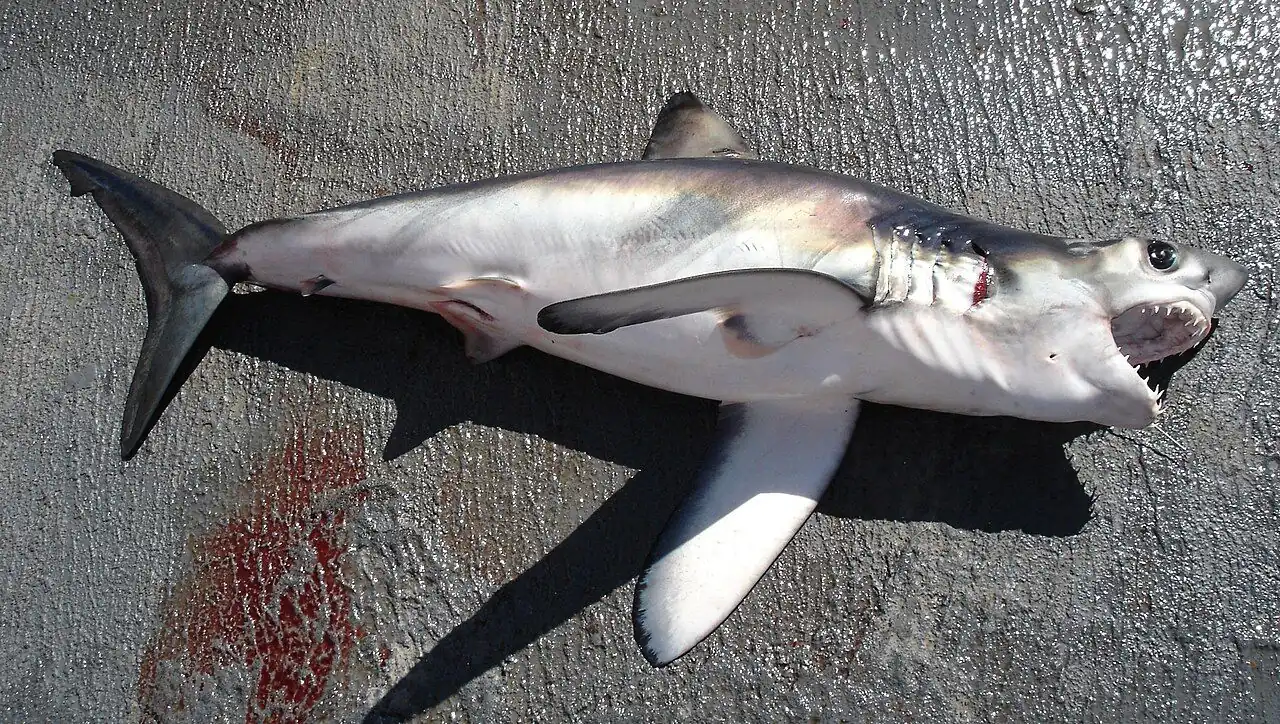
Longfin Mako
Isurus paucus
A rare, little-known open-ocean relative of the shortfin mako, with long, broad pectoral fins and only 2 to 8 pups per litter.
Photo: Allen Shimada (NOAA) / Public domain
3 things to know
- Its pectoral fins are as long as its head or longer, with broad, rounded tips.
- A litter holds only 2 to 8 pups, each roughly 1 to 1.35 m (3.2 to 4.4 ft) long at birth.
- Keeping a longfin mako is prohibited in US Atlantic commercial shark fisheries.
- Scientific name
- Isurus paucus
- Depth
- 0 m – 500 m
0 – 1,640 ft - Size
- Commonly about 2 m (6.6 ft) long; up to about 4.3 m (14 ft)
- Weight
- Not well known
- Lifespan
- Unknown
- Diet
- Thought to be schooling fishes and open-ocean squid; deep-water squid have been found in its stomach
- Where
- Patchy in tropical and temperate oceans, including the Gulf Stream off Florida and north of Hawaii; also Cuba, West Africa, Madagascar and Taiwan
- IUCN status
- Endangered
- Depth zones
- Sunlight · Twilight
Its pectoral fins give the longfin mako its name: they are as long as its head or longer, and broad and rounded at the tips. In most other ways it resembles its better-known relative, the shortfin mako: a slender, torpedo-shaped body, a conical snout, a crescent tail with a strong keel at its base and lower teeth that stick out of the mouth. Its back is dark slate-blue or gray-black and its belly white, but in adults and large juveniles the underside of the snout and jaw is dark, unlike the white mouth area of the shortfin. Adults are commonly about 2 meters (6.6 feet) long, and the largest are believed to reach about 4.3 meters (14 feet).
The Florida Museum notes that little is known about its habits. It is often seen at the surface, but deep-water squid in its stomach hinted at a much wider depth range. In a 2017 paper, Robert Hueter of Mote Marine Laboratory and colleagues tracked two mature males tagged in the Gulf of Mexico and off Cuba. They stayed shallower at night and deeper by day, spent 42 to 54 percent of their time below 200 meters (660 feet), and one reached 1,767 meters (5,797 feet). It probably eats schooling fish and open-ocean squid. Like other members of its family, it has heat-exchanging blood vessels that keep its muscles, eyes, brain and gut warmer than the surrounding water.
Records are scattered, from the Gulf Stream off Florida and Cuba, where it was first described, to Brazil, West Africa, Madagascar, Taiwan and north of Hawaii.
The embryos eat unfertilized eggs inside the mother, and a litter holds only 2 to 8 pups, each roughly 1 to 1.35 meters (3.2 to 4.4 feet) long at birth, bigger than newborn shortfin makos. Females mature at more than 3 meters (10 feet). How long the species lives, and how long a pregnancy lasts, are unknown. The Florida Museum gives an estimated population doubling time of more than 14 years.
Longfin makos are taken as bycatch in heavily fished open-ocean fisheries aimed at tunas, shortfin makos and other sharks, and adult fins and jaws are valuable. The IUCN's 2018 assessment lists the species as Endangered, with a decreasing population. International trade is monitored under CITES Appendix II, and in US Atlantic commercial shark fisheries, any longfin mako caught must be released.
Sources
- floridamuseum.ufl.edu/discover-fish/species-profiles/isurus-paucus
- fishbase.se/summary/Isurus-paucus.html
- fisheries.noaa.gov/atlantic-highly-migratory-species/commercial-atlantic-shark-fishery-…
- Study: doi:10.7755/FB.115.1.9
- iucnredlist.org/species/60225/3095898
- api.gbif.org/v1/species/5216258/iucnRedListCategory



