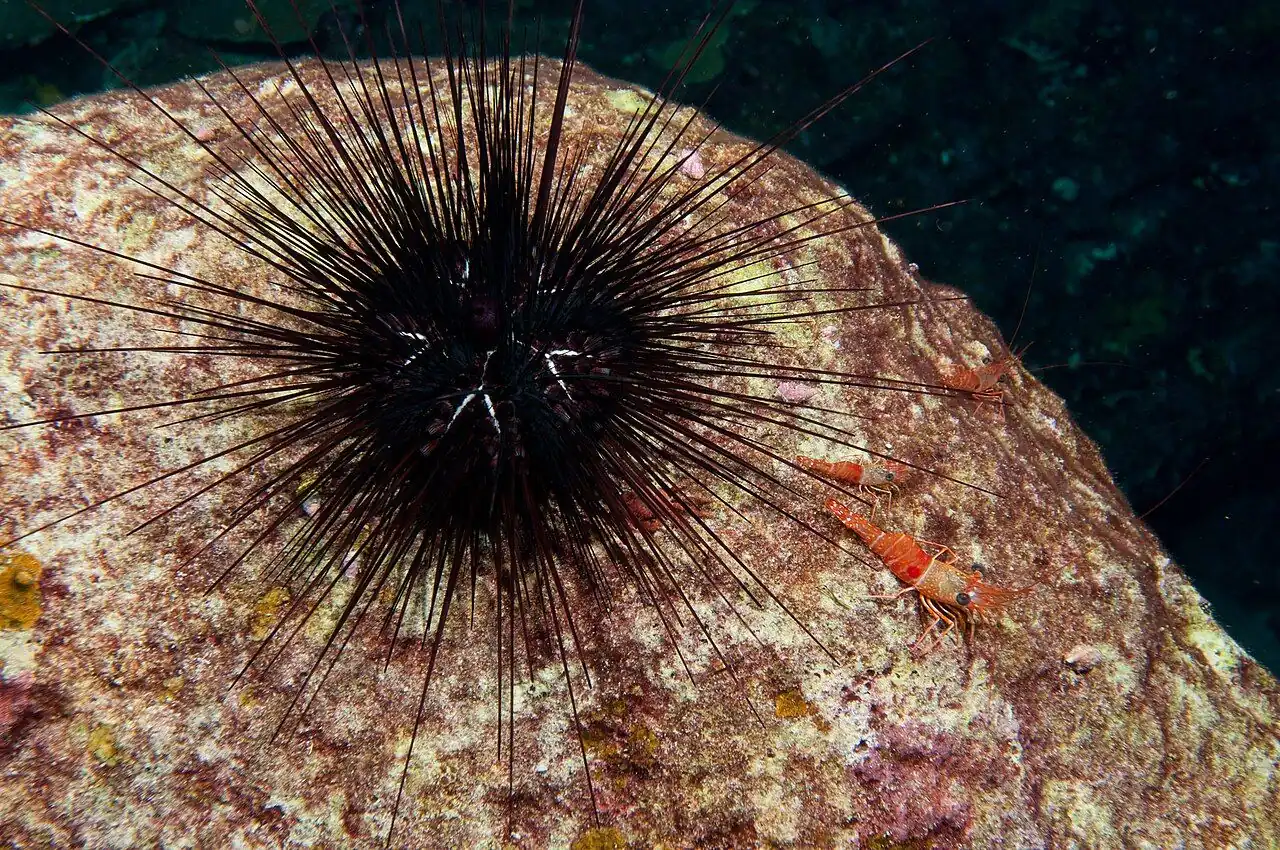
Long-spined Sea Urchin
Diadema antillarum
A black Caribbean urchin with very long spines whose grazing keeps algae off reefs; most died in 1983, and a second die-off began in 2022.
Photo: NOAA (Flower Garden Banks National Marine Sanctuary) / Public domain
3 things to know
- Its spines can reach about 30 cm (12 in), roughly four times the width of its shell.
- A 1983 to 1984 die-off killed most of these urchins across the Caribbean, Florida and Bermuda.
- A second die-off that began in 2022 was traced to a single-celled parasite called a scuticociliate.
- Scientific name
- Diadema antillarum
- Depth
- 0 m – 50 m
0 – 164 ft - Size
- Shell up to about 10 cm (4 in) across; spines can reach about 30 cm (12 in)
- Weight
- Unknown
- Lifespan
- About 4 to 6 years, according to the Aquarium of the Pacific
- Diet
- Algae scraped from coral reefs and rocks, mostly at night
- Where
- Western Atlantic from Florida and the Gulf of Mexico through the Caribbean to Brazil; also Madeira, the Canary Islands and the Gulf of Guinea
- IUCN status
- Not Evaluated
- Depth zones
- Sunlight
Over a single week in July 1983, the long-spined sea urchins on Florida Keys reefs were all dead or dying, marine biologist Martin Moe wrote in 2012. The die-off had first been noticed in Panama that January, and by January 1984 it had spread across the Caribbean and to Bermuda. H. A. Lessios and his co-authors found that its spread mostly matched major surface currents and suggested a waterborne pathogen, calling it the most extensive epidemic documented in a marine invertebrate. The University of Florida puts the loss at about 97% of the Caribbean's Diadema.
The animal is hard to mistake. Its black shell can reach 10 centimeters (4 inches) across, and the Aquarium of the Pacific says the spines can extend about 30 centimeters (12 inches), up to four times the width of the shell. It reacts to shadows, hides in crevices by day and comes out at night to scrape algae off reefs and rocks with five teeth. It lives from Florida and the Gulf of Mexico through the Caribbean to Brazil, and on eastern Atlantic islands such as Madeira and the Canary Islands. It is common in shallow water and found on reefs to about 50 meters (164 feet), with rare records as deep as 400 meters (1,312 feet).
That grazing matters to corals. In a 2016 review, Lessios, of the Smithsonian Tropical Research Institute, wrote that losing the urchin contributed to Caribbean reefs shifting from coral to algae, and that populations had recovered on average to only about 12% of their former density. Then a second mass die-off began in January 2022. A team led by Ian Hewson of Cornell University traced it to a scuticociliate, a single-celled parasite most similar to Philaster apodigitiformis, and confirmed the cause by infecting healthy urchins in the lab.
Restoration efforts are under way in Florida. University of Florida researchers working at The Florida Aquarium raised 100 juveniles in June 2019, a hard job because the larvae take 40 days or more to develop, and that December the partners signed on to breed the urchins for NOAA's Mission: Iconic Reefs project. The Aquarium of the Pacific gives a life expectancy of four to six years, and the urchin has not been assessed by the IUCN.
Sources
- aquariumofpacific.org/onlinelearningcenter/species/black_longspine_urchin
- sealifebase.se/summary/Diadema-antillarum.html
- Study: doi:10.1126/science.226.4672.335
- Study: doi:10.1146/annurev-marine-122414-033857
- Study: doi:10.1126/sciadv.adg3200
- dan.org/alert-diver/article/diadema-caretake-of-the-reefs
- blogs.ifas.ufl.edu/news/2019/12/09/uf-researchers-team-up-with-florida-aquarium-for-noa…
- api.gbif.org/v1/species/5188162/iucnRedListCategory



