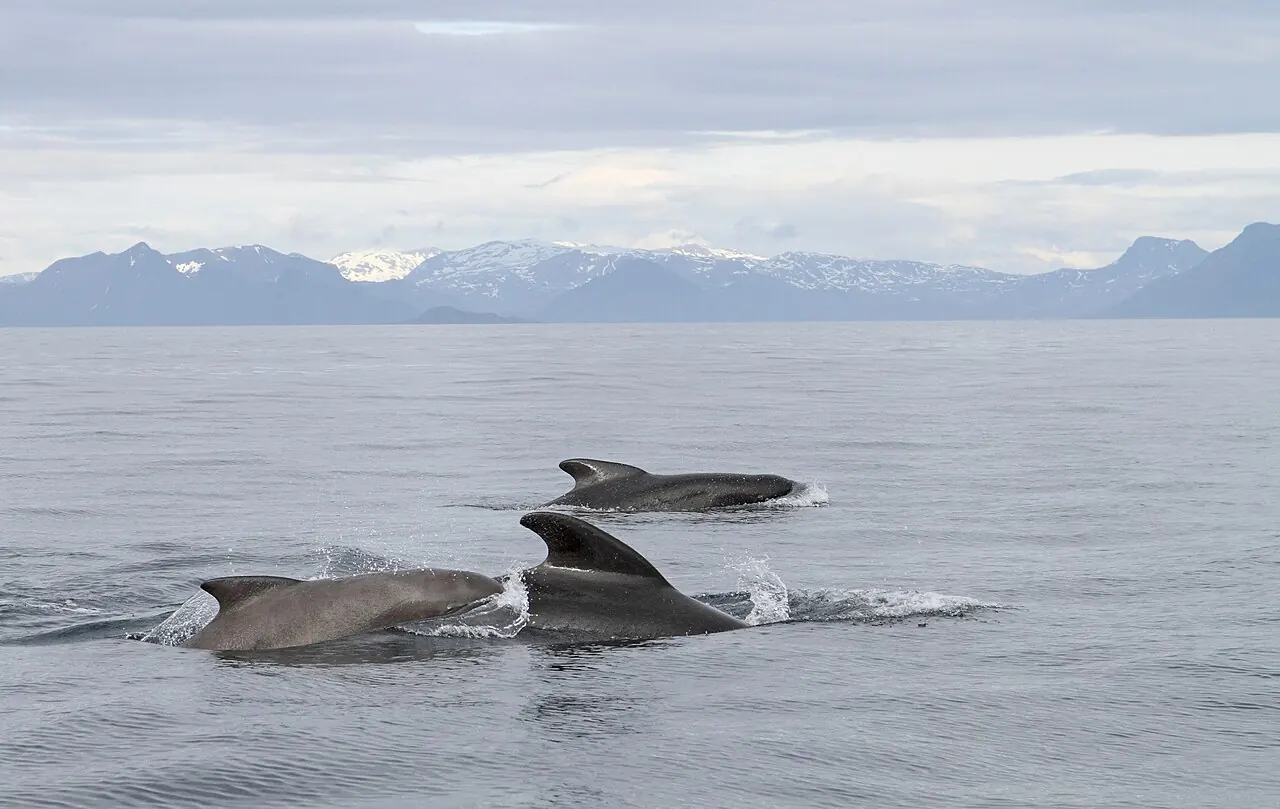
Long-finned Pilot Whale
Globicephala melas
A deep-diving, squid-eating member of the dolphin family from colder seas, known for big family pods and mass strandings.
Photo: Bouke ten Cate / CC BY 4.0
3 things to know
- Its common name comes from its long, sickle-shaped flippers.
- Pods are usually 20 to 100 whales but can number up to a thousand.
- A female gives birth only once every three to six years.
- Scientific name
- Globicephala melas
- Depth
- 0 m – 610 m
0 – 2,001 ft - Size
- About 5.8–7.6 m (19–25 ft) long
- Weight
- About 1,300–2,300 kg (2,900–5,000 lb)
- Lifespan
- At least 60 years for females; 35–45 years for males
- Diet
- Mainly squid, plus octopus, fish such as mackerel, herring and cod, and shrimp
- Where
- Cold temperate and subpolar waters of the North Atlantic and the Southern Hemisphere
- IUCN status
- Least Concern
- Depth zones
- Sunlight · Twilight
Long, sickle-shaped flippers give the long-finned pilot whale its name. It is a stocky, dark member of the dolphin family with a bulbous or squarish forehead, a thick dorsal fin set about a third of the way back, a pale streak running up from behind the eye, a gray saddle behind the fin and a pale anchor-shaped patch underneath. NOAA Fisheries gives adults a length of 5.8 to 7.6 meters (19 to 25 feet) and a weight of 1,300 to 2,300 kilograms (2,900 to 5,000 pounds).
Unlike its short-finned relative, it stays out of the tropics. One population lives in the North Atlantic, from the US East Coast and the Gulf of St. Lawrence to Greenland, the Barents Sea and the western Mediterranean. Another circles the Southern Hemisphere, and the IUCN says the two appear to be isolated from each other. Skeletal remains suggest the species once lived in the western North Pacific as well, where it now seems to be absent. Long-finned pilot whales can dive to about 610 meters (2,000 feet) for 10 to 16 minutes, and most feeding happens at night, 200 to 500 meters (650 to 1,650 feet) down, as they echolocate squid, octopus and fish such as mackerel, herring and cod.
Their lives revolve around big family groups. Pods of 20 to 100 are typical, sometimes joining into hundreds or even a thousand animals, and studies show the pods are built around mothers. A single calf is born every three to six years after a pregnancy of 12 to 16 months, one of the longest birth intervals known for any whale or dolphin, and older females help care for the young. Females live at least 60 years, males 35 to 45. NOAA notes the tight social structure has been suggested as a reason the species so often strands in groups, and the IUCN says mass strandings occur regularly in New Zealand and Australia.
The same cohesion made them easy to hunt. Whalers herded groups into tight bunches, and drive hunts once took place in Newfoundland, Iceland, Norway, Scotland and on Cape Cod in Massachusetts. Shore-based hunters in the Faroe Islands, who have hunted them for centuries, still take an average of about 850 a year, which the IUCN says has caused no detectable decline. Its 2018 assessment lists the species as Least Concern, with available estimates adding up to about one million animals.



