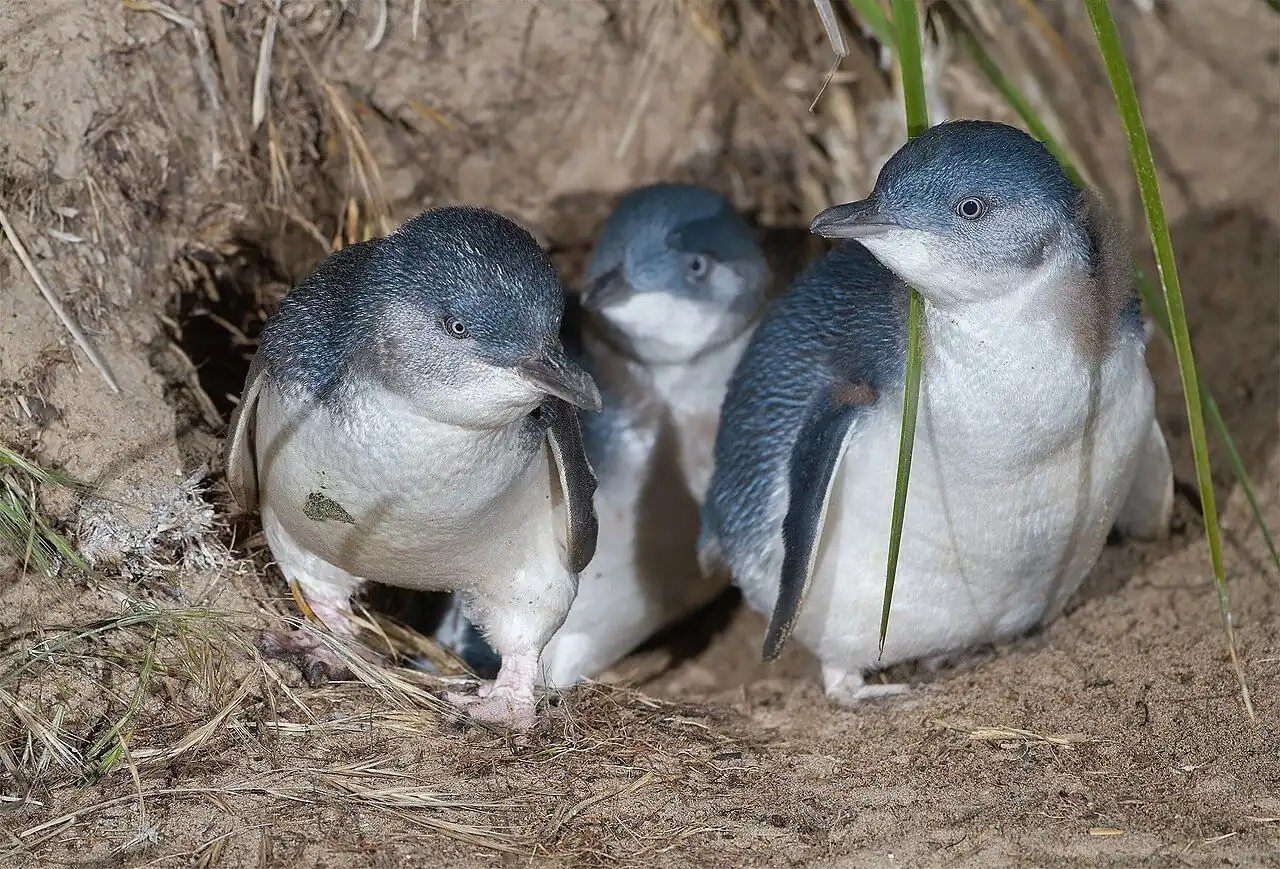
Little Penguin
Eudyptula minor
The world's smallest penguin, about 30 cm tall, which forages in shallow water by day and on one Australian island is guarded by dogs.
Photo: JJ Harrison / CC BY-SA 3.0
3 things to know
- It is the smallest penguin in the world.
- It can dive to 67 m (220 ft) but mostly stays within 5 m (16 ft) of the surface.
- Since 2006, Maremma guard dogs have been used to protect a colony on Australia's Middle Island from foxes.
- Scientific name
- Eudyptula minor
- Depth
- 0 m – 5 m
0 – 16 ft - Size
- About 30 cm (1 ft) tall
- Weight
- About 1.1–1.2 kg (2.4–2.6 lb)
- Lifespan
- About 6 years on average; a banded bird reached 25 years 8 months
- Diet
- Mostly small schooling fish such as anchovies and sardines, plus small squid, octopus and crustaceans
- Where
- Southern Australia and New Zealand
- IUCN status
- Least Concern
- Depth zones
- Sunlight
At about 30 centimeters (1 foot) tall and a little over 1 kilogram (2.4 pounds), the little penguin is the smallest penguin in the world. Its head, back and the tops of its flippers are indigo blue, the color behind the names little blue penguin and blue penguin, and its chin, throat and belly are white.
Little penguins breed along the southern coast of Australia and around New Zealand, nesting in burrows dug in sand or under plants, or in caves and rock crevices where the ground is too soft. They spend the day at sea and come back to land at dusk, walking up the beach to their nests in groups. During the breeding season they forage on average only 8 to 9 kilometers (5 to 6 miles) from shore. According to Animal Diversity Web, they can dive as deep as 67 meters (220 feet) but mostly stay within 5 meters (16 feet) of the surface, chasing anchovies, sardines and other small fish, along with small squid, octopus and crustaceans.
Pairs are usually monogamous and often stay together from year to year. Both parents take turns incubating the eggs, swapping every 3 to 4 days, and the eggs hatch after 31 to 40 days. The average lifespan is about 6 years, but one banded bird was recaptured at 25 years and 8 months.
The birds in Australia and New Zealand may be two species. Genetic work by Stefanie Grosser, Jonathan Waters and colleagues, published in 2015, found two cryptic lineages, an Australian one and a New Zealand one, which now overlap in southern New Zealand. The IUCN still treats them as one species and lists it as Least Concern. In the US, the white-flippered form, Eudyptula minor albosignata, found only in New Zealand, has been listed as threatened under the Endangered Species Act since 2010.
Small colonies are easy prey for foxes. On Middle Island, off Warrnambool in Victoria, foxes cut a colony of more than 600 to fewer than 10 birds in the mid-2000s. Starting in 2006, the local Middle Island Project put Maremma dogs, a breed raised to guard livestock, on the island to keep foxes away. With the first two guardians, Eudy and Tula, on duty, the colony grew to an estimated 180 penguins in the 2016 to 2017 breeding season.
Sources
- animaldiversity.org/accounts/Eudyptula_minor
- Study: doi:10.1371/journal.pone.0144966
- Study: doi:10.2305/IUCN.UK.2020-3.RLTS.T22697805A202126091.en
- warrnamboolpenguins.com.au/maremma-dogs
- landcarevic.org.au/landcare-magazine/landcare-magazine-winter-2026/big-lessons-from-lit…
- federalregister.gov/documents/2010/08/03/2010-18884/endangered-and-threatened-wildlife-…
- en.wikipedia.org/wiki/Little_penguin



