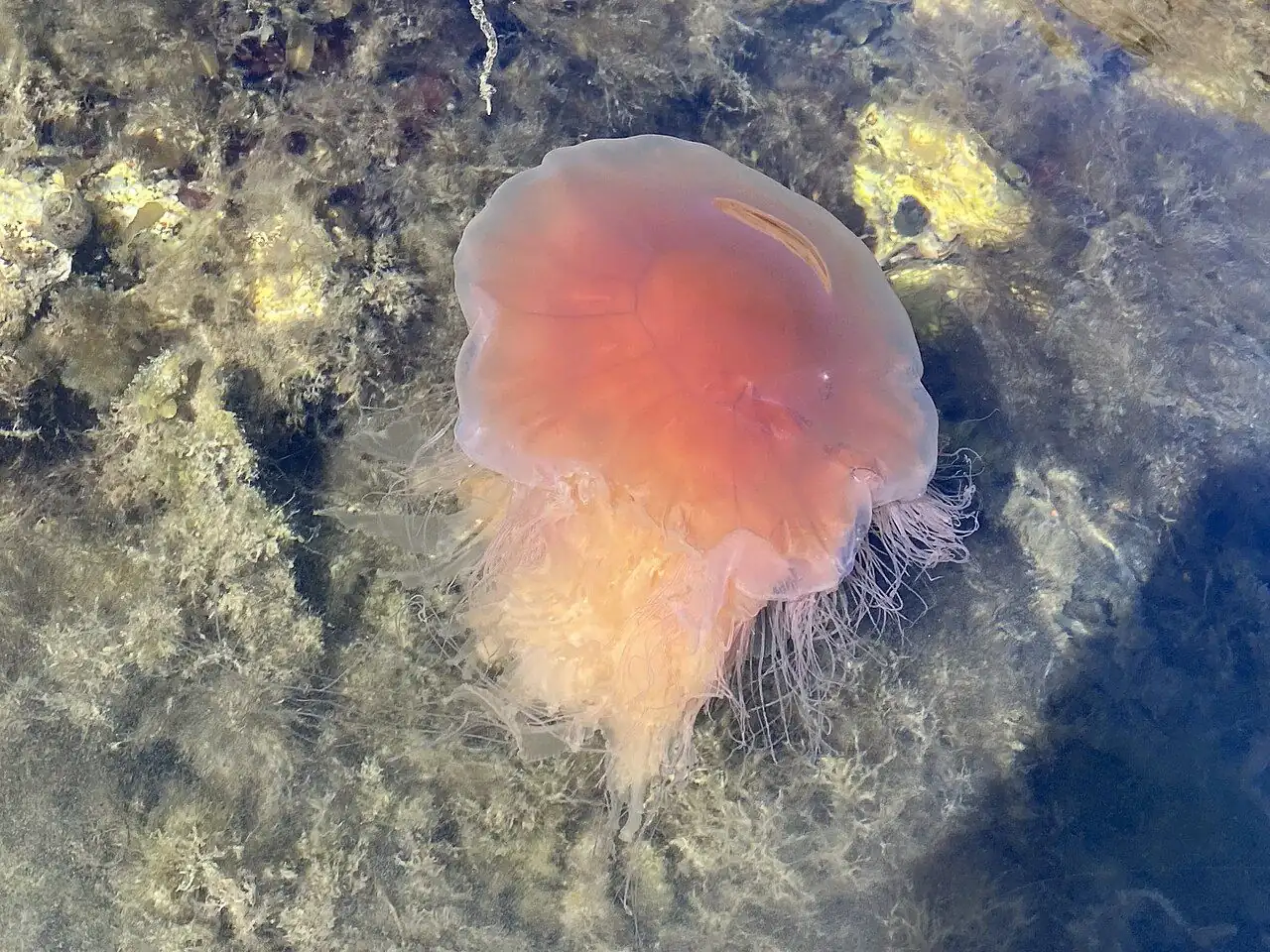
Lion's Mane Jellyfish
Cyanea capillata
The largest jellyfish on record, trailing eight clusters of hair-like tentacles that can keep stinging after the animal dies.
Photo: Hannes Grobe / CC BY-SA 4.0
3 things to know
- Its tentacles hang in eight groups, each with 70 to 150 or more.
- Guinness World Records lists a Massachusetts Bay specimen with a bell 2.28 meters (7.5 feet) wide.
- One that appeared to be dead was blamed for stings on 50 to 100 beachgoers in New Hampshire in 2010.
- Scientific name
- Cyanea capillata
- Depth
- 0 m – 85 m
0 – 279 ft - Size
- Bell usually 30–50 cm (12–20 in) across in British waters; known to reach about 2 m (6.6 ft)
- Weight
- Not well known
- Lifespan
- Not well known
- Diet
- Mainly fish; also plankton and other jellyfish
- Where
- Cold northern waters: the Arctic and North Atlantic, including the North and Baltic Seas; Animal Diversity Web also lists the Pacific; reaches the lower Chesapeake Bay in winter and early spring
- IUCN status
- Not Evaluated
- Depth zones
- Sunlight
Cyanea capillata gets its common name from the mass of fine, hair-like tentacles under its bell, which hang in eight groups of 70 to 150 or more each. The bell is a saucer, usually yellowish brown or reddish, and in British waters it typically grows to 30 to 50 centimeters (12 to 20 inches) across. MarLIN, the UK's Marine Life Information Network, says the species has been known to reach 200 centimeters. Guinness World Records lists one that washed up in Massachusetts Bay in 1870 with a bell 2.28 meters (7 feet 6 inches) wide and tentacles 36.5 meters (120 feet) long. An earlier account is rougher: in Seaside Studies in Natural History (1865), Elizabeth and Alexander Agassiz described laying an oar across a live one, putting its bell at about seven feet (2.1 meters) and its tentacles at some 112 feet (34 meters).
It is a cold-water jellyfish. Animal Diversity Web places it in the cooler Atlantic and Pacific, the North Sea and the Baltic, while SeaLifeBase lists only the Arctic and the northeast Atlantic, from Iceland to France. On the US East Coast, the Virginia Institute of Marine Science reports it in the lower Chesapeake Bay in winter and early spring, where it stays much smaller. It feeds mainly on fish, sinking slowly with its tentacles spread in a circle like a net and stunning whatever swims in. Like other true jellyfish, it alternates between a free-swimming medusa that spawns and a small polyp on the bottom that buds off young jellyfish.
The sting is severe. MarLIN lists blisters and muscle cramps, and in rare cases effects on breathing and the heart, and notes that a lion's mane can still sting long after it strands. On July 21, 2010, a lion's mane that appeared to be dead drifted in at Wallis Sands State Beach in Rye, New Hampshire, and between 50 and 100 beachgoers were treated for stings. Park staff used a pitchfork to remove the 18-kilogram (40-pound) animal. Sean Colin of Roger Williams University told Live Science that broken-off tentacles drifting in the water could explain the numbers, while John Costello of Providence College called one jellyfish stinging that many people essentially impossible. Officials did not spot a second large jellyfish.
The species has not been assessed for the IUCN Red List.
Sources
- marlin.ac.uk/species/detail/2090
- guinnessworldrecords.com/world-records/70599-largest-jellyfish
- animaldiversity.org/accounts/Cyanea_capillata
- vims.edu/bayinfo/jellyfish/guide/lions_mane.php
- livescience.com/6736-jellyfish-stung-100-people.html
- nbcnews.com/id/wbna38380914
- sealifebase.se/summary/Cyanea-capillata.html
- archive.org/details/seasidestudiesin00agas



