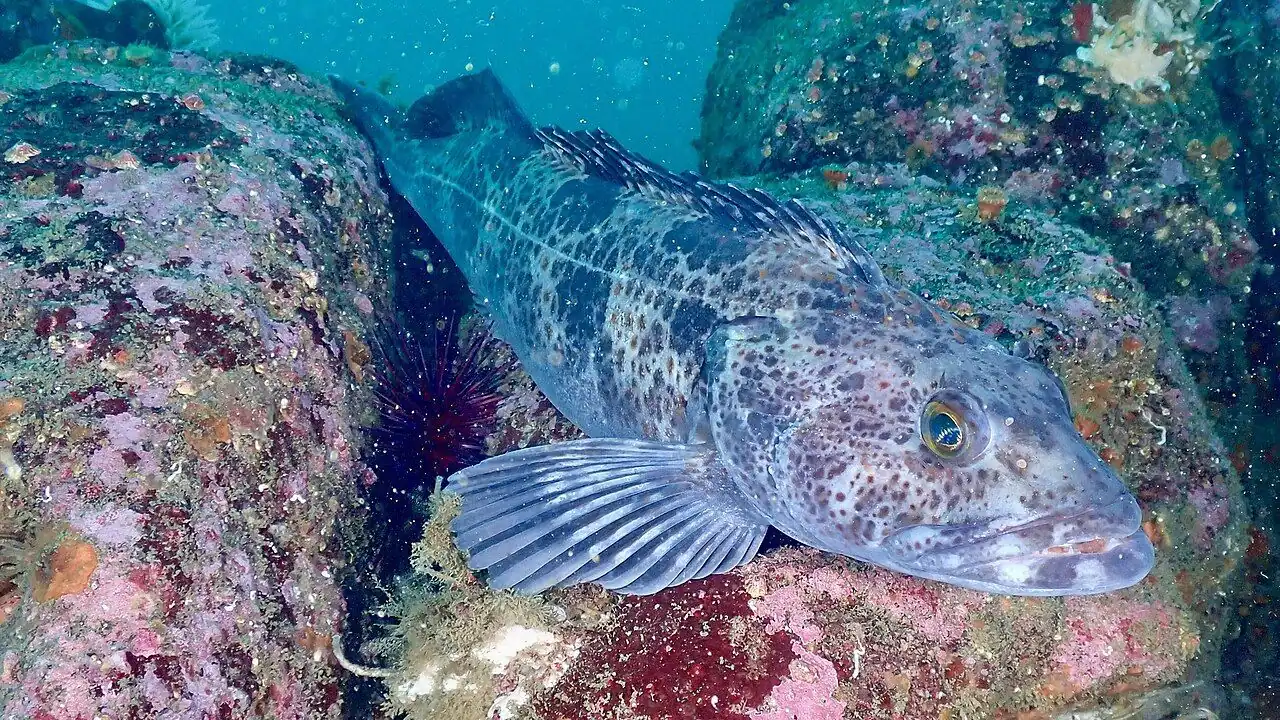
Lingcod
Ophiodon elongatus
A big-mouthed West Coast predator that is a greenling, not a cod. Males guard the egg nests, and some fish have blue-green flesh.
Photo: Chris Spain / CC0
3 things to know
- Despite the name, lingcod are greenlings, not true cods.
- Males guard the egg nests for weeks, and an unguarded nest can be eaten within 48 hours.
- Between 4 and 25 percent of lingcod in different regions have blue-colored flesh, a 2021 study found.
- Scientific name
- Ophiodon elongatus
- Depth
- 9 m – 100 m
30 – 328 ft - Size
- Up to about 1.5 m (5 ft)
- Weight
- Up to about 36 kg (80 lb), per NOAA; Alaska's Department of Fish and Game reports a fish of about 39 kg (85 lb)
- Lifespan
- More than 20 years; the oldest reported was 25
- Diet
- Bottom fish (including smaller lingcod), squid, octopus and crabs; larvae eat zooplankton
- Where
- West coast of North America, from the western Gulf of Alaska to Baja California, Mexico; most abundant off British Columbia and Washington
- IUCN status
- Not Evaluated
- Depth zones
- Sunlight
Despite the name, a lingcod is no cod. The Alaska Department of Fish and Game says lingcod are greenlings, family Hexagrammidae. They have long bodies that taper to the tail, a big head and a big mouth set with 18 large, sharp teeth, which is why NOAA Fisheries says some anglers call them bucketheads. The skin is dark gray, brown or greenish with copper mottling.
They live only along the west coast of North America, from the western Gulf of Alaska to Baja California, and are most abundant off British Columbia and Washington. Alaska's biologists say they have been found as deep as about 300 meters (1,000 feet) but typically live on nearshore rocky reefs from 9 to 100 meters (30 to 330 feet). Adults are voracious and eat almost anything, including other lingcod. Most stay close to a home reef.
Open a fillet and it may be blue-green. In a 2021 study in Marine Biology, Aaron Galloway and colleagues examined 2,021 lingcod caught from southeast Alaska to southern California and found blue flesh in 4 to 25 percent of fish, depending on the region. Blue fish were more likely to be female, smaller and caught in shallower water, and they had lower levels of fatty acids. The cause is still unknown, though the team found possible links to diet. The color turns white when cooked, NOAA notes.
Fathers do the parenting. Females visit the spawning reefs in winter and spring just long enough to lay their eggs in crevices and under ledges, and the male guards the nest until the eggs hatch, 8 to 10 weeks according to NOAA and 5 to 11 weeks according to Alaska's biologists. Without him, rockfish, sea stars, sculpins and other fish can wipe out a nest within 48 hours. Lingcod grow fast, reaching about 1.5 meters (5 feet) and 36 kilograms (80 pounds), and can live 25 years.
Off the US West Coast, the stock was declared overfished in 1999. Catch cuts followed, and in 2005 the Pacific Fishery Management Council announced the stock rebuilt, four years ahead of schedule. NOAA reports both West Coast stocks are not overfished today. The IUCN has not assessed the species.
Sources
- fisheries.noaa.gov/species/lingcod
- adfg.alaska.gov/index.cfm
- fishbase.se/summary/Ophiodon-elongatus.html
- Study: doi:10.1007/s00227-021-03936-6
- pcouncil.org/documents/2005/11/council-announces-good-news-on-rebuilding-fish-stocks.pdf
- api.gbif.org/v1/species/2336521/iucnRedListCategory
- commons.wikimedia.org/wiki/File:Ophiodon_elongatus_458366655.jpg



