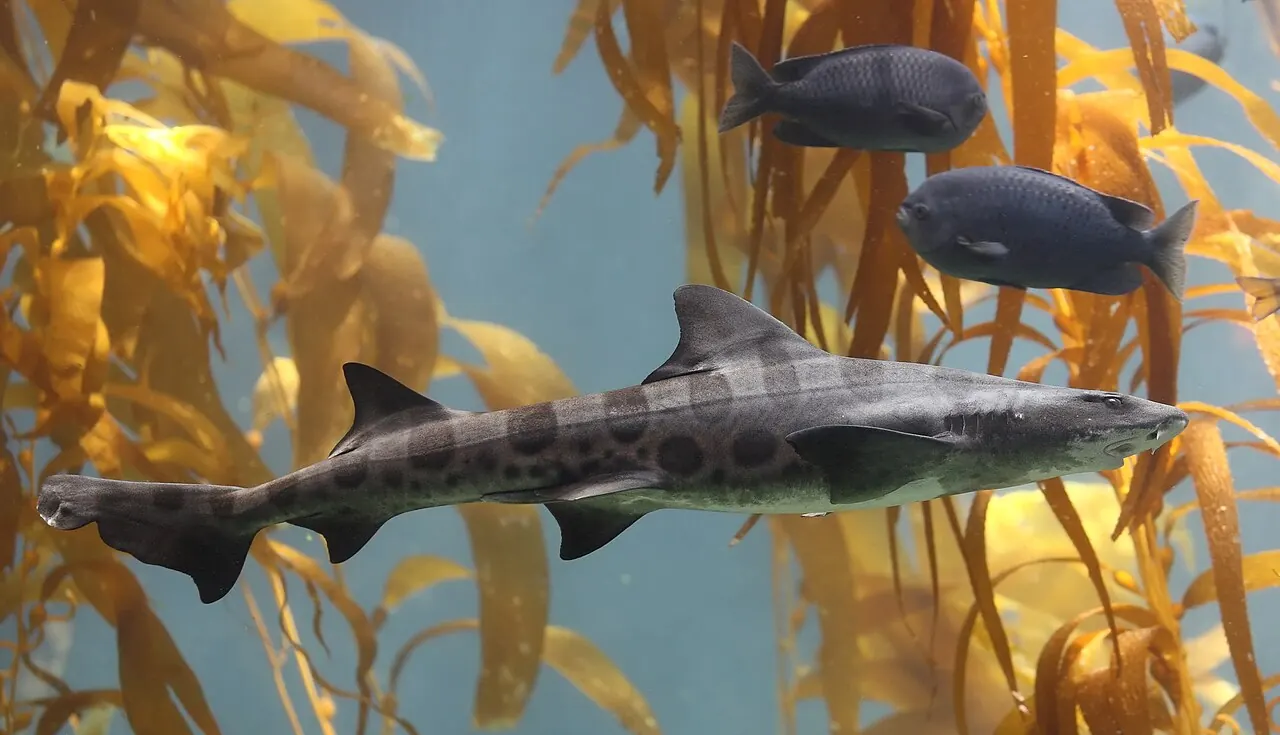
Leopard Shark
Triakis semifasciata
A slender, saddle-marked shark of California bays and kelp beds, where females gather in warm shallows off La Jolla every summer and fall.
Photo: Matthew Field / CC BY-SA 3.0
3 things to know
- Juveniles skim the bottom for crabs, clam siphons, fish eggs and fat innkeeper worms.
- A mother gives birth to between 7 and 36 pups after carrying her eggs inside her body for 10 to 12 months.
- In 2017 more than 1,000 leopard sharks died in San Francisco Bay, and a brain-infecting parasite was found in the stranded sharks.
- Scientific name
- Triakis semifasciata
- Depth
- 0 m – 20 m
0 – 66 ft - Size
- Up to about 1.8–2 m (6–6.5 ft) long
- Weight
- Up to about 18 kg (41 lb)
- Lifespan
- Up to about 30 years (FishBase maximum reported age)
- Diet
- Crabs, shrimp, clam siphons, fat innkeeper worms, fish eggs and small fish; older sharks eat more fish
- Where
- Eastern Pacific coast from Oregon to the Gulf of California
- IUCN status
- Least Concern
- Depth zones
- Sunlight
Dark saddles across the back and dark spots along the sides give the leopard shark its name. It is a slender, silvery-bronze to gray shark of the eastern Pacific, and the Monterey Bay Aquarium points out that the older the shark, the paler the centers of its spots. The largest reach about 2 meters (6.5 feet) and 18 kilograms (41 pounds). In Australia and Britain the same name is sometimes used for the zebra shark, a different species.
Leopard sharks live from Oregon to the Gulf of California, in shallow bays, estuaries and lagoons, over sand and mud and near rocky reefs and kelp beds. They are rarely found deeper than about 20 meters (65 feet), though some have strayed to 91 meters (300 feet). At high tide they follow the water onto mudflats to feed, then move back out as it drops. Juveniles take crabs, clam siphons, fish eggs and the hot dog-shaped fat innkeeper worm, and older sharks eat more fish. They often travel in mixed schools.
Mothers keep their eggs inside the body until they hatch and, according to the Monterey Bay Aquarium, give birth after 10 to 12 months to 7 to 36 pups about 18 centimeters (7 inches) long. A female usually has her first litter at about 10 years old, and FishBase gives a maximum age of 30 years. Each year, females gather in the shallows off La Jolla, near San Diego. Andrew Nosal and colleagues at Scripps Institution of Oceanography tracked 20 tagged females and 13 males for more than three years and reported in 2014 that female numbers there peaked from late June through early December and rose and fell with sea surface temperature, which fits the idea that warm water speeds up their pregnancies. Half the tagged females came back every year.
San Francisco Bay has seen mass deaths of leopard sharks in 1967, 2011 and 2017. From March to August 2017, sharks swam close to shore, uncoordinated and disoriented, before stranding, and researchers estimated that more than 1,000 died. Hanna Retallack and Joseph DeRisi of the University of California, San Francisco, with Mark Okihiro of the California Department of Fish and Wildlife and others, found the single-celled parasite Miamiensis avidus in the brains of stranded sharks but not in leopard sharks caught elsewhere. The IUCN lists the species as Least Concern, in an assessment from 2014.



