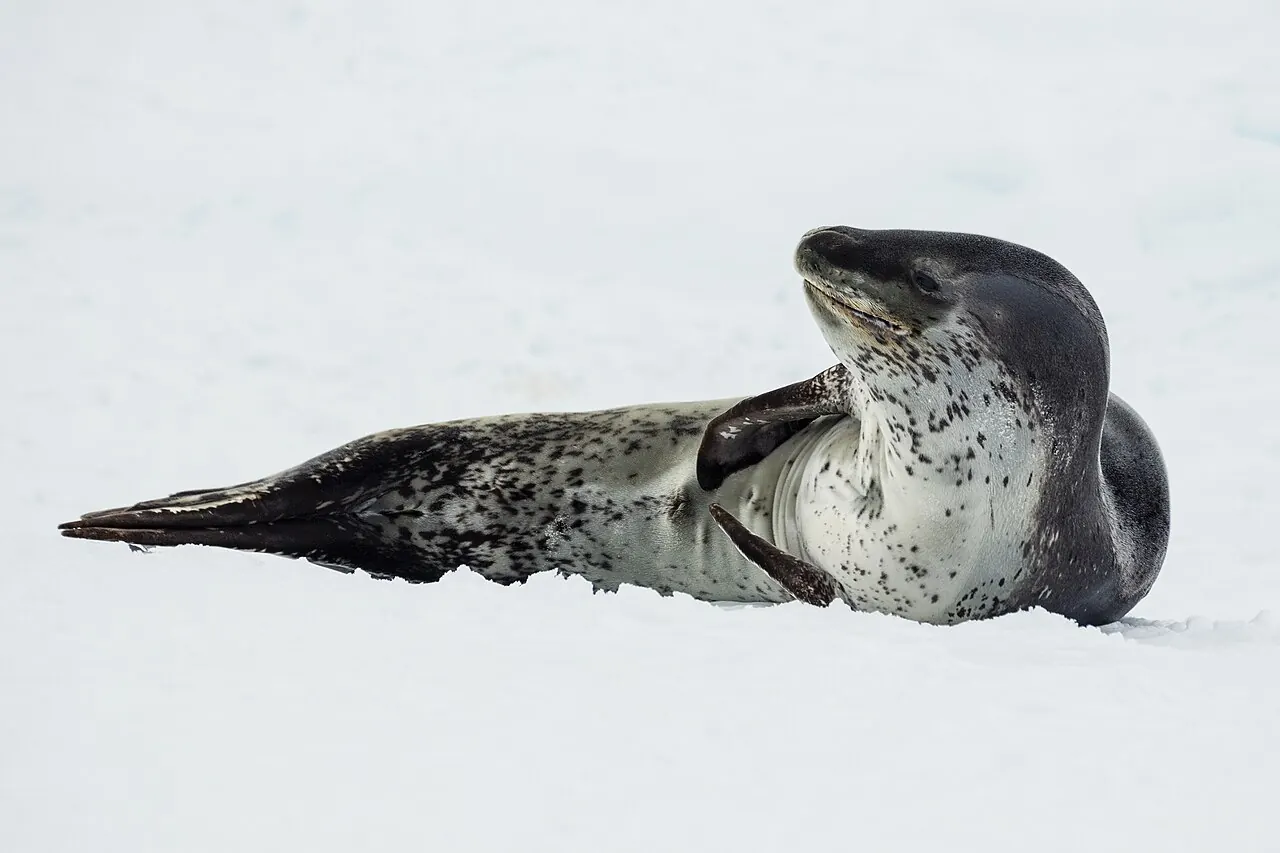
Leopard Seal
Hydrurga leptonyx
Antarctica's big-headed predator seal, which hunts penguins, strains krill, and was recorded diving to 1,256 m in a 2022 study.
Photo: Godot13 / CC BY-SA 4.0
3 things to know
- Females are bigger than males, by about 50 percent in one 2022 study.
- Its teeth can strain krill from the water, like a crabeater seal's.
- One tagged male dived to 1,256 m (4,121 ft) and stayed down 25 minutes.
- Scientific name
- Hydrurga leptonyx
- Depth
- 0 m – 40 m
0 – 131 ft - Size
- About 2.8–3 m (9–10 ft) long; large females over 3.5 m (11.5 ft)
- Weight
- Males about 300–320 kg (660–710 lb); females about 370–450 kg (815–1,000 lb), large ones over 500 kg (1,100 lb)
- Lifespan
- 26 years or more
- Diet
- Penguins, seal pups, fish, squid and krill
- Where
- Antarctic pack ice and sub-Antarctic islands; strays reach Australia
- IUCN status
- Least Concern
- Depth zones
- Sunlight
Leopard seals are built for speed, with a slender body, long front flippers and a large head whose jaws open wide on long canine teeth and sharply pointed back teeth. Their teeth are also suited to straining krill from the water, as crabeater seals' teeth are. Females are the bigger sex. In a 2022 study off the Antarctic Peninsula, Sarah Kienle and colleagues found adult females averaged 454 kilograms (1,001 pounds) and 3.0 meters (9.9 feet), against 302 kilograms (666 pounds) and 2.8 meters (9.1 feet) for males, one of the most extreme cases of females outsizing males among marine mammals. The Australian Antarctic Division notes large females can pass 3.5 meters (11.5 feet) and 500 kilograms (1,100 pounds).
They live alone in the pack ice around Antarctica and are perhaps the greatest wanderers of the Antarctic seals, with sightings in Tasmania and one as far north as Heron Island on the Great Barrier Reef. One caught near Sydney had eaten a fully grown platypus.
Leopard seals eat almost anything: penguins, fish, squid, krill and the pups of crabeater, Weddell and southern fur seals. They usually catch penguins in the water and thrash them until the skin peels away. Individuals have their own tastes. Some stay near penguin colonies, while others prefer crabeater seal pups.
Kienle's team tagged 22 seals from the US Antarctic Marine Living Resources research station at Cape Shirreff, on Livingston Island. Most dives were short and shallow, averaging about 3 minutes and 29 meters (95 feet). Some seals stayed within 50 kilometers (31 miles) of the tagging site, and others traveled up to 1,700 kilometers (1,056 miles). One adult male dived to 1,256 meters (4,121 feet) and stayed down 25 minutes, the deepest and longest dive yet recorded for the species; the previous deepest was 425 meters (1,394 feet).
Females aged 6 or older give birth to a single pup on the sea ice in November after a nine-month pregnancy, and pups can weigh more than 30 kilograms (66 pounds). Leopard seals may live 26 years or more. Their only natural predator is the killer whale, and the IUCN lists the species as Least Concern.



