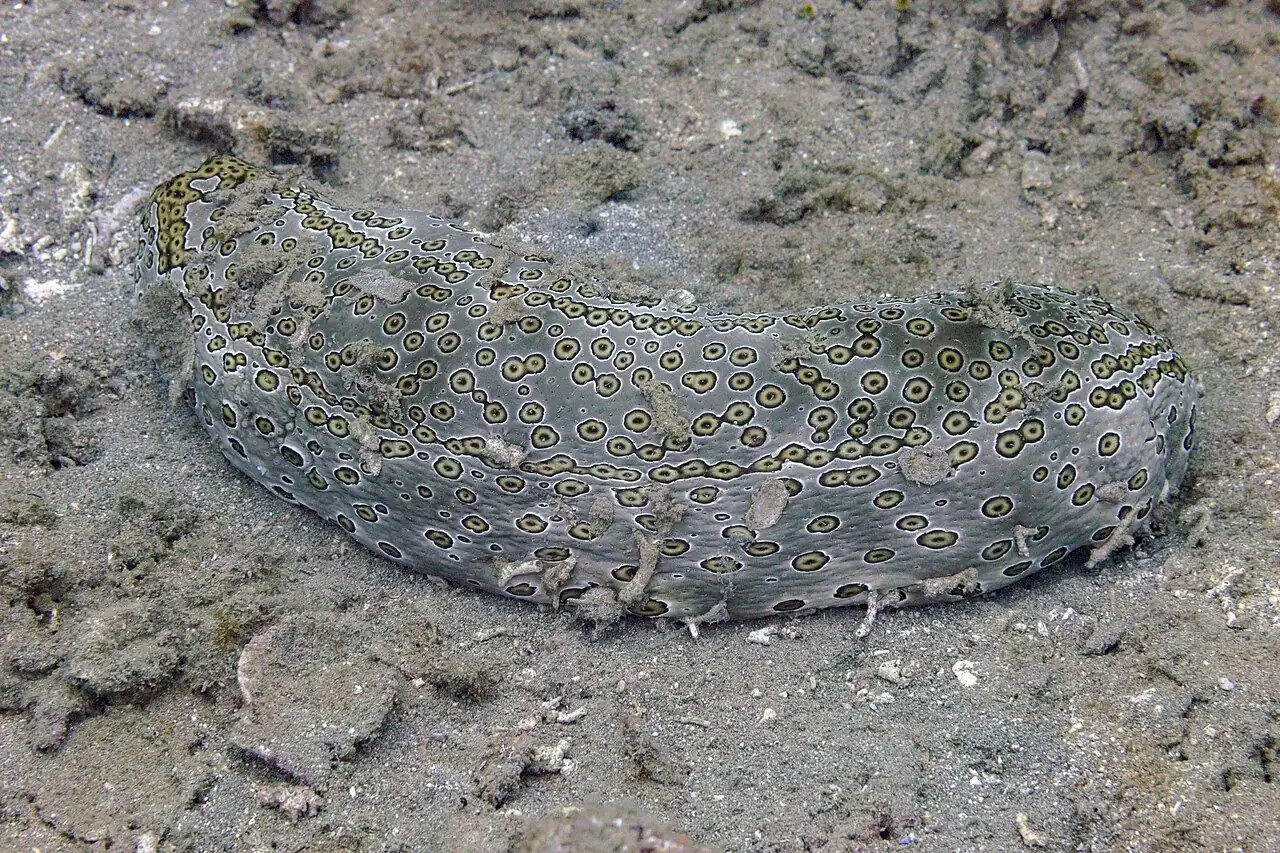
Leopard Sea Cucumber
Bohadschia argus
A big reef sea cucumber covered in ringed spots. It fires sticky white threads when handled, yet pearlfish often live in its back end.
Photo: Diego Delso / CC BY-SA 4.0
3 things to know
- When disturbed, it readily shoots out large, sticky white threads called Cuvierian tubules.
- In one lagoon on Moorea, French Polynesia, 84 percent of 257 leopard sea cucumbers had pearlfish inside.
- It spawns in December in New Caledonia but in June on the Great Barrier Reef.
- Scientific name
- Bohadschia argus
- Depth
- 2 m – 10 m
7 – 33 ft - Size
- Up to about 60 cm (24 in) long; commonly about 36 cm (14 in)
- Weight
- Average fresh weight about 1.8–2 kg (4–4.4 lb)
- Lifespan
- Unknown
- Diet
- A deposit feeder that gathers organic material from the sandy sea floor with its tentacles
- Where
- Tropical Indo-Pacific reefs from Sri Lanka and the Bay of Bengal to French Polynesia, including Guam and American Samoa; not Hawaii
- IUCN status
- Least Concern
- Depth zones
- Sunlight
Numerous ringed spots cover the back of Bohadschia argus, each about 1 centimeter (0.4 inch) across with a thin black border and a small bump at its center. The background color runs from beige or brown to gray or violet. This is a fairly big sea cucumber: up to about 60 centimeters (24 inches) long, commonly about 36 centimeters (14 inches), with a firm, cylindrical body that is arched on top and flat underneath. Twenty short, dark tentacles ring the mouth on its underside.
It lives on coral reefs across the tropical Indo-Pacific, from Sri Lanka and the Bay of Bengal east to French Polynesia, including the US territories of Guam and American Samoa, but not Hawaii. According to the FAO's catalogue of commercial sea cucumbers, it is usually found 2 to 10 meters (7 to 33 feet) down on reef flats and back-reef lagoons, mostly on coarse sand near the reef, and in the western Pacific to 30 meters (98 feet). It is a deposit feeder, using its tentacles to feed from the sea floor. Spawning varies by place: December in New Caledonia, June on the Great Barrier Reef. How long it lives is unknown.
Pick one up and it is likely to release large, white, sticky threads called Cuvierian tubules from its rear opening. In field tests on Moorea, in French Polynesia, Eric Parmentier and Pierre Vandewalle of the University of Liège found that light pressure by hand set off the threads in 42 of 46 animals. Each time, the sea cucumber bent sideways and swung its rear end forward, placing the threads against its own mouth tentacles. Pushing a small rod into the rear opening triggered them in only 2 of the 46.
That rear opening is often occupied. In the same lagoon the two researchers collected 257 leopard sea cucumbers and found pearlfish living inside 84 percent of them.
Fishers in more than a dozen Pacific nations collect it to be dried and sold as bêche-de-mer. In Kiribati the fishery boomed from 2000 to 2002, and the FAO catalogue describes the species there as now considered depleted. The IUCN lists it as Least Concern, in an assessment made in 2010 that the Red List itself marks as needing an update.
Sources
- openknowledge.fao.org/3/i1918e/i1918e.pdf
- sealifebase.se/summary/Bohadschia-argus.html
- museum.wa.gov.au/online-collections/names/Bohadschia-argus-0
- iucnredlist.org/species/180541/1645352
- Study: doi:10.2305/IUCN.UK.2013-1.RLTS.T180541A1645352.en
- Study: doi:10.1007/s00227-004-1467-7
- orbi.uliege.be/bitstream/2268/12846/1/19etho-eco.pdf



