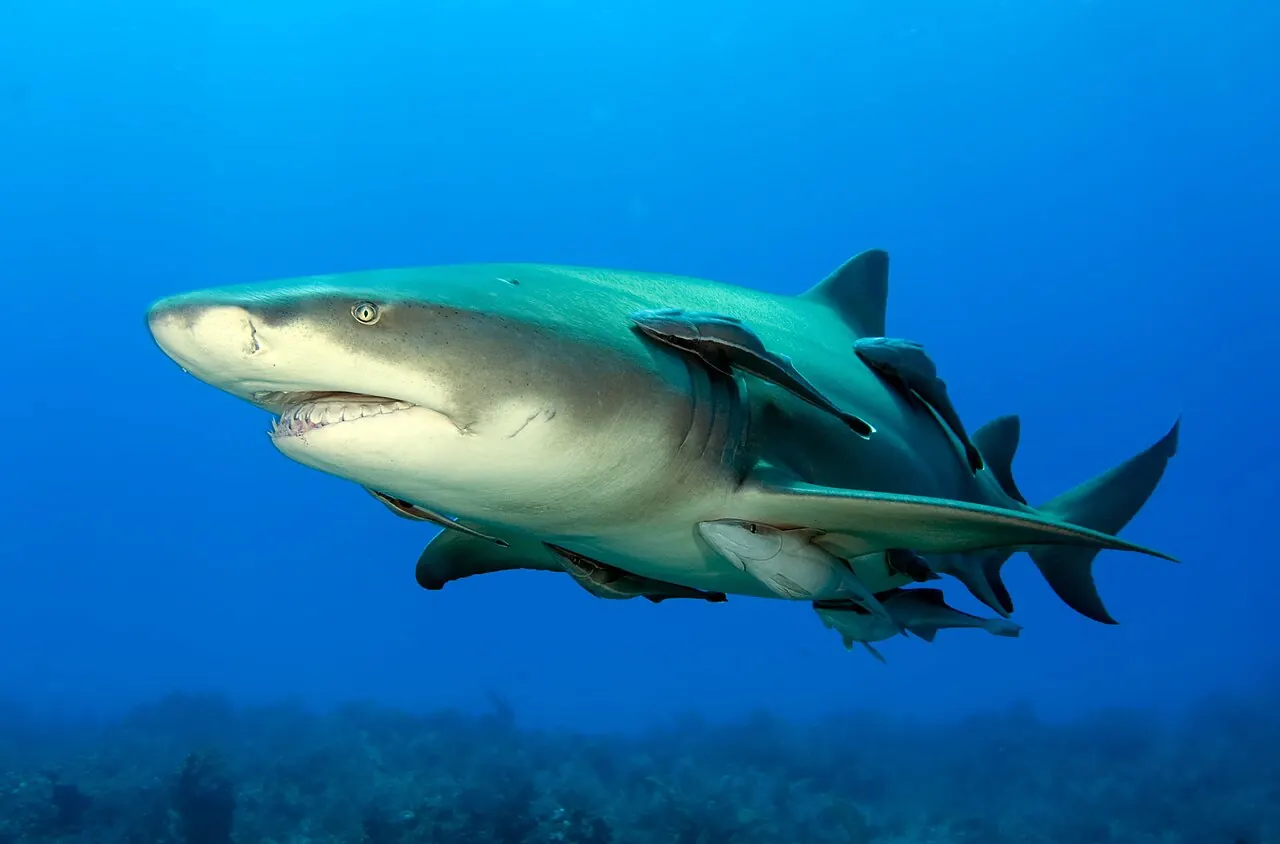
Lemon Shark
Negaprion brevirostris
A yellowish coastal shark of mangroves and sand flats whose females return to the nursery where they were born to give birth.
Photo: Albert Kok / CC BY-SA 3.0
3 things to know
- Its two dorsal fins are almost the same size.
- Pups are fed through a placenta and born 50 to 60 cm (20 to 24 in) long.
- Females born at Bimini in the Bahamas returned to give birth there 14 to 17 years later.
- Scientific name
- Negaprion brevirostris
- Depth
- 0 m – 90 m
0 – 295 ft - Size
- Commonly 2.4–3 m (8–10 ft) long; up to about 3.4 m (11 ft)
- Weight
- Heaviest published about 184 kg (405 lb)
- Lifespan
- About 25–27 years at most
- Diet
- Mainly bony fishes such as catfish, mullet, jacks and porcupinefish; also crabs, rays, seabirds and smaller sharks
- Where
- Western Atlantic from New Jersey to southern Brazil, including the Gulf of Mexico and the Caribbean; West Africa; and the eastern Pacific from Baja California to Ecuador
- IUCN status
- Vulnerable
- Depth zones
- Sunlight
Two dorsal fins of nearly equal size and a yellow-brown to olive back give the lemon shark away. The color blends with the sandy shallows where it hunts. It is a stocky, blunt-nosed shark, and adults commonly measure 2.4 to 3 meters (8 to 10 feet).
Lemon sharks live along warm coasts from New Jersey to southern Brazil, including the Gulf of Mexico and the Caribbean, as well as off West Africa and from Baja California to Ecuador. They favor mangroves, coral reefs, enclosed bays and river mouths down to about 90 meters (300 feet), but do not travel far into fresh water. Some gather near docks and fishing piers at night. They feed mostly on bony fish such as catfish, mullet, jacks, croakers and porcupinefish, and also take crabs, stingrays, eagle rays, seabirds and smaller sharks.
Mating takes place in shallow water in spring and summer. A pregnant female carries 4 to 17 pups, nourished through a placenta, for 10 to 12 months, then returns to a shallow nursery to give birth. The pups, 50 to 60 centimeters (20 to 24 inches) long, stay in the nursery for several years. Both sexes mature at around 12 to 13 years.
The nurseries at Bimini in the Bahamas have been studied for decades, and they gave the first direct evidence that sharks come home to breed. Kevin Feldheim of Chicago's Field Museum, Samuel Gruber of the Bimini Biological Field Station and colleagues built genetic profiles of lemon sharks from 20 straight yearly cohorts born there, 1993 to 2012. Some females gave birth at Bimini again and again for nearly two decades, and at least six females born there between 1993 and 1997 came back to give birth 14 to 17 years later. Biologists call this natal philopatry. The authors, writing in Molecular Ecology, argued that this loyalty to nursery sites supports local, site-based conservation.
Lemon sharks are caught by commercial and recreational fishers along the US Atlantic coast, in the Caribbean and in the eastern Pacific, for meat, fins and leather. The IUCN lists the species as Vulnerable.



