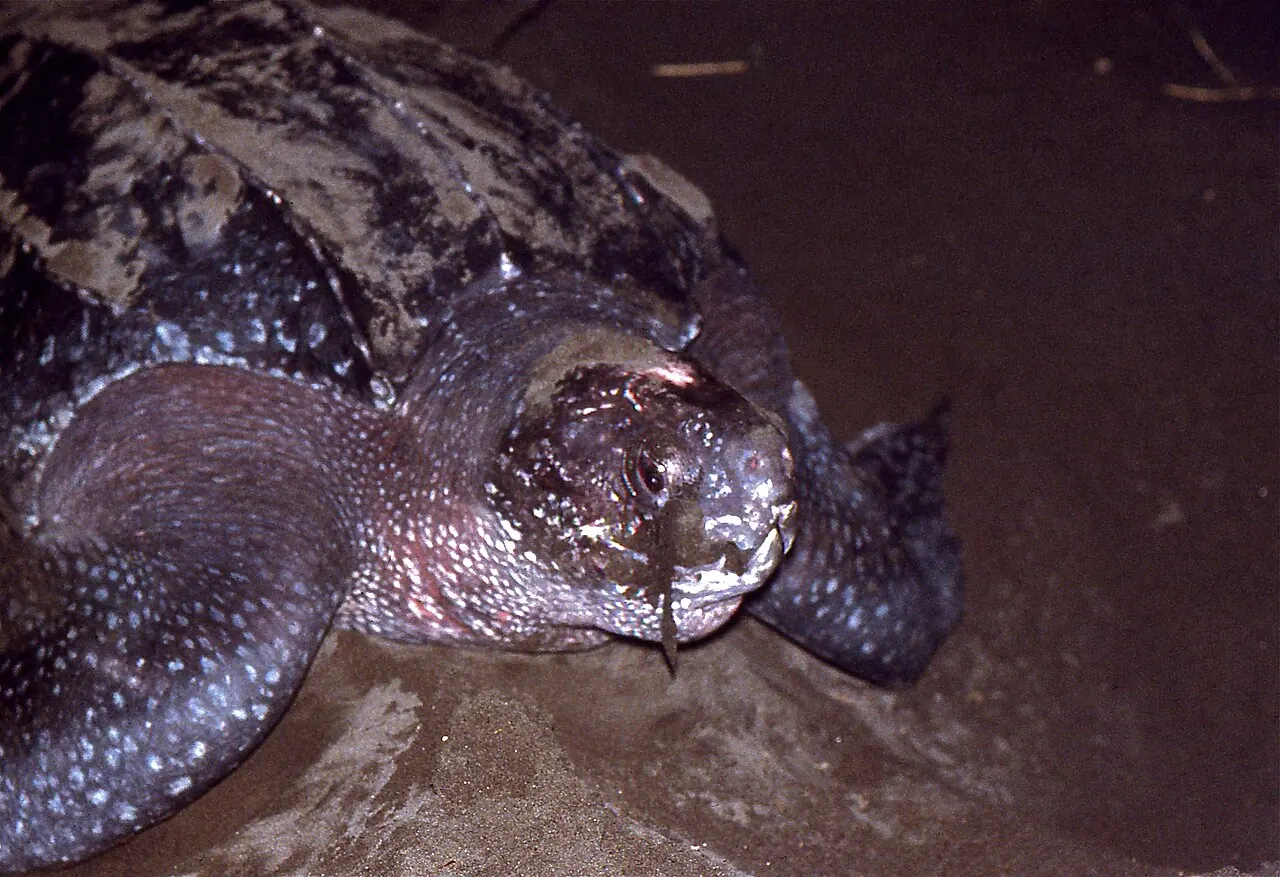
Leatherback Sea Turtle
Dermochelys coriacea
The largest living turtle, a deep-diving jellyfish eater with a rubbery, ridged shell that migrates thousands of miles.
Photo: Bernard DUPONT from FRANCE / CC BY-SA 2.0
3 things to know
- It is the largest turtle in the world.
- Its deepest recorded dive reached nearly 1,200 m (4,000 ft).
- Backward-pointing spines line its mouth and throat and help it hold onto jellyfish.
- Scientific name
- Dermochelys coriacea
- Depth
- 0 m – 200 m
0 – 656 ft - Size
- Adults about 1.5–1.8 m (5–6 ft) long
- Weight
- Adults about 340–450 kg (750–1,000 lb); up to about 650 kg (1,430 lb) recorded
- Lifespan
- Not well known; estimated at 45–50 years or more
- Diet
- Jellyfish, salps and other soft-bodied animals
- Where
- Atlantic, Pacific and Indian Oceans; nests mainly on tropical beaches
- IUCN status
- Vulnerable
- Depth zones
- Sunlight
No other sea turtle looks like a leatherback. It has no scales and no hard shell. Black, rubbery skin, pinkish-white underneath, covers a shell of small interlocking bones over a layer of connective tissue and fat, with seven ridges running along its back. Its front flippers are longer, for its size, than those of any other sea turtle. Adults are about 1.5 to 1.8 meters (5 to 6 feet) long and weigh 340 to 450 kilograms (750 to 1,000 pounds), making it the largest turtle in the world.
Leatherbacks make the longest migrations of any sea turtle, some averaging about 6,000 kilometers (3,700 miles) each way between nesting beaches and feeding grounds in the Atlantic, Pacific and Indian Oceans. Most of their time is spent in the top 200 meters (660 feet), but NOAA Fisheries reports dives to about 1,200 meters (4,000 feet) lasting up to 85 minutes, deeper than any other turtle.
Instead of the crushing beak other sea turtles have, a leatherback has pointed cusps and sharp-edged jaws, plus backward-pointing spines in its mouth and throat for holding soft prey such as jellyfish and salps. Off Cape Breton Island, Nova Scotia, Susan Heaslip of Dalhousie University and colleagues put cameras on 19 leatherbacks and filmed 601 captures, mostly lion's mane jellyfish. They estimated that the turtles ate an average of 330 kilograms (730 pounds) of jellyfish a day, about 73% of their body weight and 3 to 7 times their daily energy needs.
Females nest at night on tropical and subtropical beaches, laying about 100 eggs at a time, several times a season at 8- to 12-day intervals, and return to nest every 2 to 4 years. In the US, most nesting happens in Florida, Puerto Rico and the US Virgin Islands, from March to July. Western Pacific leatherbacks feed off the Pacific coast of North America and cross the ocean to nest in Indonesia, Papua New Guinea and the Solomon Islands.
The IUCN lists the species as Vulnerable, in a 2013 assessment, and it is endangered under the US Endangered Species Act. NOAA estimates the global population has fallen 40% over three generations; eastern Pacific nesting is down more than 90%. The biggest threats are capture in fishing gear, hunting of turtles and the taking of eggs. Leatherbacks may also swallow plastic bags and balloons, which they can mistake for food.



