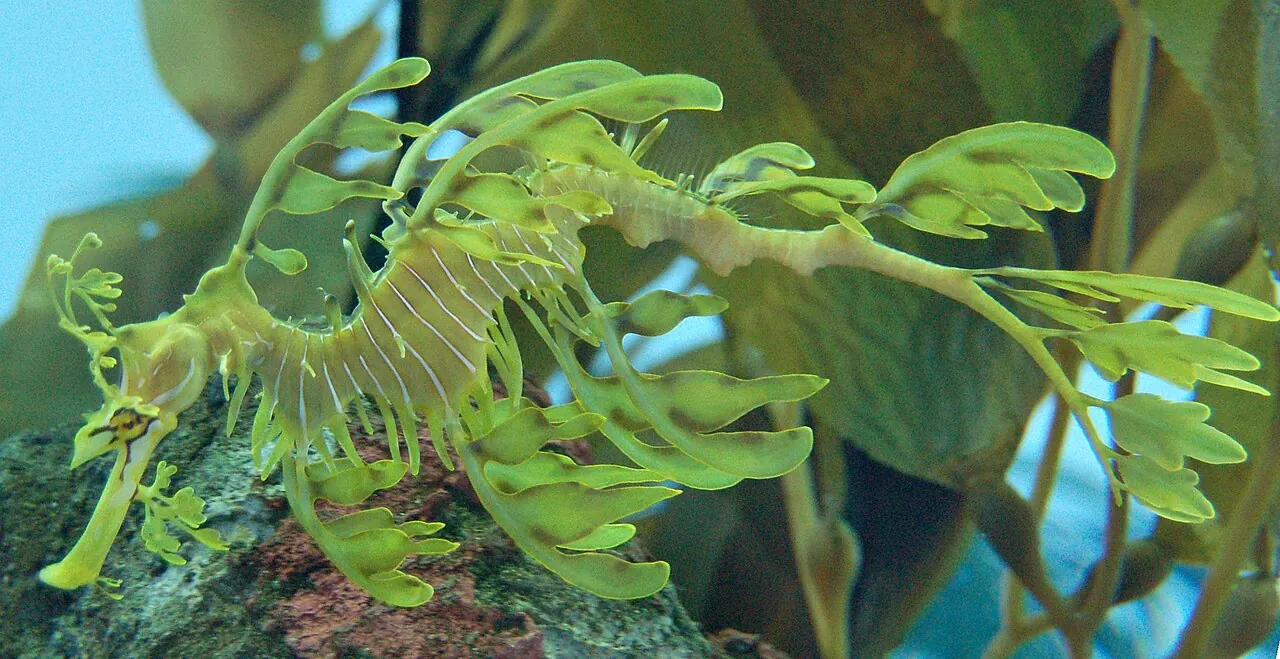
Leafy Seadragon
Phycodurus eques
A southern Australian relative of seahorses draped in leaf-shaped flaps, whose fathers carry the eggs on the underside of the tail.
Photo: Derek Ramsey / CC BY-SA 4.0
3 things to know
- Its leafy flaps and slow rocking motion make it look like drifting kelp.
- Males carry 250 to 300 eggs on a patch of spongy skin under the tail for 6 to 8 weeks.
- It is the marine emblem of South Australia.
- Scientific name
- Phycodurus eques
- Depth
- 4 m – 30 m
13 – 98 ft - Size
- Up to about 35 cm (14 in) long
- Weight
- Unknown
- Lifespan
- Unknown
- Diet
- Mysids and other tiny crustaceans, sucked in through the long snout
- Where
- Endemic to southern Australia, from about Victor Harbor and Kangaroo Island in South Australia west to about Yanchep in Western Australia
- IUCN status
- Least Concern
- Depth zones
- Sunlight
Leaf-shaped flaps and long spines cover the leafy seadragon, and its body is greenish to yellowish brown with thin pale lines. Among kelp it rocks back and forth with the waves, which makes it look even more like a loose frond. FishBase calls it one of the most spectacular examples of camouflage, a fish that neither its prey nor its predators recognize as a fish. Its head is set at a right angle to its body and ends in a long snout, and adults reach about 35 centimeters (14 inches).
It lives only along the southern coast of Australia, from South Australia west to Western Australia, usually in sheltered bays over Posidonia seagrass and around rocky reefs covered in kelp, between about 4 and 30 meters (13 and 98 feet) deep. Fishes of Australia records it as deep as 50 meters (164 feet). It sucks mysids and other tiny crustaceans in through its tubular snout. The leafy seadragon is the marine emblem of South Australia and is protected by state law in both South Australia and Western Australia.
As in its relatives the seahorses, the father carries the eggs. Pairs form in late winter, and in summer the female lays 250 to 300 eggs onto a patch of spongy tissue under the male's tail. He carries them for 6 to 8 weeks, and they hatch over 6 or 7 days as young about 3 centimeters (just over an inch) long.
Adults do not wander far. In a 2002 study, Rod Connolly and colleagues at Griffith University tracked nine adults with ultrasonic tags around West Island, on Australia's southern coast. All but one stayed within home ranges of up to 5 hectares (12 acres), resting for as long as 68 hours between short bursts of movement. In a second study, Connolly's group found that individual leafy seadragons could be recognized by their facial markings for at least 11 months.
A 2016 genetic study of 71 leafy seadragons, by a team led by Josefin Stiller at Scripps Institution of Oceanography, found two main groups, one in Western Australia and one in South Australia, with low genetic diversity in the western group. The IUCN lists the species as Least Concern, from a 2016 assessment; an earlier assessment had listed it as Near Threatened.
Sources
- fishbase.se/summary/Phycodurus-eques.html
- fishesofaustralia.net.au/home/species/3126
- Study: doi:10.2305/IUCN.UK.2017-2.RLTS.T17096A67622420.en
- Study: doi:10.1111/j.1095-8649.2002.tb00904.x
- Study: doi:10.1071/MF01168
- Study: doi:10.1093/jhered/esw075
- today.ucsd.edu/story/neither-myth-nor-legend-seadragon-mysteries-are-still-to-be-solved
- commons.wikimedia.org/wiki/File:Leafy_Seadragon_Phycodurus_eques_2500px.jpg



