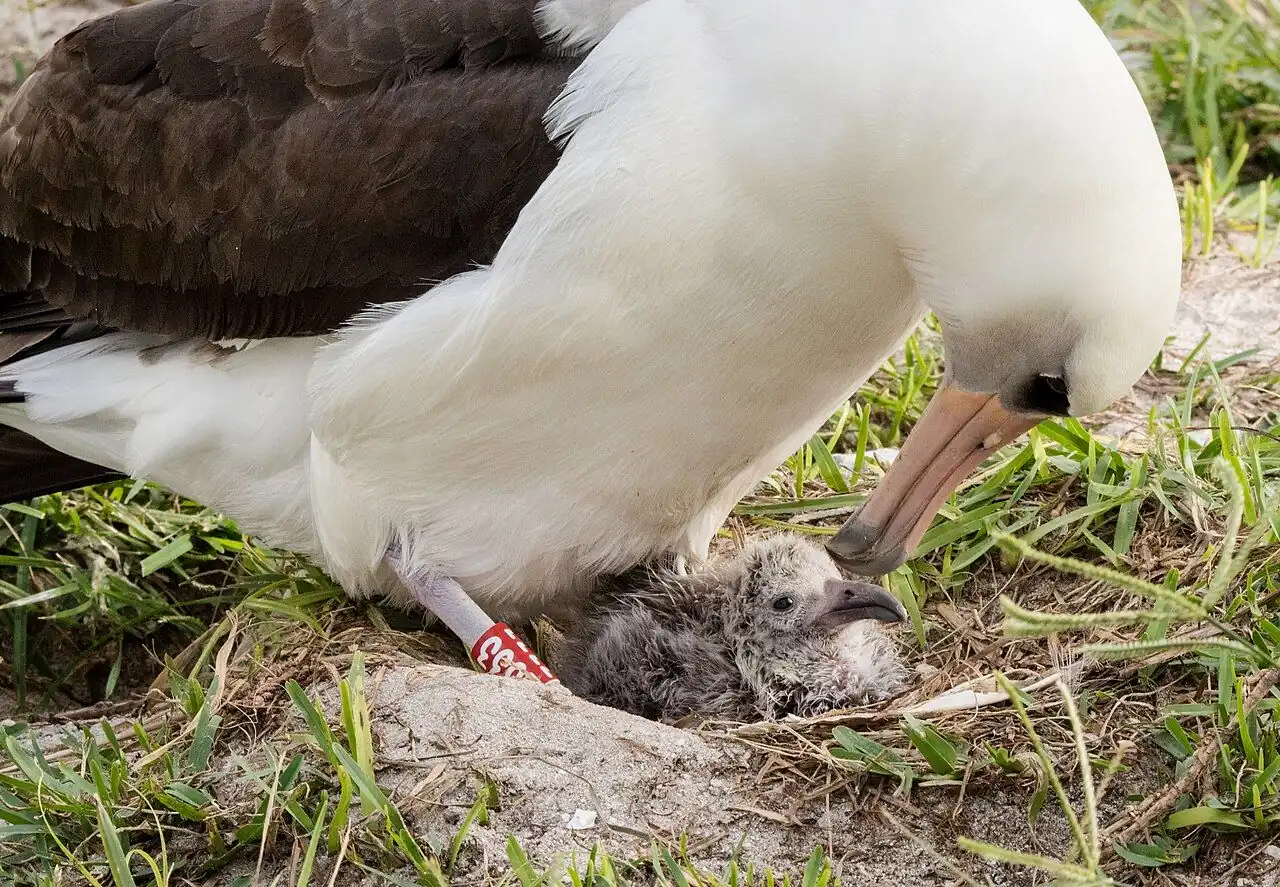
Laysan Albatross
Phoebastria immutabilis
A long-winged North Pacific seabird that nests on Hawaiian atolls, mates for life and can live more than 70 years.
Photo: Naomi Blinick/USFWS (via National Marine Sanctuaries) / Public domain
3 things to know
- Pairs lay just one egg a season, and both parents raise the chick.
- Young birds spend their first three to five years at sea without touching land.
- Adults swallow floating plastic and feed it to their chicks.
- Scientific name
- Phoebastria immutabilis
- Depth
- 0 m – 6 m
0 – 20 ft - Size
- About 79–89 cm (31–35 in) long, with a wingspan of about 2 m (6.5 ft)
- Weight
- About 1.9–4.1 kg (4–9 lb)
- Lifespan
- Decades; one known bird, Wisdom, was at least 74 in 2025
- Diet
- Mostly squid, plus fish, fish eggs and crustaceans
- Where
- North Pacific; nests mainly in the Northwestern Hawaiian Islands
- IUCN status
- Near Threatened
- Depth zones
- Sunlight
With wings spanning about 2 meters (6.5 feet), the Laysan albatross is a big seabird, white on the head and body and dark on the back and upper wings. It is about 79 to 89 centimeters (31 to 35 inches) long and weighs roughly 2 to 4 kilograms (4 to 9 pounds), males a little more than females. In Hawaii the bird is called mōlī.
A majority of the world's Laysan albatrosses nest in the Northwestern Hawaiian Islands, and Midway Atoll is one of their major colonies. At sea they range across the North Pacific; Audubon notes they are most numerous off Alaska in summer and off California in winter. They feed mainly at night, often far from the colony, sometimes 1,770 kilometers (1,100 miles) away. Squid is the main food, along with deep-water crustaceans, fish and flyingfish eggs, which they seize at or near the surface while swimming. When Maria Düssler and colleagues put dive loggers on albatrosses in Hawaii, about three in four Laysans dived at least once, but never deep: the record was 6 meters (20 feet).
Birds first breed between five and eight years old. Pairs mate for life and lay a single egg between November and December, and both parents share the work of raising the chick, which fledges in July. The young then spend three to five years at sea without touching land.
Some live a very long time. Wisdom, first banded in 1956, was caring for a new chick on Midway in early 2025 at an estimated 74 or older. Around then, Fish and Wildlife Service biologist Jon Plissner told NPR that the next oldest bird they knew of was 52.
The IUCN lists the species as Near Threatened. Feather hunters decimated many colonies around 1900. Today's threats include bycatch in fishing fleets, introduced predators, lead poisoning of chicks from old paint on Midway, rising seas over low-lying atolls, and plastic. Adults swallow floating debris and then feed it to their chicks.
Sources
- dlnr.hawaii.gov/wildlife/birds/moli
- audubon.org/field-guide/bird/laysan-albatross
- en.wikipedia.org/wiki/Laysan_albatross
- doi.gov/employees/news/she-flies-on-and-on-oldest-us-wild-bird-returns-to-midway-to-rai…
- kpbs.org/news/science-technology/2025/02/14/at-74-wisdom-the-albatross-is-welcoming-new…
- Study: doi:10.2305/IUCN.UK.2018-2.RLTS.T22698365A132643073.en
- bmis-bycatch.org/zotero_item/30125



