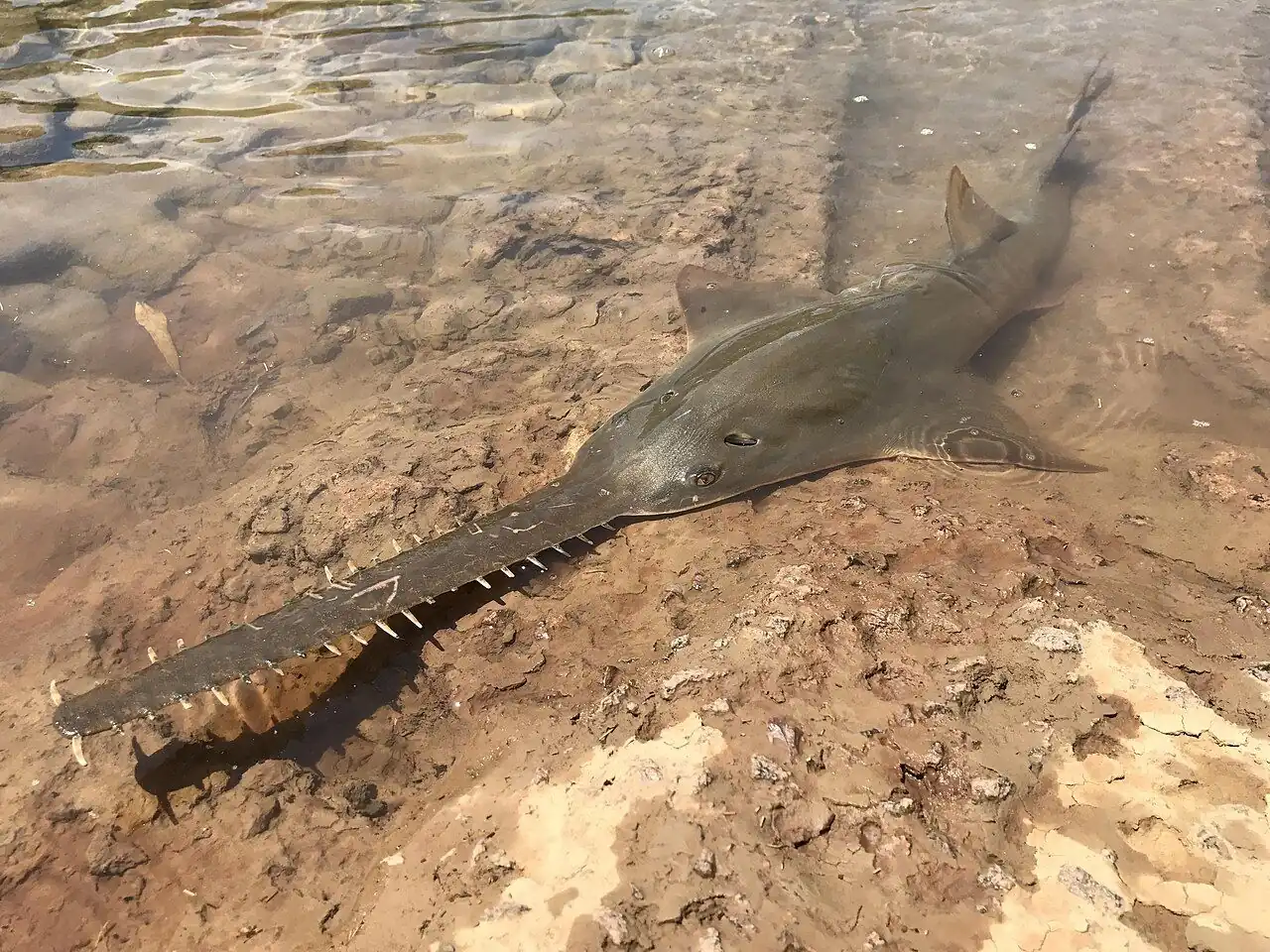
Largetooth Sawfish
Pristis pristis
A critically endangered sawfish that grows past 7 meters and raises its young far up tropical rivers, now mostly in northern Australia.
Photo: Peter Kyne, Charles Darwin University / CC BY 3.0
3 things to know
- Its saw carries 14 to 24 evenly spaced teeth on each side.
- Newborns live in very shallow fresh water far up rivers.
- None has been found in US waters in more than 50 years.
- Scientific name
- Pristis pristis
- Depth
- 0 m – 60 m
0 – 197 ft - Size
- Up to at least 7.05 m (23 ft)
- Weight
- Not well known
- Lifespan
- About 30–36 years from aged animals; NOAA cites study estimates of 36–80 years
- Diet
- Mainly fish; also mollusks, crabs and shrimp
- Where
- Tropical and subtropical coasts and rivers worldwide; now mainly northern Australia, Amazonia and the Indo-Pacific
- IUCN status
- Critically Endangered
- Depth zones
- Sunlight
No sawfish ever ranged wider. The largetooth sawfish lived along tropical and subtropical coasts from eastern Africa through Southeast Asia to Australia, from Mexico to Peru, and on both sides of the Atlantic, including the Gulf of Mexico. It has since vanished or become extremely rare across much of that range, and none has been found in US waters in more than 50 years. The largest remaining populations are in Australia, Amazonia and the Indo-Pacific.
Like other sawfish it is a ray with a shark-like body. It is brown above and white below, and its saw is sturdier than other species' saws, tapering from the head to the tip, with 14 to 24 evenly spaced teeth on each side. The largest on record measured just over 7 meters (23 feet).
It ranges between salty coastal water and inland freshwater lakes and billabongs. Pups are born 76 to 90 centimeters (2.5 to 3 feet) long and spend their early years in very shallow fresh water far up rivers, where few predators reach them, then shift toward coastal salt water as they grow. The IUCN assessment gives its depth range as 0 to 60 meters (200 feet). It eats mainly fish, plus mollusks, crabs and shrimp, slashing through schools with its saw and sensing the weak electric fields of prey.
A 2021 review of every available life history record, by Peter Kyne and colleagues, gives maturity at 8 to 10 years, litters of 1 to 20 pups, and a lifespan of 30 to 36 years. That slow pace makes losses hard to replace. Gill nets, trawls and hooks catch sawfish, and fishers often kill them rather than free them because the saw damages gear. Fins fetch high prices in Asian markets, and saws are used in ceremonies. The IUCN lists the species as Critically Endangered.
The rivers of northern Australia are now its stronghold. In the Daly River in the Northern Territory, researchers working with the Malak Malak Rangers analyzed DNA from 113 sawfish caught over 13 years. In a 2026 preprint that has not yet been peer reviewed, they report 20 full-sibling and 55 half-sibling pairs, evidence that females come back to the same river to give birth. That loyalty makes the Daly a critical nursery, and leaves its sawfish open to local extinction as pressure on the river grows.



