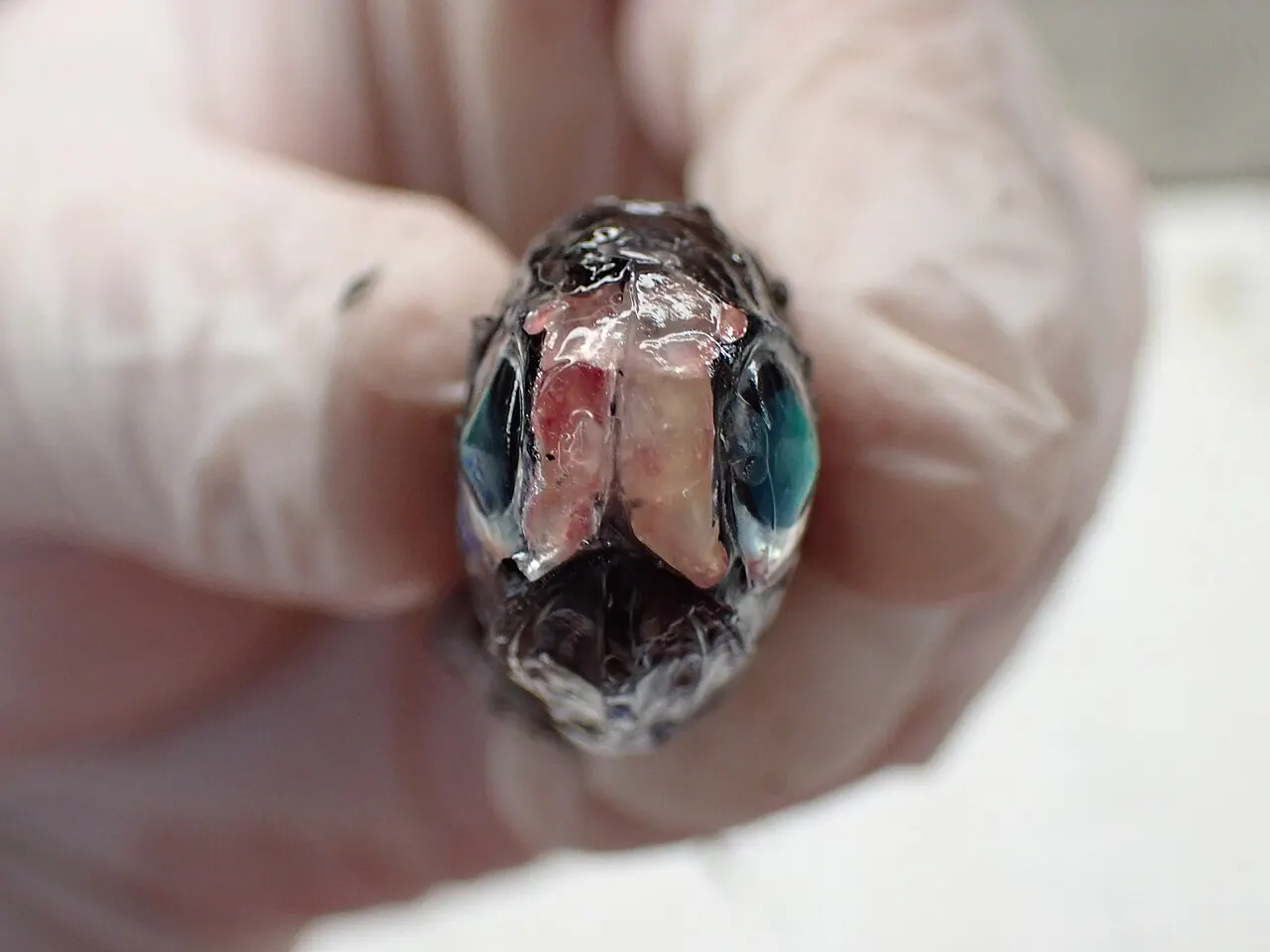
Lanternfishes
Myctophidae
Small fish dotted with light organs that fill the ocean's twilight zone, and most species rise toward the surface each night to feed.
Photo: HulloThere / CC BY-SA 4.0
3 things to know
- The family holds more than 250 species.
- Rows and groups of light organs on the head and body give lanternfishes their name.
- Most species spend the day 400 to 1,000 meters down and feed in the top 200 meters at night.
- Scientific name
- Myctophidae
- Depth
- 0 m – 1,000 m
0 – 3,281 ft - Size
- Most under 15 cm (6 in); the largest species reach about 30–35 cm (12–14 in)
- Weight
- Small; published maximums for two species are 11.4 g (0.4 oz) and 47.1 g (1.7 oz)
- Lifespan
- Varies by species; FishBase records up to 8 years for two species
- Diet
- Small planktonic crustaceans, small fish and rarely drifting molluscs
- Where
- All oceans, from Arctic to Antarctic waters
- IUCN status
- Varies by species
- Depth zones
- Sunlight · Twilight
Lanternfishes are named for their light organs, called photophores, which sit in rows and groups on the head and body. The pattern differs between species, and some of the organs near the tail are often arranged differently in males and females. The family, Myctophidae, holds more than 250 species in 32 genera, according to Fishes of Australia. Most are small. The Australian Museum says the vast majority never grow past 15 centimeters (6 inches), some reach only 3, and the largest species is about 35 centimeters long.
They are found in every ocean, from Arctic to Antarctic waters, and Fishes of Australia calls them the most widely distributed, diverse and abundant fishes in the deep-sea midwaters. By day most live in the twilight zone, roughly 400 to 1,000 meters (1,300 to 3,300 feet) down. At night most species swim up into the top 200 meters (660 feet), where food is richer, then sink back. One species, the headlight fish (Diaphus effulgens), takes its common name from the large light organs on its snout.
Their food is mostly small planktonic crustaceans, along with small fish and, rarely, drifting molluscs. In turn, the Australian Museum says, lanternfishes are eaten by many other fishes, squids, seabirds and marine mammals. Some live for years. FishBase gives a maximum reported age of 8 years for both the glacier lanternfish and the northern lampfish.
How much lanternfish the ocean holds is part of a larger argument about all twilight-zone fish. Estimates of the global weight of those fish have ranged from about 1 to 20 billion metric tons. A sonar-based model led by Roland Proud put the range at 1.8 to 16 billion tons and found that the size and shape of fish swim bladders, and the share of the echo that comes from siphonophores, drive much of the uncertainty.
The IUCN Red List rates each lanternfish species separately, so no single status covers the family. FishBase lists ten common species, including ones from the North Atlantic, North Pacific and Southern Ocean, as Least Concern.
Sources
- australian.museum/learn/animals/fishes/classification-diversity-and-biology-of-lanternf…
- fishesofaustralia.net.au/Home/family/332
- fishbase.se/summary/Benthosema-glaciale.html
- fishbase.se/summary/Stenobrachius-leucopsarus.html
- fishbase.se/summary/Ceratoscopelus-warmingii.html
- fishbase.se/summary/Gymnoscopelus-nicholsi.html
- fishbase.se/summary/Diaphus-effulgens.html
- fishbase.se/summary/Myctophum-punctatum.html
- fishbase.se/summary/Electrona-antarctica.html
- fishbase.se/summary/Lampanyctus-crocodilus.html
- fishbase.se/summary/Notoscopelus-kroyeri.html
- fishbase.se/summary/Tarletonbeania-crenularis.html
- Study: doi:10.1093/icesjms/fsy037



