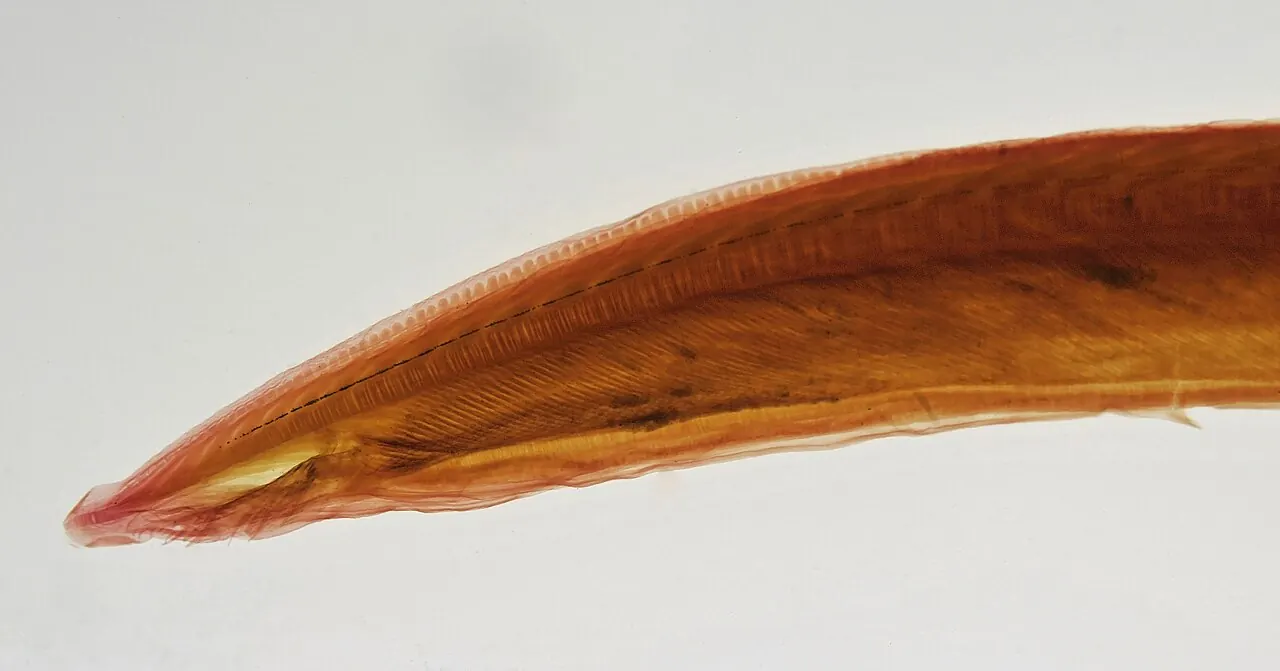
Lancelet
Subphylum Cephalochordata (about 25 species, including Branchiostoma)
Small, eel-like animals that filter food while half buried in sand. A notochord, nerve cord and gill slits make them close kin of vertebrates.
Photo: Parent Géry / CC BY-SA 3.0
3 things to know
- Its other name, amphioxus, comes from the Greek for "both ends pointed."
- Up to 5,000 lancelets have been reported in a single square meter of sand at Discovery Bay, Jamaica.
- The lancelet genome was sequenced from one male collected in Tampa Bay, Florida, in July 2003.
- Scientific name
- Subphylum Cephalochordata (about 25 species, including Branchiostoma)
- Depth
- 0 m – 30 m
0 – 98 ft - Size
- Up to about 8 cm (3 in) long (European lancelet)
- Weight
- Not well known
- Lifespan
- 2 to 5 years, depending on species; European lancelets estimated at 5 to 6 years
- Diet
- Tiny food particles filtered from the water
- Where
- Shallow sandy seafloors in tropical and temperate seas, including Florida
- IUCN status
- Not Evaluated (for the species we checked)
- Depth zones
- Sunlight
Pointed at both ends, a lancelet is a small, eel-like animal with no obvious head. Its other name, amphioxus, comes from the Greek for "both ends pointed." The European lancelet, Branchiostoma lanceolatum, grows to about 8 centimeters (3 inches) and is semi-transparent pink. A rod called a notochord runs along the back and supports the nerve cord, the body muscles are arranged in V-shaped blocks, more than 100 gill slits pierce the throat, and there is a tail behind the anus. Vertebrates share every one of those features. A lancelet, though, has no true vertebrae, a very small brain and poorly developed sense organs.
About 25 species live in shallow tropical and temperate seas. They spend much of their time partly buried in sand, filtering. Beating cilia draw water into the mouth past a fringe of slender cirri, food particles are caught in mucus, and the water leaves through the gill slits. The European species prefers sand mixed with shell to muddier bottoms, and Britain's Marine Life Information Network (MarLIN) records it down to 30 meters (98 feet). SeaLifeBase lists the Florida lancelet, B. floridae, in water 0 to 3 meters (10 feet) deep. They can be very common: the University of California Museum of Paleontology cites reports of up to 5,000 per square meter of sand at Discovery Bay, Jamaica.
The sexes are separate, eggs are fertilized in the water, and they develop into free-swimming larvae. MarLIN gives lifespans of 2 to 5 years depending on species, with European lancelets estimated at 5 years in southern France and 6 at Helgoland.
For a long time lancelets were taken to be the closest living relatives of vertebrates. In 2006 Frédéric Delsuc and colleagues compared 146 genes and found that tunicates, the group that includes sea squirts, are closer. Two years later a team led by Nicholas Putnam published the genome of the Florida lancelet, about 520 million base pairs, from a single male collected in Tampa Bay in July 2003. That one animal showed the highest level of sequence variation then reported in any individual. Neither the Florida nor the European lancelet has been assessed by the IUCN.
Sources
- ucmp.berkeley.edu/chordata/cephalo.html
- marlin.ac.uk/species/detail/85
- marlin.ac.uk/habitats/detail/244/branchiostoma_lanceolatum_in_circalittoral_coarse_sand…
- sealifebase.se/summary/Branchiostoma-floridae.html
- Study: doi:10.1038/nature04336
- Study: doi:10.1038/nature06967
- api.gbif.org/v1/species/5227670/iucnRedListCategory
- api.gbif.org/v1/species/5227671/iucnRedListCategory



