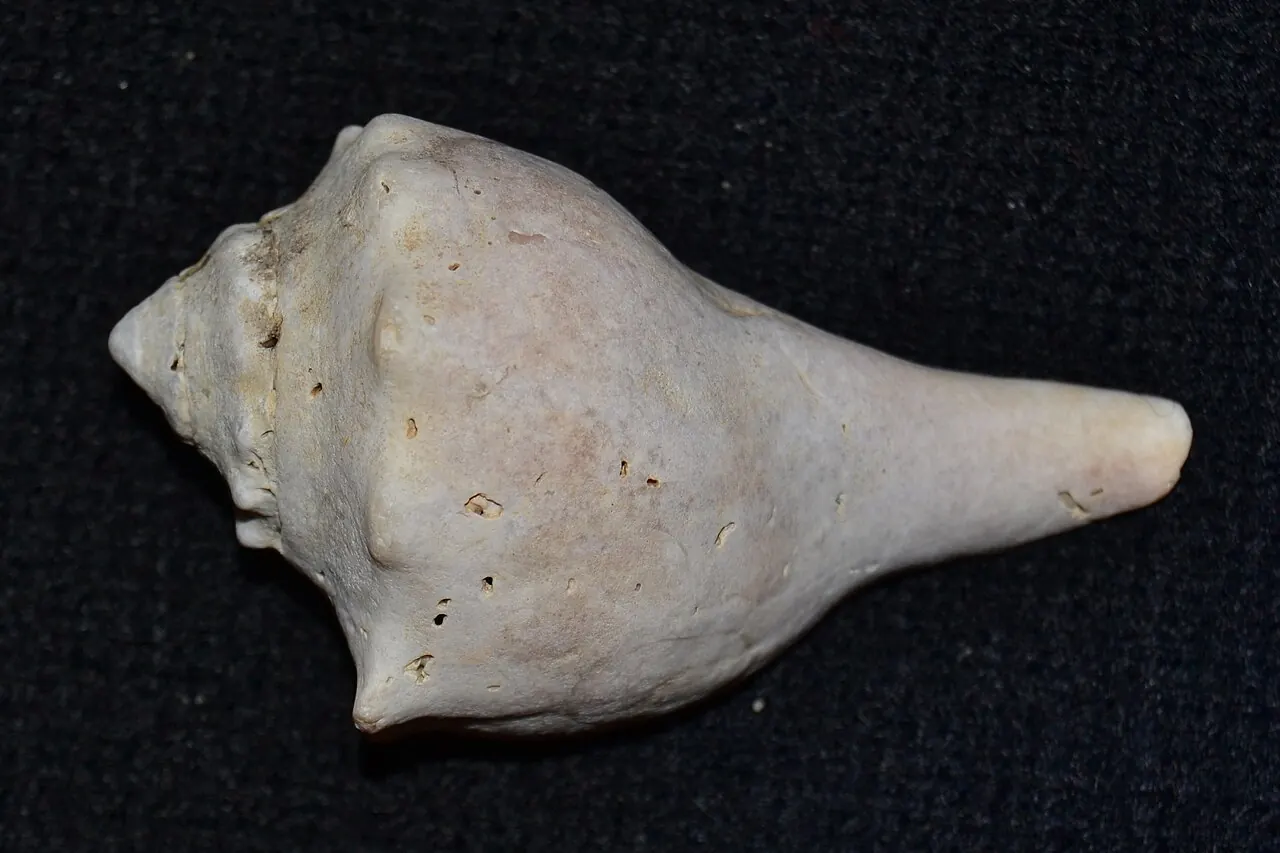
Knobbed Whelk
Busycon carica
A big East Coast sea snail that pries open clams with the edge of its own shell, takes about nine years to mature and can change sex.
Photo: Andrew C / CC BY 2.0
3 things to know
- It uses the lip of its own shell to pry and chip open clams and oysters.
- In a Virginia lab study, knobbed whelks first matured at 9 years old.
- Its shell is New Jersey's official state shell.
- Scientific name
- Busycon carica
- Depth
- 0 m – 75 m
0 – 246 ft - Size
- Shell up to about 25 cm (10 in) long
- Weight
- Not well known
- Lifespan
- Not well known; lab-reared whelks first matured at 9 years old
- Diet
- Clams, oysters, scallops and other bivalves, forced open with the lip of its shell
- Where
- US Atlantic coast from Cape Cod, Massachusetts, to Cape Canaveral, Florida; also reported from the north coast of Campeche, Mexico
- IUCN status
- Not Evaluated
- Depth zones
- Sunlight
Beachcombers on the US East Coast often call its shell a conch, but the snail that builds it is the knobbed whelk. Its knobbed spiral shell can reach about 25 centimeters (10 inches) long. It lives from Cape Cod, Massachusetts, to Cape Canaveral, Florida, and has also been reported from Mexico's Campeche coast. It ranges from the intertidal zone down to about 75 meters (250 feet), on sand flats, in tidal creeks fringed by oyster reefs and in subtidal channels. New Jersey has made it the state shell, and the state notes that the snail itself is harvested and canned as scungilli.
The knobbed whelk is a predator of other shellfish. It forages for oysters, scallops and clams, and it opens them with its own shell. Working its foot and the lip of its shell together, it chips at the edges of a clam's two valves and wedges in until it can force them apart.
It grows slowly and matures late. M. Castagna and J. H. Kraeuter of the Virginia Institute of Marine Science raised knobbed whelks in the lab and found that they first matured at 9 years old, and that every animal showed male organs first. One laid an egg case with no embryos in it at 12.4 years. By 13.5 years three egg cases had been laid and more than half of the whelks had changed sex, losing the penis. In the wild, females lay strings of egg capsules on tidal flats in the fall, and the young hatch the following spring.
Growth in the wild can be hard to see at all. A. G. Eversole and colleagues tagged knobbed whelks off South Carolina's coastal islands and recaptured 396 of them, some after more than seven years. Only 24% had grown; 29% were the same size and 47% measured smaller than when they were released.
That slow pace makes the species hard to fish sustainably. The Virginia researchers wrote that animals which take a long time to mature, lay few eggs per season and stay vulnerable for a long time are difficult to manage for a sustained yield. The knobbed whelk has not been assessed by the IUCN.



