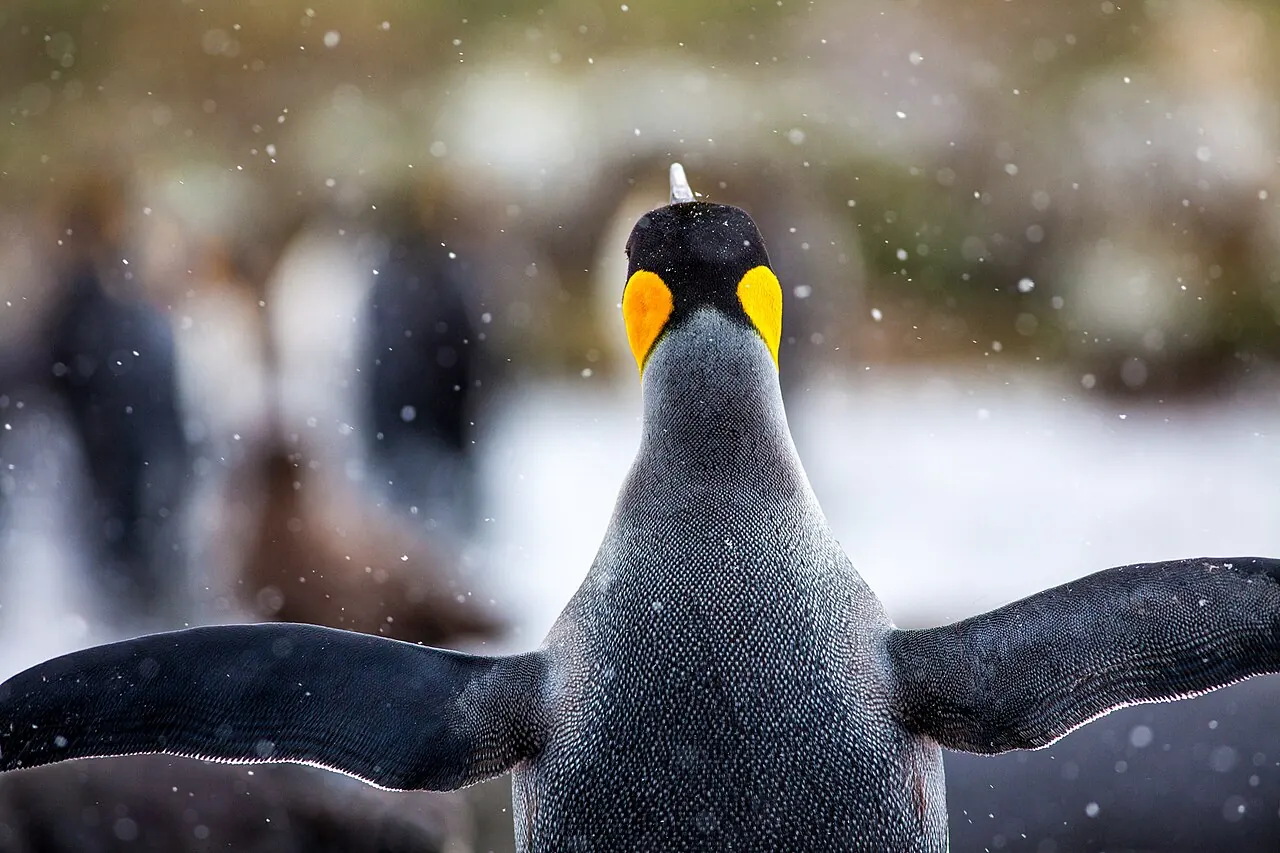
King Penguin
Aptenodytes patagonicus
The second-largest penguin, which holds its egg on its feet and has a breeding cycle of 13 to 16 months, longer than any other penguin's.
Photo: Anne Dirkse / CC BY-SA 4.0
3 things to know
- It builds no nest; the egg rests on a parent's feet for about 54 days.
- One breeding cycle lasts 13 to 16 months, longer than any other penguin's.
- Its dives have been measured at more than 300 m (980 ft).
- Scientific name
- Aptenodytes patagonicus
- Depth
- 0 m – 300 m
0 – 984 ft - Size
- Stands about 85–95 cm (2.8–3.1 ft) tall
- Weight
- About 10–15 kg (22–33 lb) at the start of breeding, as little as 8–11 kg (18–24 lb) later in the season
- Lifespan
- Not well known in the wild; captive birds have lived to 26 years
- Diet
- Mainly lanternfish, with more squid in winter
- Where
- Sub-Antarctic islands between about 45°S and 55°S
- IUCN status
- Least Concern
- Depth zones
- Sunlight · Twilight
Bright orange ear patches, joined to the upper chest by a thin orange strip, mark the king penguin, the second-largest penguin after the emperor. It stands 85 to 95 centimeters (2.8 to 3.1 feet) tall and weighs 10 to 15 kilograms (22 to 33 pounds) when it returns to the colony to court, dropping to as little as 8 to 11 kilograms (18 to 24 pounds) later in the season.
Kings breed on many of the sub-Antarctic islands between about 45 and 55 degrees south. The Australian Antarctic Division puts the world population at about 1.6 million breeding pairs and says it appears to have stabilised in recent decades. At sea the birds eat mainly lanternfish, especially while breeding, and more squid over winter. In a 1992 study, G. L. Kooyman and colleagues logged 18,537 dives by 34 birds. The deepest reached 304 meters (997 feet), and dives deeper than 100 meters (330 feet) happened only in daylight.
No penguin has a longer breeding cycle. Kings build no nest; the egg is incubated on a parent's feet for about 54 days. Eggs are laid anywhere from November to April, and including the pre-moult period one cycle runs 13 to 16 months, so chicks stay in the colony right through the winter. While the adults are away feeding, a chick may fast for several months between meals. Breeding birds are most successful every second year. How long kings live in the wild is not well known, though Animal Diversity Web reports captive birds living to 26.
Not every colony is holding steady. Ile aux Cochons, in the Crozet Islands of the southern Indian Ocean, was known in the 1980s as the largest king penguin colony anywhere. In 2018 Henri Weimerskirch and colleagues used helicopter photographs and satellite images to check on it and found it had shrunk by 88 percent over 35 years, from about 500,000 pairs to 60,000. They explored possible causes and could not find a plausible explanation.
The species as a whole is listed as Least Concern by the IUCN, in a 2020 assessment.



