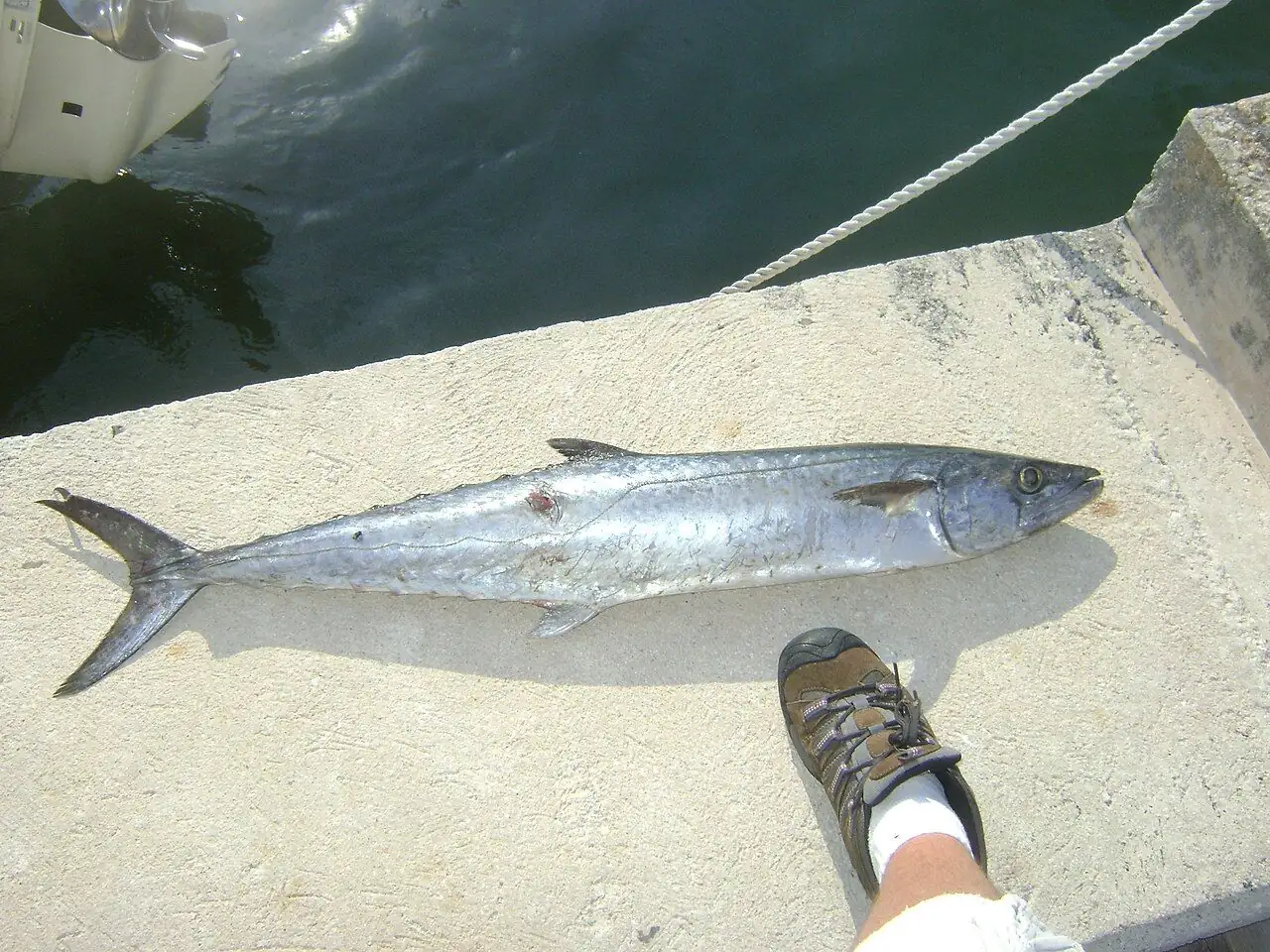
King Mackerel
Scomberomorus cavalla
A big, fast-growing mackerel of the US Southeast and Gulf, managed back from depletion and listed by the FDA among the highest-mercury fish.
Photo: Stephen Ewen / CC BY-SA 3.0
3 things to know
- A king mackerel's lateral line dips sharply below the second dorsal fin, which sets it apart from Spanish mackerel.
- Female king mackerel grow much larger than males.
- The FDA lists king mackerel among the fish with the highest mercury levels.
- Scientific name
- Scomberomorus cavalla
- Depth
- 5 m – 140 m
16 – 459 ft - Size
- Up to about 1.7 m (5.5 ft) long
- Weight
- Up to about 45 kg (100 lb)
- Lifespan
- More than 20 years; FishBase lists a maximum reported age of 26
- Diet
- Fish, squid and shrimp
- Where
- Western Atlantic from Massachusetts to Brazil, including the Gulf of Mexico and the Caribbean
- IUCN status
- Least Concern
- Depth zones
- Sunlight
Follow the lateral line on a king mackerel and it drops sharply below the second dorsal fin. Small kings can be spotted like Spanish mackerel, and NOAA Fisheries uses that dip and the gray front dorsal fin to tell them apart. Adults are iron gray on the back and silvery on the sides and belly. Like its cousin the Atlantic mackerel, it has no swim bladder. NOAA says kings grow fast, up to about 1.7 meters (5.5 feet) and 45 kilograms (100 pounds), and can live more than 20 years; FishBase lists a maximum reported age of 26.
These open-water coastal fish range from Massachusetts to Brazil, including the Caribbean and the Gulf of Mexico. NOAA describes them living over water 35 to about 180 meters (115 to almost 600 feet) deep, and the IUCN gives a depth range of 5 to 140 meters (16 to 460 feet). They seldom enter water colder than 20°C (68°F), and they migrate with the seasons in large schools, north in summer and south in winter. Two US groups, one from the Gulf and one from the Atlantic, mix each winter from November to March in waters south of the Florida Keys.
They hunt fish, squid and shrimp and have been seen leaping clear of the water after prey. Females grow much larger than males, which lets them carry more eggs: from 50,000 to several million each. Kings mature at about 2 and spawn on the outer continental shelf from May through October, releasing eggs into open water. Bottlenose dolphins, sharks and tunas eat adults.
In federal advice for people who are or may become pregnant, and for young children, the FDA and EPA put king mackerel among seven "choices to avoid" for their high mercury, with marlin, orange roughy, shark, swordfish, Gulf of Mexico tilefish and bigeye tuna. The FDA's mercury table, drawing on a 2000 Gulf of Mexico report, lists an average of 0.73 parts per million across 213 king mackerel, and a maximum of 1.67.
Before the 1980s, king mackerel fishing was largely unregulated and the stocks were depleted. Regulations brought in from 1983 rebuilt them, and the 2020 assessments found both the Atlantic and Gulf stocks not overfished and not subject to overfishing. Recreational anglers take more than commercial boats do: 5.5 million pounds in 2024, against about 4 million. The IUCN lists it as Least Concern.
Sources
- fisheries.noaa.gov/species/king-mackerel
- fishbase.se/summary/Scomberomorus-cavalla.html
- iucnredlist.org/species/170339/46939740
- fda.gov/food/consumers/advice-about-eating-fish
- fda.gov/food/environmental-contaminants-food/mercury-levels-commercial-fish-and-shellfi…
- commons.wikimedia.org/wiki/File:King_Mackerel.JPG



