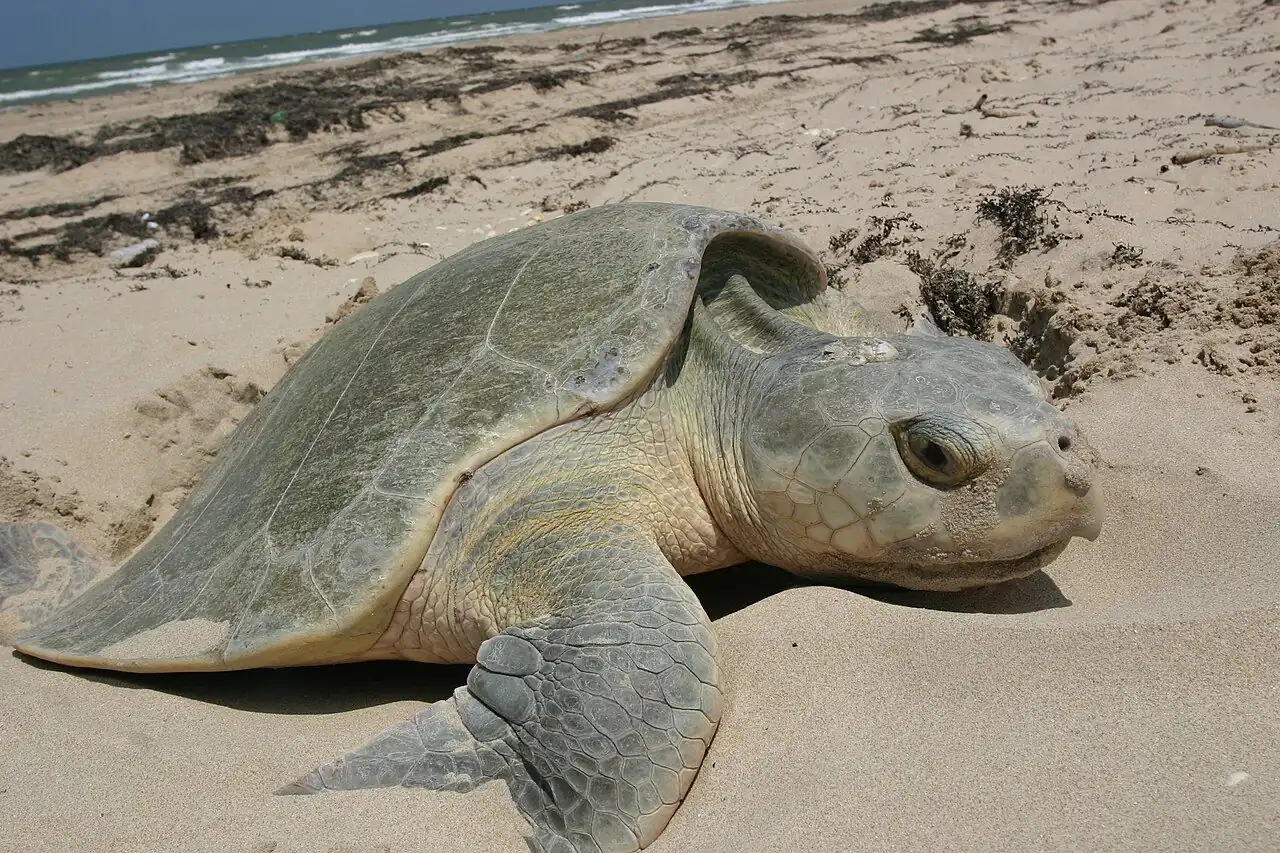
Kemp's Ridley Sea Turtle
Lepidochelys kempii
The smallest sea turtle, which nests by day in mass arrivals on Gulf beaches and fell to 702 nests in 1985.
Photo: National Park Service / Public domain
3 things to know
- It is the smallest sea turtle, about 60 cm (2 ft) long as an adult.
- Females come ashore together in large groups called arribadas, mainly in daylight.
- About 95 percent of all nesting happens in the Mexican state of Tamaulipas.
- Scientific name
- Lepidochelys kempii
- Depth
- 0 m – 68 m
0 – 223 ft - Size
- Adults about 60 cm (2 ft) long
- Weight
- About 32–45 kg (70–100 lb)
- Lifespan
- Unknown; estimated at 30 years or more
- Diet
- Mainly crabs, plus some fish, jellies and mollusks
- Where
- Gulf of Mexico and the US Atlantic coast from Florida to New England
- IUCN status
- Critically Endangered
- Depth zones
- Sunlight
Kemp's ridleys are the smallest sea turtles, and the National Park Service calls them the most critically endangered. Adults are about 60 centimeters (2 feet) long and weigh 32 to 45 kilograms (70 to 100 pounds). Nobody knows how long they live; NOAA estimates 30 years or more.
They live in the Gulf of Mexico and along the US Atlantic coast from Florida to New England. Once they settle in shallow coastal water, crabs become their preferred food, with occasional fish, jellies and mollusks. In a 2013 study, Donna Shaver and colleagues followed 31 nesting females by satellite after they left beaches at Padre Island, Texas, and Rancho Nuevo, Mexico. All of them fed in nearshore Gulf waters, and their final foraging sites were in water less than 68 meters (223 feet) deep, on average about 33 kilometers (21 miles) from the mainland.
Nesting is unusual. Kemp's ridleys nest mainly by day, and the females come ashore in large groups called arribadas, Spanish for "arrival." About 95 percent of all nesting happens in the Mexican state of Tamaulipas. Each female lays about 100 eggs per clutch and two to three clutches a season, and the eggs incubate for 50 to 60 days.
Amateur footage from 1947 showed tens of thousands of Kemp's ridleys nesting near Rancho Nuevo on a single day. By 1985 the count had fallen to a record low of 702 nests, from fewer than 250 nesting females. Nests then increased about 15 percent a year through 2009, until in 2010 the rise abruptly ended; numbers have fluctuated since. In 1978 the US joined the recovery work, and an international program set out to boost nesting at Padre Island National Seashore, which now has more Kemp's ridley nesting than anywhere else in the US.
NOAA names bycatch in commercial and recreational fishing gear as the biggest threat today. The species is listed as endangered under the US Endangered Species Act and as Critically Endangered by the IUCN, in a 2019 assessment.



