John Dory
Zeus faber
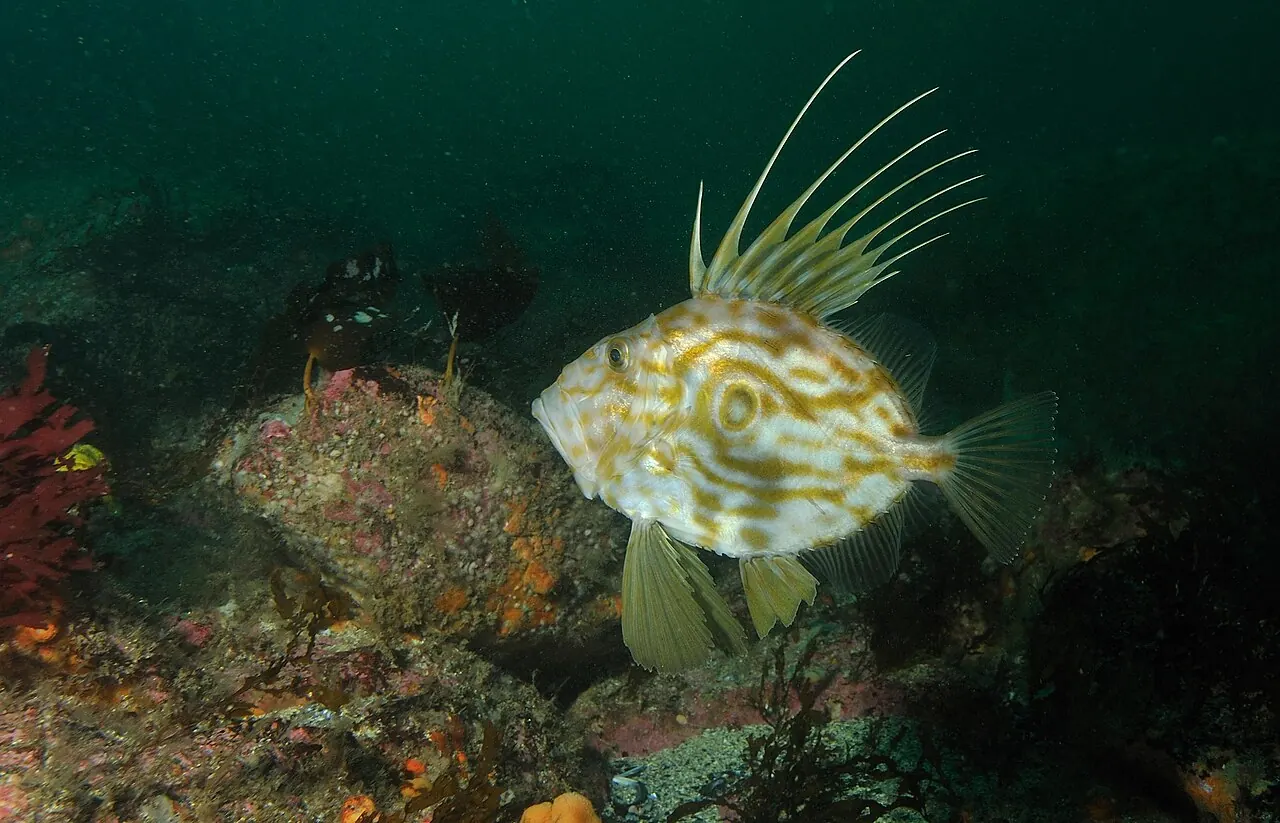
A flat, olive-gold fish with a dark thumbprint on each side that eases up on small fish head-on, then shoots its jaws out to grab them.
Photo: Olivier Dugornay (Ifremer) / CC BY 4.0
3 things to know
- It approaches prey slowly and head-on, then shoots out its protrusible jaws to catch small fish.
- The large dark spot on each side is thought to confuse predators.
- DNA work suggests the fish called John Dory in Australia, New Zealand and Japan may be a separate species, Zeus japonicus.
- Scientific name
- Zeus faber
- Depth
- 50 m – 150 m
164 – 492 ft - Size
- Commonly about 40 cm (16 in); Australian sources give up to 66 cm (26 in), FishBase up to 90 cm (35 in)
- Weight
- Usually 0.5–1.5 kg (1–3 lb) in Australian catches; Australia's fisheries agency gives up to about 3 kg (6.6 lb), FishBase a maximum of 8 kg (18 lb)
- Lifespan
- Up to about 12–15 years
- Diet
- Mainly schooling fish; occasionally cephalopods and crustaceans
- Where
- Eastern Atlantic from Norway to South Africa, the Mediterranean and Black Sea, and the Indo-West Pacific from Japan and Korea to Australia and New Zealand
- IUCN status
- Data Deficient
- Depth zones
- Sunlight
Side on, a John Dory is a tall oval of silver to olive-gold, often marked with darker wavy lines, with a blue-black spot ringed in yellow in the middle of each flank. Head on, it is a sliver: Fishes of Australia describes the body as extremely compressed. Long spines stream from the first dorsal fin, and rows of bony plates called bucklers run along the bases of the dorsal and anal fins. The Australian Museum calls the spot a thumbprint and says the old name St Peter's fish refers to the Bible story in which Peter brings a fish to Jesus. In French it is Saint-Pierre.
That thin profile suits the way it hunts. According to Fishes of Australia, a John Dory approaches its prey slowly and head-on, then shoots out its highly protrusible jaws to catch small fish. FishBase says it feeds mainly on schooling fish, with the occasional cephalopod or crustacean. It usually lives alone near the bottom, over sand, mud, rock and reef, and the spot on its side is thought to confuse predators.
FishBase records John Dory from 5 to 400 meters (16 to 1,310 feet) and usually between 50 and 150 meters (165 to 490 feet). The range is wide: the eastern Atlantic from Norway to South Africa, the Mediterranean and Black Sea, and the Indian and western Pacific oceans to Japan, Korea, Australia and New Zealand. That range may hide two species. Fishes of Australia reports DNA barcoding that separates the fish of Europe from those of South Africa and Australasia, and says the southern and Japanese populations may belong to Zeus japonicus.
Eggs float freely in the open water. Fish mature at about 3 to 5 years, and Australia's fisheries agency gives a lifespan of up to 15 years, with females living longer and growing larger than males.
The flesh is prized, and much of the catch comes as bycatch in trawls. The Australian Fisheries Management Authority assessed its John Dory stock as overfished in 2021 and cut the allowed catch. Globally the IUCN lists the species as Data Deficient, in an assessment made in 2013 that the Red List itself marks as needing an update.



