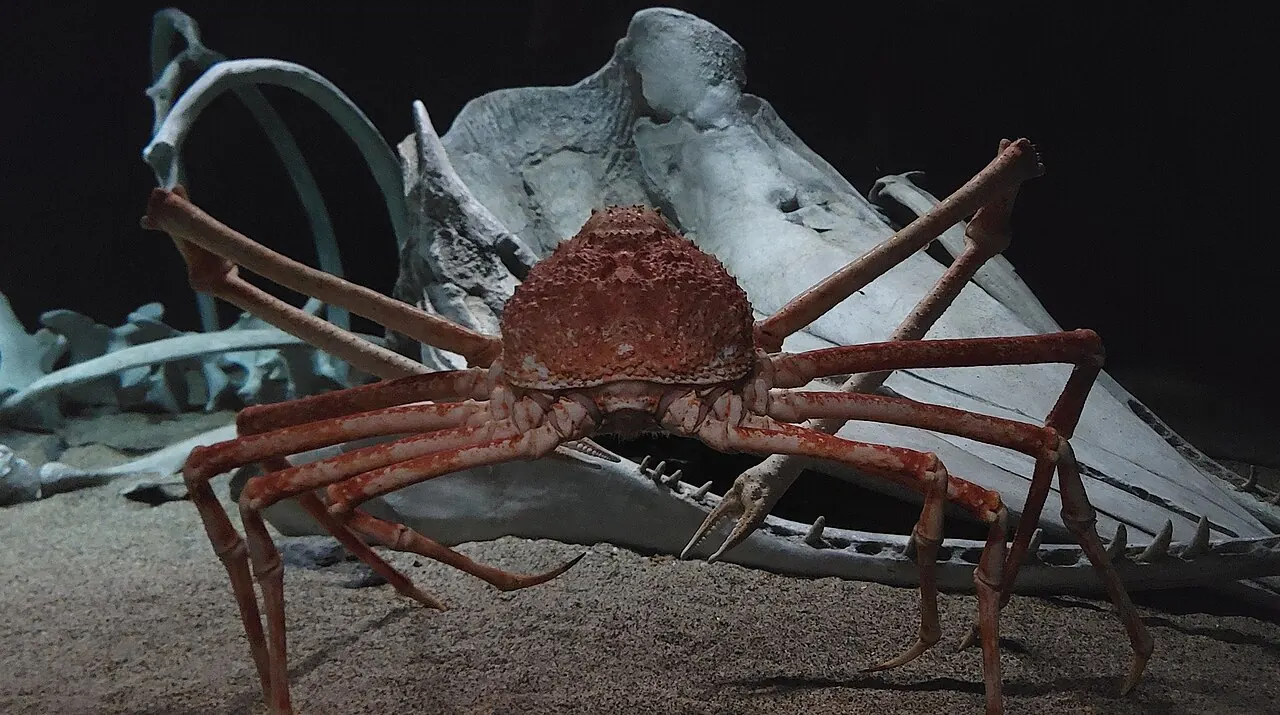
Japanese Spider Crab
Macrocheira kaempferi
A slow, gentle scavenger from the seafloor off Japan whose legs can span 3.7 meters (12 feet) from claw to claw.
Photo: Macrophyseter / CC BY-SA 4.0
3 things to know
- Guinness lists it as the longest marine crustacean.
- A female can produce up to 1.5 million eggs in a season.
- Nearly three-quarters of these crabs are missing at least one leg.
- Scientific name
- Macrocheira kaempferi
- Depth
- 50 m – 400 m
164 – 1,312 ft - Size
- Leg span up to about 3.7 m (12 ft); body shell about 37 cm (15 in) long
- Weight
- Record specimen 18.6 kg (41 lb)
- Lifespan
- Uncertain: a 2026 growth model gives about 13 to 21 years; often-quoted figures of 50 to 100 years are unverified
- Diet
- Dead and decaying animals and plants, some kelp and algae, and small invertebrates
- Where
- Pacific coast of Japan; one record from eastern Taiwan
- IUCN status
- Not Evaluated
- Depth zones
- Sunlight · Twilight
With legs that can span 3.7 meters (about 12 feet) from claw to claw, the Japanese spider crab is the largest known living arthropod, though not the heaviest. Its pear-shaped body shell, covered in spiny bumps and colored from dark orange to light tan, is only about 37 centimeters (15 inches) long. Guinness lists it as the longest marine crustacean, and its record specimen weighed 18.6 kilograms (41 pounds).
Nearly all of them live off the Pacific side of Japan, most often in Sagami, Suruga and Tosa bays and off the Kii Peninsula, according to the University of Michigan's Animal Diversity Web. One turned up as far south as eastern Taiwan. Adults usually stay on sandy and rocky bottoms 150 to 300 meters (490 to 980 feet) down, and SeaLifeBase lists the species from 50 to 400 meters (165 to 1,300 feet). In early spring they move up to about 50 meters to mate. A female can produce up to 1.5 million eggs in a season and carries them on her body, stirring the water with her back legs to keep them supplied with oxygen until they hatch into drifting larvae.
These are slow, placid scavengers. They pick through dead and decaying animals and plants on the seafloor, eat some living kelp and algae, and now and then catch small invertebrates. Many young crabs decorate their shells with sponges or kelp as camouflage, while big adults mostly don't. The long legs come off easily, and one study found nearly three-quarters of crabs missing at least one limb. Lost legs can grow back over later molts.
How long they live is unsettled. Figures of 50 to 100 years are widely repeated, but Animal Diversity Web says the 100-year claim may be conjecture. A 2026 growth model by Kazutoshi Okamoto, published by Shizuoka Prefecture's fisheries research institute, estimated about 13 to 21 years from hatching. The crab is eaten as a delicacy in Japan, the catch fell considerably over four decades, and fishing is banned during the mating season. It has not been assessed for the IUCN Red List.



