Irukandji Jellyfish
Carukia barnesi
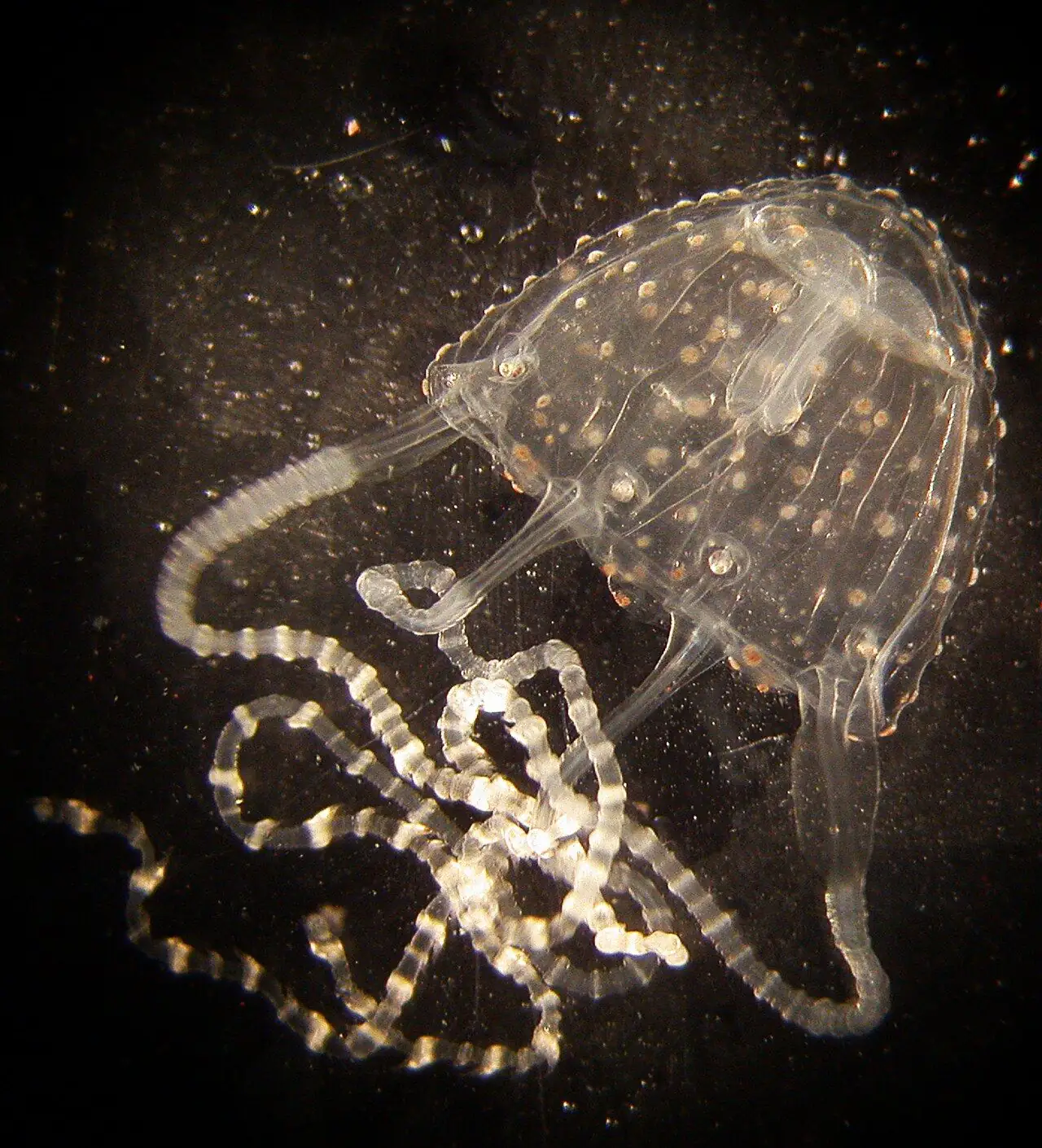
A see-through box jellyfish about 2 cm across from tropical Australia, whose sting causes the delayed and sometimes dangerous Irukandji syndrome.
Photo: Lisa-ann Gershwin / CC BY 4.0
3 things to know
- Its bell is about 2 cm (0.8 in) across, but its tentacles can be 75 cm (30 in) long.
- In 1961 Jack Barnes let one sting himself and his nine-year-old son to prove it caused Irukandji syndrome.
- Adults twitch their tentacles, and clusters of stinging cells on them attract larval fish.
- Scientific name
- Carukia barnesi
- Depth
- 0 m – 6 m
0 – 20 ft - Size
- Bell about 2 cm (0.8 in) across; four tentacles up to about 75 cm (30 in)
- Weight
- Unknown
- Lifespan
- Unknown
- Diet
- Mostly larval fish as adults; mostly small crustaceans when young
- Where
- Coastal and reef waters of tropical northeastern Australia
- IUCN status
- Not Evaluated
- Depth zones
- Sunlight
A mature Carukia barnesi is a box jellyfish with a transparent bell only about 2 centimeters (0.8 inch) across. Its four tentacles, one from each corner of the bell, can stretch to 75 centimeters (30 inches) and are beaded with alternating large and small clusters of stinging cells. It lives off tropical northeastern Australia, around coral reefs and islands and at times along beaches. The medusae are mostly present near the coast from November to May, the same months Queensland calls its marine stinger season.
Its sting causes Irukandji syndrome, which the radiologist Hugo Flecker named in 1952 after the Irukandji people of the coast just north of Cairns. For years nobody could find the culprit. On December 10, 1961, the Cairns doctor Jack Barnes and his helpers caught two candidate jellyfish while diving. To prove the link, Barnes let the first one sting himself and his nine-year-old son, and a young lifesaver volunteered for the second. All three were rushed to Cairns Base Hospital with pain in the back, belly and chest, muscle spasms, trouble breathing and a striking restlessness. They recovered, Barnes published the account in 1964, and the species was named in his honor.
Symptoms can be slow to start: Queensland's government warns that symptoms may take 20 to 40 minutes to develop, and tells anyone stung to call an ambulance and pour vinegar on the sting.
In 2015 Robert Courtney, Jamie Seymour and colleagues at James Cook University described how the jellyfish feeds. Young ones eat mostly small crustaceans; adults eat mostly larval fish. The adults stretch out their tentacles and twitch them often, and the stinging-cell clusters work as lures. In the lab, young fish were often drawn to them. The team caught their jellies at night near Double Island in North Queensland with powerful LED lights submerged beside a small boat, in water 3 to 6 meters (10 to 20 feet) deep. No study we found has measured how deep the species usually lives.
Carukia barnesi has not been recorded in the Florida Keys. Even so, in 2025 doctors from the Medical College of Wisconsin reported a probable case of an Irukandji-like syndrome there and pointed to a cluster of four incidents in the western Keys, which they suggest were caused by other jellyfish. The species has not been assessed for the IUCN Red List.
Sources
- Study: doi:10.1371/journal.pone.0124256
- litfl.com/jack-barnes-and-the-irukandji-enigma
- Study: doi:10.5694/j.1326-5377.1964.tb114424.x
- qld.gov.au/emergency/safety/dangerous-marine
- sealifebase.se/summary/Carukia-barnesi.html
- en.wikipedia.org/wiki/Carukia_barnesi
- Study: doi:10.4269/ajtmh.25-0217
- api.gbif.org/v1/species/2264716/iucnRedListCategory



